Shrub · Apocynaceae
Asiatic Jasmine
Trachelospermum asiaticum
Tough, glossy, and happy in sun or deep shade, Asiatic jasmine carpets the ground and demands next to nothing.
Full sun
Every 7–14 days
USDA 7–11
6–24 in · 15–61 cm
Overview
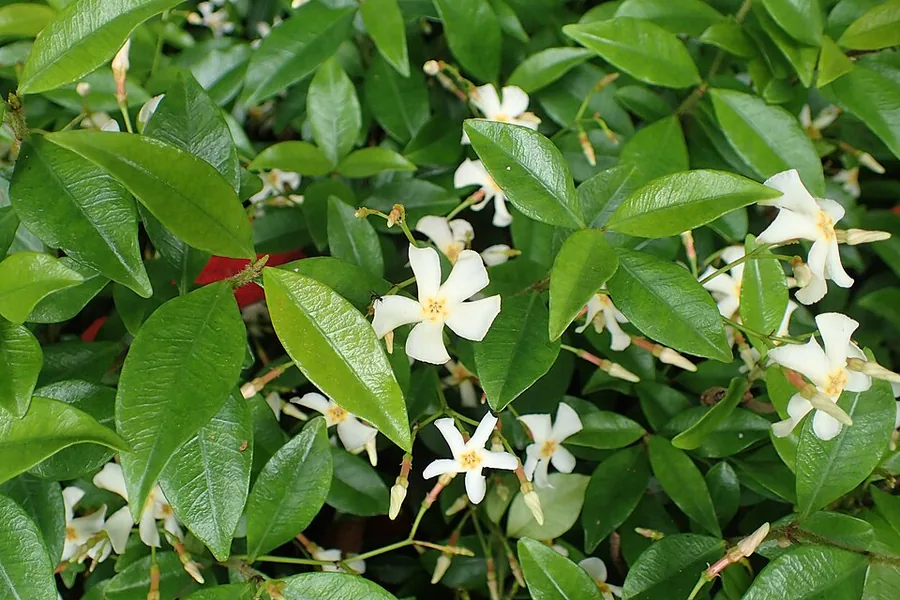
Asiatic jasmine is a low evergreen groundcover valued for its tight mat of small, glossy leaves rather than for bloom. It sits in the dogbane family and, the name aside, is not a true jasmine. New growth frequently emerges a coppery bronze or red and only later deepens to green, which gives an established planting a subtle seasonal turn of color.
Its appeal rests on tolerance. It performs in full sun to deep shade, withstands drought once established, and accepts clay, loam, or sand. Rated for zones 7 to 11, it endures down to roughly 10°F (-12°C) and tolerates heat to 100°F (38°C), and that range explains why it succeeds under trees and along curbs where most plants fail.
The cost of that vigor is spread. The trailing stems root as they advance, so the plant that covers a bare slope will, unchecked, climb a trunk or breach a sidewalk. Provide a defined edge to contain the runners and an annual shearing, and it persists as a clean, even carpet for decades.
Care
The short version: site it almost anywhere from full sun to full shade, water it through the establishment season, then largely leave it be and shear it once a year in early spring to hold the mat dense and within bounds.
Light
Few groundcovers are this adaptable to light. Asiatic jasmine performs from full sun through to full shade, though it holds densest and develops the strongest color where it gets at least some direct sun, because foliage color and growth density both respond to light. Deep shade slows it and thins the mat somewhat, yet it still persists.
Water
Hold the soil evenly moist through the first season while the root system establishes. Beyond that it is truly drought tolerant and seldom calls for added water. Keep irrigation restrained, since excess water is one of the inputs that tips it into aggressive, unruly growth.
Soil
It accepts nearly any well-drained soil, clay, loam, or sand alike, across a broad pH range of 6.0 to 8.0. The exception is strongly alkaline ground, which binds iron out of reach and yellows the foliage, so target neutral to slightly acidic conditions where possible.
Temperature
Hardy in zones 7 to 11, it manages a wide span from roughly 10°F to 100°F (-12°C to 38°C). The combination of cold hardiness and heat tolerance is precisely what lets it carpet ground in climates that defeat less durable plants.
Humidity
Ambient outdoor humidity suits it, with no target to maintain. It accepts humid Southern summers and drier intervals equally well.
Feeding
Feed sparingly, if at all. A modest dose of balanced slow-release fertilizer in spring is sufficient, and most established plantings require none. Excess nitrogen translates directly into faster, more unruly growth that you then have to cut back.
Pruning
The principal task is a once-a-year mow or shear in early spring to renew the planting and maintain density. Trim the margins periodically through the season to check its advance into lawns, beds, and walkways.
Repotting
In the ground it rarely needs repotting. In a container, step it up only when roots circle the pot, emerge from the drainage holes, or water begins running straight through, all signs the rootball has outgrown its space.
Size & spacing
It stays low, only 6 to 24 inches (15 to 61 cm) in height, but each plant spreads broadly, 3 to 12 feet (91 cm to 3.7 m) across. Set plants 1.5 to 3 feet apart for groundcover use and keep them clear of trunks and structures they could climb.
When to plant
Set Asiatic jasmine out in spring, after the last frost and as the soil begins to warm so roots can establish actively. Plant at that point and water through the first season to drive rooting, and it will take the following two years to close into a solid evergreen carpet.
Northern hemisphere
Southern hemisphere
Typical months for a temperate climate: start earlier in warm zones, later where spring frosts linger.
- Plant: spring after last frost
- Harvest: late spring to early summer (blooms sparsely)
Hardiness
USDA hardiness zones: 7–11
Temperature: down to -18°C
Troubleshooting
This is a low-trouble species, and most issues fall into one of two camps: a spreading habit that needs controlling, or a soil condition you can correct. Match the description below, then intervene before a localized problem moves through the whole planting.
Stems running into turf and scaling nearby trunks
This species is a fast, twining groundcover, and its trailing stems strike roots anywhere they rest against moist soil, which is how a single planting marches well past its bed. Surplus water, sun, or fertilizer drives that vigor higher still, and the stems begin twining up trunks and crossing paving. Edge the bed to give the runners a hard boundary, lift stems off shrubs and trees, and shear the entire planting once a year in early spring to reset it to a level mat.
Fix:
- Trim and edge the perimeter regularly to keep it in bounds
- Pull or cut stems climbing trees and shrubs
- Mow or shear the whole planting once a year in early spring to renew it
- Reduce supplemental water and fertilizer to slow aggressive growth
Leaf blades yellowing while the veins hold green
A yellow leaf with veins that stay green is the classic signature of iron chlorosis, and on this plant the trigger is nearly always alkaline soil, where high pH binds iron into forms the roots cannot take up. Because iron is immobile in the tissue, the symptom appears first on the youngest leaves. A chelated iron supplement delivers iron in an available form for a quick correction, while lowering the soil pH addresses the underlying cause and prevents a return.
Fix:
- Apply a chelated iron supplement
- Acidify or amend the soil to lower pH
Open gaps between plants during year one
Expect a fresh planting to read as thin and patchy across its opening season; that is the plant behaving exactly as it should. Energy in year one goes into root development rather than top spread, and full coverage takes about two growing seasons to knit together. Hold the soil evenly moist, set plants 1.5 to 3 feet apart to shorten the time to closure, and let the second season carry the spread.
Fix:
- Keep soil evenly moist while establishing
- Space plants closer (about 1.5 to 3 feet apart) for faster coverage
- Be patient; growth accelerates in the second season
Raised bumps on stems with a sticky film
On occasion scale insects colonize the stems and the undersides of leaves, where they feed and excrete a sticky honeydew that, in turn, supports sooty mold. Significant pest pressure is uncommon on this species. A horticultural oil works by smothering the insects under their protective covering, and any stem that is heavily encrusted is best pruned out.
Fix:
- Treat with horticultural oil
- Prune out heavily infested stems
Toxicity
Reassuring for homes with pets and children: Asiatic jasmine is regarded as non-toxic, and the related star jasmine appears on the ASPCA non-toxic list. The single caveat is the milky latex that cut stems release, which can irritate sensitive skin, so wear gloves when pruning.
Safe for
People · Cats · Dogs · Horses · Rabbits · Livestock · Birds
Cats None
Safe to plant where cats roam. Its close relative, star jasmine, is on the ASPCA non-toxic list, and an exploratory nibble should produce nothing beyond a mild, self-limiting stomach upset.
Dogs None
Dogs can share the bed with it freely. No toxin is known in the species, so a chewed stem is unlikely to cause more than transient digestive grumbling.
Horses Safe
Regarded as safe in pasture and near horses. There is no recognized toxin, though prudence still says not to let any animal overload on lush new growth.
Rabbits Safe
Non-toxic to rabbits. The foliage is leathery and milky rather than palatable, so most rabbits pass it by for softer forage.
Livestock Safe
Safe for cattle, goats, and sheep, with no recorded poisoning. The bitter latex in the stems generally discourages grazing in the first place.
Birds Safe
No toxic risk to birds. They can nest and shelter in the dense mat with no harm coming from the foliage.
People Safe
Safe around children and adults alike. Cut stems do release a milky latex that can irritate sensitive skin, so glove up before any substantial pruning session.
It is a member of the dogbane family (Apocynaceae) and exudes a milky latex sap when cut that may cause mild skin irritation in sensitive people; wear gloves when pruning. Despite the name it is not a true jasmine.
Varieties
Beyond the standard green form, several selections add color through variegation or strongly tinted new growth. These are the ones you are most likely to encounter.
'Snow-N-Summer' ('HOSNS')
A variegated selection in which emerging growth opens pink and white, then matures to a green and white pattern with age.
'Variegatum'
Green leaves rimmed and marbled in creamy white account for its bright, two-tone appearance.
'Bronze Beauty'
Selected for new foliage that emerges a deep bronze to reddish tone before turning green.
'Goshiki' / 'Ogon Nishiki'
New growth arrives in a blend of yellow, orange, and red, producing a multicolored carpet.
'Elegant' / dwarf forms
Lower, more compact selections that deliver a fine-textured dwarf groundcover where reduced height is wanted.
How to propagate
Asiatic jasmine multiplies easily, and the plant effectively propagates itself wherever a stem makes contact with the ground.
LayeringEasy
Growing season · Several weeks to months
Layering is the most reliable route to new plants, since the trailing stems already self-root wherever they contact moist soil. Pin a stem to the ground during the growing season and roots form over the next several weeks to months, at which point you can sever it as an independent plant.
Stem cuttingsModerate
Summer · Several weeks to a couple of months
Semi-hardwood stem cuttings taken in summer are the other option, demanding somewhat more attention than layering. Allow them several weeks to a couple of months to develop roots before potting them on.
Myths
Asiatic jasmine is a true jasmine.
The name notwithstanding, this is Trachelospermum asiaticum in the dogbane family, not a genuine jasmine, which sits in the genus Jasminum within the olive family. The common name is misleading, and the two are not close relatives at all.
Asiatic jasmine is the same as star jasmine and is grown for its flowers.
This is a separate plant from star or Confederate jasmine; it remains lower and denser, with smaller leaves and considerably fewer blooms. It rarely flowers and is grown as a foliage groundcover, not for display.