Shrub · Apocynaceae
Oleander
Nerium oleander
A tough, drought-adapted evergreen shrub that blooms all summer and carries a serious caveat: every part is dangerously poisonous.
Full sun
Every 7–14 days
USDA 8–10
5–20 ft · 1.5–5.9 m
Overview
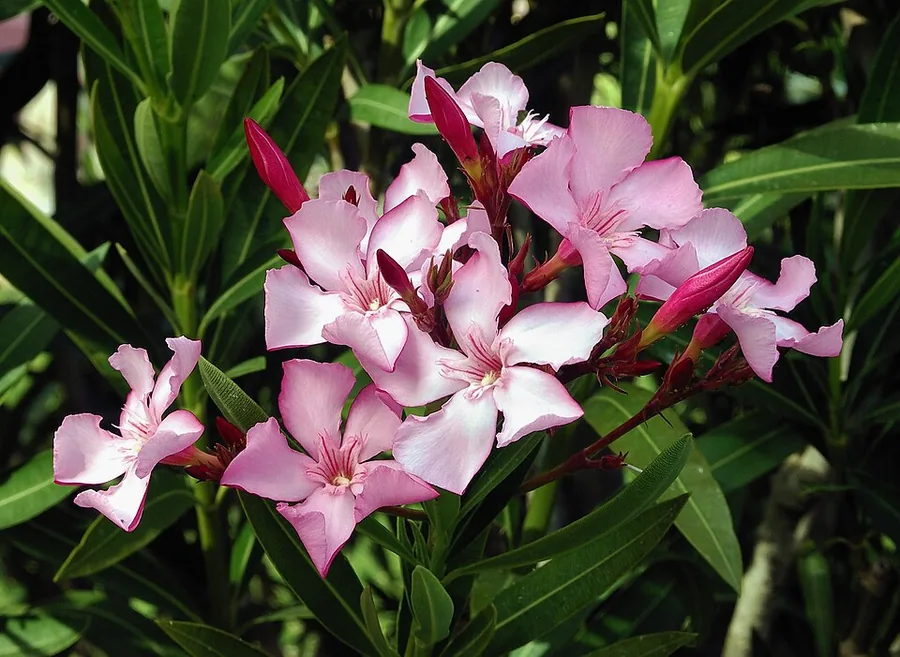
Oleander is a fast-growing evergreen shrub adapted to conditions that limit most ornamentals, tolerating drought, salt spray, and impoverished soil. That resilience underpins its long garden season, which runs months of pink, white, or salmon flowers from late spring into summer in warm climates. Unpruned specimens reach 20 feet (6 m) in height, yet the plant regenerates freely from hard cutting, which is why it is so often managed as a hedge or screen.
The traits that make it adaptable also make it hazardous. Every tissue, root to flower, contains cardiac glycosides that disrupt heart function, placing oleander among the most poisonous shrubs planted in home landscapes. Critically, those compounds are stable, so they remain active in dried leaves, in the smoke of burning clippings, and in the water a cut stem has stood in.
Sound placement resolves the tension between its usefulness and its toxicity. Position it away from pastures, play areas, and vegetable beds, handle it in gloves, and dispose of trimmings without burning. Managed on those terms, it delivers one of the longest, most dependable bloom seasons available in a woody ornamental.
Care
The short version: site it in full sun with well-drained soil, water deeply then let it dry between drinks, and prune to shape after flowering. It demands little once established, but every tissue is poisonous, so handle it in gloves.
Light
Oleander flowers most heavily in full sun, since maximum light drives the bud production the display depends on, and it manages in partial shade only at the cost of fewer blooms. Greater direct exposure also yields a denser, better-furnished plant.
Water
Water regularly through establishment, then allow the top half of the soil to dry before rewetting, which trains a deeper, drought-resilient root system. A mature plant is genuinely drought-tolerant and copes with poor, saline ground, so watering every 7 to 14 days at most suffices. Reduce watering over winter for any container specimen.
Soil
The species is indifferent to soil type, growing in clay, loam, sand, or shallow rocky ground and tolerating poor or saline conditions. Drainage matters more than fertility, since the roots resent waterlogging, and it performs across a broad pH span of 6.0 to 7.8.
Temperature
Oleander withstands sustained heat to about 100°F (38°C) without stress. It survives a light freeze near 19°F (-7°C), but tissue below that threshold is damaged or killed, which is why container plants are brought in or overwintered cool.
Humidity
Average outdoor humidity meets its needs, and the record sets no target to maintain. Its tolerance of dry air and coastal salt spray means humidity is effectively a non-issue.
Feeding
Feed seasonally from spring through summer with a balanced general-purpose fertilizer matched to active growth. Established in-ground plants draw enough from the soil to need little, whereas container specimens, with a limited root volume, benefit from regular light feeding through the season.
Pruning
Prune to shape after flowering, from late summer into early fall. Because buds set on new growth, cuts made later than early fall remove the wood that would carry next year's flowers. Deadhead spent blooms, wear gloves for the whole operation, and never burn the clippings.
Repotting
Move a container plant up every 2 to 3 years, or sooner once roots circle the pot, water runs straight through, or growth stalls, all signs the root mass has outgrown its volume. Shift it into a marginally larger pot with fresh, well-drained medium, gloves on.
Size & spacing
Mature height runs 5 to 19.5 feet (1.5 to 6 m) with a spread of 6 to 10 feet (1.8 to 3 m), so a full-size hedge requires substantial allotted space. Dwarf cultivars stay far more compact and suit large containers.
When to plant
Oleander performs in the mild end of the temperate range, broadly zones 8 to 10. Begin cuttings or seed in late winter to early spring, transplant young stock after the last frost, and expect bloom to carry from late spring through late summer.
Northern hemisphere
Southern hemisphere
Typical months for a temperate climate: start earlier in warm zones, later where spring frosts linger.
- Sow: late winter to early spring
- Plant: spring after last frost
- Harvest: late spring through late summer
Hardiness
USDA hardiness zones: 8–10
Temperature: down to -12°C
Troubleshooting
Oleander is largely trouble-free, and the disorders that do appear are confined to the foliage rather than the whole plant. Identify the symptom below, then intervene early, while the problem is contained. Keep gloves on for any operation that involves handling the plant.
Foliage reduced to a network of bare veins
The oleander caterpillar feeds gregariously, so a group works through the softer leaf tissue and leaves only the harder veins behind, which is why damage spreads across a branch so quickly. Removing the colony early limits how far that feeding front advances. Wearing gloves, pick the orange, black-tufted larvae off by hand and prune out any branch already carrying a heavy population. Where an outbreak has scaled beyond hand control, Bacillus thuringiensis provides a targeted biological option.
Fix:
- Hand-pick and destroy caterpillars (wear gloves)
- Remove and dispose of heavily infested branches
- Apply Bacillus thuringiensis (Bt) for severe infestations
Tacky foliage darkened by mold with insects on the undersides
Bright yellow oleander aphids, and at times scale or mealybugs, colonize the soft new growth and excrete honeydew, a sugary waste that coats the leaf surface and feeds the black sooty mold that follows. Because the mold lives on that sugar rather than on the leaf, removing the insects removes its food supply. Dislodge light colonies with a firm jet of water, then apply insecticidal soap or horticultural oil, which kill by smothering soft-bodied pests. A second application catches the individuals missed in the first, after which the mold washes off.
Fix:
- Spray off light infestations with a strong jet of water
- Apply insecticidal soap or horticultural oil to affected growth
- Repeat treatment to break the pest cycle and wash off sooty mold
Defined leaf spots preceding some defoliation
Brown or yellow lesions with clean, defined margins are the signature of a fungal leaf spot, though the sooty mold that follows insect honeydew can mimic the discoloration, so confirm the margin before treating. Fungal spores spread on moisture and lingering debris, which is the leverage point for control. Strip the affected leaves and clear fallen material from the base, where spores overwinter. Thin the canopy for airflow and keep irrigation off the foliage, since dry leaf surfaces give spores far less opportunity to germinate.
Fix:
- Remove and destroy affected leaves
- Improve air circulation and avoid overhead watering
- Clean up fallen debris around the plant
Toxicity
This is among the most dangerous plants grown in a home landscape. Every tissue holds cardiac glycosides capable of arresting the heart, and because those compounds are stable, the poison persists in dried leaves, in burning smoke, and in vase water. A single leaf has killed children, and the plant is rapidly and often fatally toxic to cats, dogs, horses, livestock, and birds. Keep it well away from anyone who might ingest it, and never burn the clippings.
Toxic to
Cats · Dogs · Horses · Rabbits · Livestock · Birds · People
Cats Severe
The cardiac glycosides disrupt the feline heart rhythm, so any ingestion is a genuine emergency. Early gastrointestinal signs, meaning drooling, vomiting, diarrhea, and abdominal pain, precede an irregular or racing heartbeat, weakness, and collapse. Because even a small dose can prove fatal, treat any contact as urgent.
Dogs Severe
A single chewed leaf or stem carries enough glycoside to endanger a dog. The initial drooling, vomiting, and diarrhea progress to dangerous heart rhythm changes, tremors, and sudden collapse as the toxin acts on cardiac muscle. Seek veterinary care immediately rather than monitoring at home.
Horses Severe
Horses show exceptional sensitivity to the glycosides, and only a few leaves constitute a lethal dose. Colic, drooling, and diarrhea accompany a markedly abnormal heartbeat, muscle tremors, and collapse. The toxin persists in dried tissue, so clippings blown into a paddock are as hazardous as the growing plant.
Rabbits Severe
The same cardiac glycosides act quickly in rabbits, where a small quantity can arrest the heart. Expect gut pain, refusal to feed, weakness, and a faltering pulse as the compound takes effect. No quantity is safe, so exclude oleander from any area a rabbit can reach.
Livestock Severe
Cattle, goats, and sheep are poisoned equally by green foliage and by dried clippings that end up raked into hay, because drying does not degrade the toxin. Vomiting, colic, diarrhea, and a staggering heartbeat advance to collapse and sudden death. Many losses trace to animals eating trimmings discarded over a fence.
Birds Severe
Birds are not exempt, and the same cardiac toxin can kill them rapidly. Watch for weakness, a ruffled, motionless posture, an erratic heartbeat, and sudden death. Exclude poultry and pet birds from every part of the plant.
People Caution
No part of oleander is edible, and a single leaf has proven sufficient to kill a child. Ingestion can produce vomiting, a dangerously irregular heartbeat, and death, while the sap causes contact dermatitis. Wear gloves, never burn the clippings, and keep children well away from the plant.
Wear gloves when handling or pruning; never burn clippings; wash hands after contact; keep all plant parts, prunings, and vase water away from pets, children, and livestock.
Helpline numbers

United States
ASPCA Animal Poison Control: (888) 426-4435 (fee applies)
Poison Control: (800) 222-1222



Canada
Poison Centres: 1-844-764-7669
Varieties
Oleander is offered in a spread of flower colors and several size classes, from dwarf selections to tall hedging forms. The following cultivars are among those most commonly available.
Hardy Pink
A pink-flowered selection bred for greater cold tolerance than the species, which is what makes it the sounder choice in marginal zones.
Petite Salmon
A compact dwarf carrying soft salmon flowers that matures well below the stature of the wild species, suiting confined sites and container culture.
Sister Agnes
A vigorous white-flowered cultivar whose fast, tall growth has long recommended it for screening and hedging.
How to propagate
Oleander propagates readily, and cuttings are the surest method for reproducing a selected plant true to type. Whichever route you take, wear gloves, because every part you handle is poisonous.
Stem cuttingsEasy
Late spring through summer · 2-4 weeks to root
Vegetative propagation from cuttings is the reliable method because it reproduces the parent genotype exactly. Softwood or semi-hardwood stems taken from late spring through summer form roots in 2 to 4 weeks, and the species roots so readily that a stem will strike even in plain water on a windowsill. Wear gloves throughout, as the cut stems and their sap carry the same toxin as the foliage.
SeedModerate
Late winter to spring · Several weeks to germinate; seedlings vary
Seed propagation is slower and genetically unpredictable, since sexual reproduction reshuffles the parent traits. Sowing from late winter into spring yields germination over several weeks to sprout, and the resulting seedlings often diverge markedly from the parent in form and flower. Handle the seed with gloves, because it carries the same cardiac glycosides as the rest of the plant.
Myths
Only the leaves are dangerous, so the flowers, smoke, and vase water are harmless.
The cardiac glycosides are distributed throughout the plant, so bark, flowers, and fruit are as poisonous as the leaves, roots, sap, seeds, and stems. Because those compounds do not break down on drying, the toxicity persists in dead tissue, the smoke from burning clippings is hazardous to inhale, and glycosides leaching into vase water make it dangerous as well. A single leaf can be enough to kill a child or a pet.