Shrub · Apocynaceae
Star Jasmine
Trachelospermum jasminoides
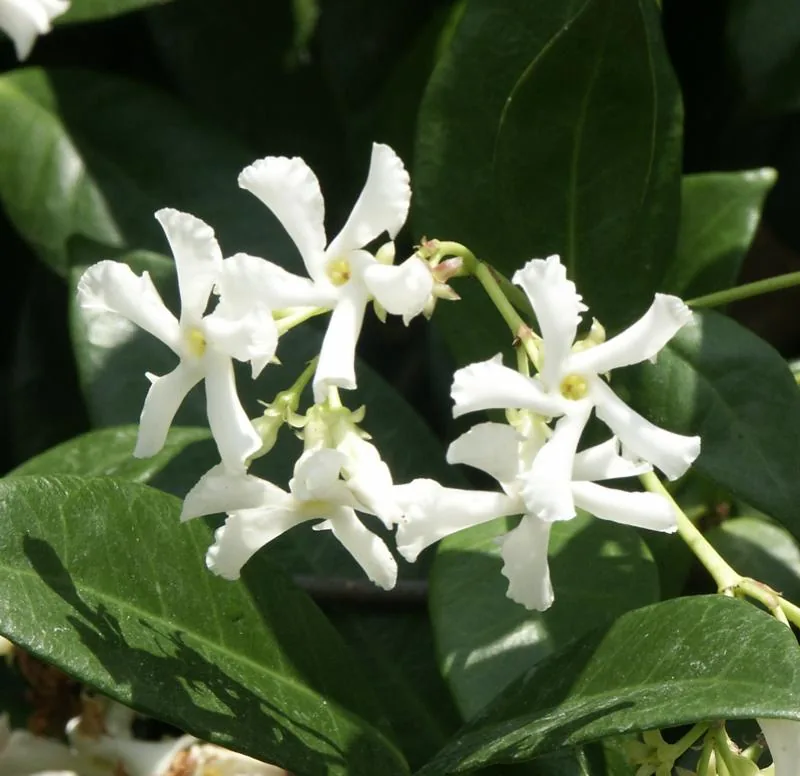
Trained onto a support, Trachelospermum jasminoides rewards the grower with clouds of fragrant white flowers.
Full sun
Every 5–10 days
USDA 8–10
3–20 ft · 0.9–6.1 m
Overview
Star jasmine, Trachelospermum jasminoides, is an evergreen twining woody perennial in the dogbane family, and its habit lets a grower use it as a vine, a sprawling shrub, or a groundcover. Its star-shaped white flowers open in late spring and release a strong fragrance that carries on warm air. Because the glossy dark foliage is evergreen, the planting holds structure and color through the year.
The stems twine rather than cling, so the plant depends on a trellis, wire, or fence to gain height; without one it spreads laterally into a dense groundcover that suppresses weeds. Growth is fast, and a settled plant reaches 3 to 20 feet (91 cm to 6 m) according to how it is trained.
That vigor comes with genuine resilience. The species carries low pest pressure, tolerates a range of soils, and withstands brief cold in milder zones. Supplied with sun, sharp drainage, and a support, it is largely self-sufficient.
Care
The short version: full sun drives the heaviest bloom, evenly moist but well-drained soil suits the roots, and a support carries the twining stems; an established plant tolerates drought and needs little intervention.
Light
Flowering is light-driven, so star jasmine blooms most freely in full sun; it accepts partial shade and performs adequately in bright indirect light indoors. In deep shade the plant diverts its energy into leggy vegetative stems at the expense of flowers, which is why exposure governs the size of the display.
Water
During establishment, maintain evenly moist soil on roughly a 5 to 10 day interval, because a young root system cannot yet buffer against drying. Once the roots extend, the plant becomes drought tolerant, and supplemental water is warranted only in extended dry spells.
Soil
A fertile, well-drained loam amended with leaf mold gives the best results, though the plant tolerates a range of textures. Hold the pH between 6.0 and 7.5, since alkaline conditions reduce iron availability and trigger chlorosis. Above all avoid waterlogging, because the roots resent wet feet and decline under poor drainage.
Temperature
The species withstands a broad range, from 10°F to 100°F (-12°C to 38°C), and that lower limit is what defines its outdoor range in zones 8 to 10. Where winters fall below its tolerance, container culture allows the plant to be moved under cover.
Humidity
Ambient average humidity meets the plant's needs, so no target range applies. It acclimates to ordinary indoor and outdoor moisture without correction.
Feeding
A single spring application of a balanced general-purpose fertilizer supports the coming season's growth. Where foliage yellows on alkaline ground, an iron supplement or acidifier restores color by addressing the underlying iron deficiency.
Pruning
Prune after flowering to manage size and form, timing the cut so the current display is spent before you shape the plant, and train the twining stems onto their support as they extend. Because the sap is a milky latex, clean the tools once cutting is complete.
Repotting
Container specimens need refreshing every 2 to 3 years, or sooner once the plant is rootbound, which shows as roots circling the base, water passing through too quickly, and a decline in growth and flowering.
Size & spacing
Mature height ranges from 3 to 20 feet (91 cm to 6 m) depending on training, with a lateral spread of 3 to 6 feet (91 to 183 cm). Allow adequate room and provide a substantial support to carry the mature weight.
When to plant
As a warm-climate species, star jasmine performs in zones 8 to 10. Plant in spring after the last frost, since young plants are most vulnerable to cold, and expect the principal bloom from late spring into early summer, followed by sporadic flowering through the warmer months.
Northern hemisphere
Southern hemisphere
Typical months for a temperate climate: start earlier in warm zones, later where spring frosts linger.
- Plant: spring, after danger of frost has passed
- Harvest: late spring to early summer, with sporadic bloom into summer
Hardiness
USDA hardiness zones: 8–10
Temperature: down to -12°C
Troubleshooting
Given its low maintenance, star jasmine presents few disorders, and those that appear read clearly. Most resolve to soil chemistry, a sap-sucking insect, or insufficient light. Identify the symptom below and correct the cause early.
Sticky foliage, black film, and bumps on the stems
The bumps are scale insects or mealybugs, and the black film is sooty mold colonizing the honeydew these sap-suckers excrete. Wash the stems with water and a mild soap, then apply horticultural oil or insecticidal soap to the insects themselves. Remove any stem carrying a heavy infestation.
Fix:
- Wash off honeydew and sooty mold with water and mild soap
- Treat infestations with horticultural oil or insecticidal soap
- Prune out heavily infested stems
Interveinal yellowing with green veins
This interveinal pattern indicates chlorosis, typically an iron deficiency expressed when the soil is alkaline and iron uptake falls. Correct it with a chelated iron supplement or an acidifier, and mulch with leaf mold to keep conditions favorable. Assess drainage as well, since waterlogged roots produce the same visual cue.
Fix:
- Apply a chelated iron supplement or soil acidifier
- Improve drainage and avoid overwatering
- Mulch with organic matter such as leaf mold
Sparse vegetative growth with little flower
Under excess shade the plant produces abundant stem but sets few flowers, since bloom depends on adequate light. Relocate a container to a brighter position or thin the overhead canopy. Full sun elicits the heaviest flush of fragrant flower.
Fix:
- Move container plants or relocate to a sunnier spot
- Thin overhead shade where possible
Toxicity
For households with pets or children, the profile is reassuring: star jasmine is not toxic. The ASPCA records it as safe for cats, dogs, and horses, and no toxic principle is reported for other animals. The one caveat is the milky latex that exudes from cut stems, which can irritate sensitive skin, so washing the hands after pruning is prudent.
Safe for
People · Cats · Dogs · Horses · Rabbits · Livestock · Birds
Cats None
A cat that samples the foliage takes no harm, and the ASPCA classifies star jasmine as non-toxic to cats.
Dogs None
The plant reports no toxic compounds affecting dogs, so an animal that chews a trailing stem is not at risk.
Horses None
Rated non-toxic to horses, the species poses no grazing hazard along a fence line or pasture edge.
Rabbits Safe
No toxins are documented for rabbits, and the bitter milky latex generally deters more than a first bite.
Livestock Safe
Cattle, goats, and sheep may graze in its vicinity without concern, as the plant contains no known toxic principle.
Birds Safe
Neither the foliage nor the flowers present any hazard to backyard or aviary birds.
People Safe
The species is safe to cultivate and handle, though the milky latex can irritate sensitive skin, so rinsing the hands after pruning is advisable.
Stems exude a milky latex sap when cut, which may cause mild skin irritation in sensitive people; wash hands and clean tools after pruning.
Varieties
Several named selections and one close relative reach the trade, each offering a distinct horticultural advantage.
'Madison'
A cold-hardier selection that exceeds the species in frost tolerance and extends cultivation into cooler gardens.
'Variegatum'
A foliage form whose leaves bear creamy-white margins, useful for lightening a shaded wall or fence.
Asiatic jasmine (Trachelospermum asiaticum)
A closely allied species with smaller, darker foliage and diminutive yellowish-white flowers, valued as a durable, fast-spreading groundcover.
How to propagate
The species propagates readily, and because its stems naturally twine and trail, two low-input clonal methods succeed without specialist equipment.
Stem cuttingsEasy
Late spring to summer · Several weeks to a few months to root
Semi-ripe stem cuttings are the standard means of increase. Collected in late spring or summer, they root over several weeks to a few months and yield plants genetically identical to the parent.
LayeringEasy
Spring to summer · One season to root before separating
Layering exploits the stems' natural tendency to twine and trail along the ground. Pin a low stem to the soil in spring or summer, allow one season for roots to form, then sever it from the parent as an independent plant.
Myths
Star jasmine is a true jasmine.
The common name and the sweet fragrance mislead many gardeners, yet this species is unrelated to true jasmine. It is classified in the dogbane family (Apocynaceae) as Trachelospermum jasminoides, distinct from the genus Jasminum that contains the true jasmines.