Shrub · Apocynaceae
Mandevilla
Mandevilla × amabilis
Supply full sun and warmth, and this tropical vine converts the season into trumpet flowers from summer through fall.
Full sun
Every 3–7 days
45–90°F · 7–32°C
USDA 10–11
Overview
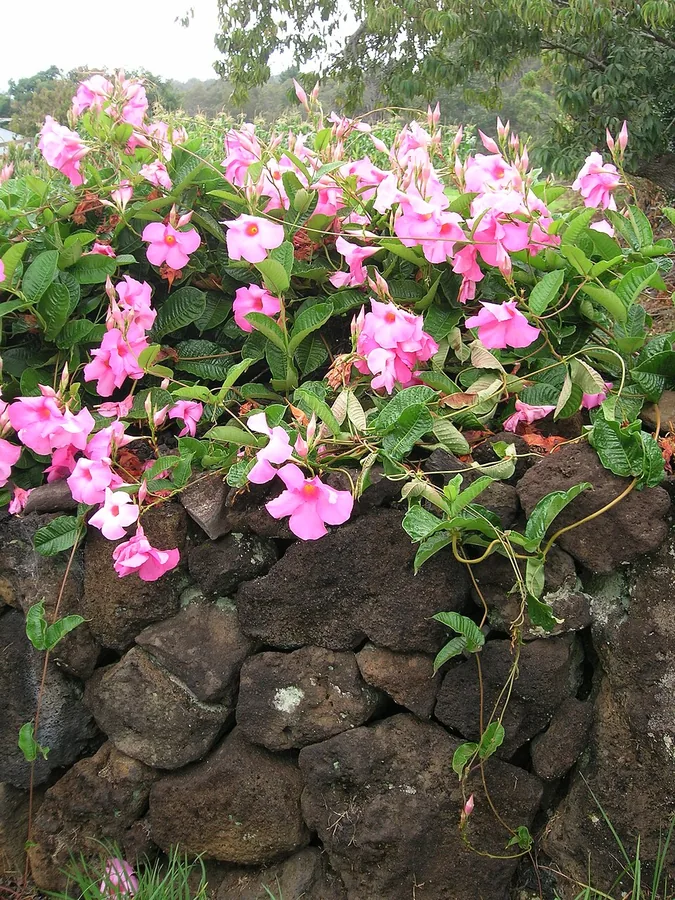
Mandevilla is a fast tropical vine in the dogbane family, grown for the large trumpet flowers it carries from summer into fall. Its origin in the warm Americas explains its narrow cold tolerance: it overwinters outdoors only in zones 10 and 11. In colder regions the practical answer is a summer container plant lifted indoors before the cold, because the roots and stems have no hardiness to spare.
The trade splits the crop into two habits. The tall twining plants sold as Mandevilla climb a trellis or post and reach well over head height, while the bushier, mounding forms sold as Dipladenia hold a compact shape in pots and baskets. Both share one set of requirements, heat, sun, and steady summer moisture, since they share a tropical parentage.
The flowering payoff comes with two conditions worth understanding. Bloom depends on full sun, and every cut stem exudes a milky sap that irritates skin and eyes, which is why gloves belong within reach at pruning time. Meet the light and warmth it evolved for and the plant returns months of color.
Care
The short version: full sun drives the best bloom, steady summer water with a drier winter rest matches its growth cycle, rich well-drained soil protects the roots, and a biweekly bloom feed supports flowering once growth resumes.
Light
Site it in full sun, 6 or more hours of direct light daily, because flowering is light-driven and falls off in shade. It persists in part shade or bright indirect light, but the trade-off is predictable: less direct light yields more foliage and fewer flowers.
Water
Hold the soil evenly moist but never soggy through summer, roughly every 3 to 7 days and more often in heat or in a pot where the root zone dries fast. Reduce watering over winter and let the soil dry further between drinks, since the resting plant uses far less and stays vulnerable to rot in cold wet soil.
Soil
Grow it in rich, well-drained ground amended with humus, or a peat-based mix in containers, because drainage is what protects the roots. It tolerates a wide pH from 6.0 to 8.0, so reaction is rarely the limiting factor, but standing moisture is, and it will rot in soil that holds water.
Temperature
Keep it in its comfort range of 45°F and 90°F (7°C to 32°C), within which growth is steady and slows only as the air cools. It has no frost tolerance, so bring it in before nights fall below 50°F (10°C) to avoid cold injury.
Humidity
Provide high humidity to match the moist tropical air it evolved in, which keeps the foliage in good condition. Indoors over winter the surrounding air runs dry, so group plants together or use a pebble tray to raise local humidity and discourage mites.
Feeding
Feed every two weeks through spring and summer while growth is active and demand is highest. A high-phosphorus bloom formula such as 10-20-10 favors flowering, whereas excess nitrogen shifts the balance toward vegetative growth at the expense of flower.
Pruning
Prune in late winter or early spring before new growth begins, removing old crowded stems and shortening the rest so the plant redirects energy into fresh flowering wood; pinching young plants promotes branching. Wear gloves, because the cut stems release an irritating milky sap.
Repotting
Step it up a pot size every 1 to 2 years, or when the record's rootbound signs appear: roots circling or escaping the drainage holes, water running straight through with little uptake, and stalled growth or bloom. Free drainage matters more than pot volume.
Size & spacing
Depending on habit it ranges from a compact 3 feet to a climbing 3 to 10 feet (0.9 to 3 m), with a spread of 3 to 4 feet (91 to 122 cm). Provide a climbing form with a trellis or post to support the twining stems.
When to plant
Mandevilla is frost-tender and temperature-driven, so its calendar follows warmth rather than daylength. Start seed or hold overwintered plants indoors in late winter, shift them outdoors once nights stay above 50°F (10°C), and expect flowering from summer through fall.
Northern hemisphere
Southern hemisphere
Typical months for a temperate climate: start earlier in warm zones, later where spring frosts linger.
- Sow: late winter to early spring
- Plant: after last frost when nights stay above 50 degrees F
- Harvest: summer through fall
Hardiness
USDA hardiness zones: 10–11
Temperature: down to -1°C
Troubleshooting
Most problems trace to one of two causes: sap-feeding pests that build up on overwintering plants in warm dry indoor air, or a shortfall of the light and warmth the plant needs to flower. Reading the early signs lets you correct the cause before it spreads. Match the symptom below and treat the driver, not just the sign.
Wilting yellow foliage over soft, blackened roots
Soil that stays wet while the leaves wilt points to root rot, the predictable result of overwatering or poor drainage. Confirm it by unpotting and comparing the roots, since healthy tissue is firm and pale while rotted tissue is dark, soft, and foul. Recovery depends on halting water, repotting into fresh fast-draining mix, cutting away the dead roots, and ensuring the pot drains freely, because the rot advances in saturated soil.
Fix:
- Stop watering and let the soil dry out
- Repot into fresh, fast-draining mix and trim away rotted roots
- Ensure the container has drainage holes and discard standing water
Fine webbing with stippled, yellowing foliage
Silvery stippling, fine webbing, and tiny moving specks indicate spider mites, which multiply in the warm, dry air that surrounds overwintering indoor plants. Confirm the diagnosis by tapping a leaf over white paper or examining the undersides with a hand lens, then dislodge the population with a hard rinse aimed at the undersides. Insecticidal soap or horticultural oil, higher humidity, and isolation together break the cycle, since mites rebound fast in dry air.
Fix:
- Rinse foliage with a strong spray of water, especially leaf undersides
- Treat with insecticidal soap or horticultural oil, repeating per label
- Raise humidity and isolate the plant to limit spread
Cottony masses and honeydew at stems and leaf joints
Honeydew, sooty mold, and white cottony masses signal mealybugs, scale, aphids, or whitefly, sap feeders that build up on overwintering vines. Inspect the stem junctions and leaf undersides to identify which is present, because the treatment differs by pest. Alcohol on a swab lifts mealybugs and scale, insecticidal soap or horticultural oil handles the softer pests, and removing the worst-infested growth reduces the reservoir.
Fix:
- Wipe off mealybugs and scale with a cotton swab dipped in rubbing alcohol
- Spray with insecticidal soap or horticultural oil, repeating as needed
- Remove heavily infested growth and isolate the plant
Vigorous foliage with few or no flowers
A leafy vine with few or no flowers almost always reflects insufficient light, since bloom in this species requires full sun. Cool nights and excess nitrogen compound the problem by favoring foliage over flower. Correcting it means at least 6 hours of direct sun, warmth, and a switch to a high-phosphorus bloom fertilizer such as 10-20-10.
Fix:
- Move the plant to a full-sun location
- Switch to a high-phosphorus bloom fertilizer such as 10-20-10
- Keep it warm, as bloom slows in cool conditions
Toxicity
Mandevilla belongs to the dogbane family, and its defining feature for safety is a milky latex sap present throughout the plant. That latex accounts for both effects on record: mild gastrointestinal upset when foliage is chewed, and irritation of skin, eyes, and mouth on contact. No part is edible, so keep it from grazing animals, pets, and children, and wear gloves when cutting.
Toxic to
Cats · Dogs · Horses · Rabbits · Livestock · Birds · People
Cats Mild
A cat that chews the leaves typically develops mild gastrointestinal upset, with drooling and possible vomiting. The latex sap can also leave the mouth sore, since it acts as a contact irritant.
Dogs Mild
Ingested foliage tends to produce drooling and some vomiting in dogs. Contact with the cut sap may redden the muzzle or irritate the mouth, again through the same latex.
Horses Mild
The same irritant latex can upset a grazing horse, most often as drooling and mild digestive trouble. Palatability is low, so most horses reject the bitter foliage after a taste.
Rabbits Mild
A rabbit that samples the leaves may drool and go off its feed for a time. Excluding clippings from the hutch and offering safer greens is the sound precaution.
Livestock Caution
Grazing livestock seldom select this bitter, sappy plant, but a hungry animal could suffer mouth irritation and digestive upset. Fencing it off where stock range is the reliable control.
Birds Caution
The record shows little documented harm to birds, yet the irritant latex justifies keeping it out of reach. Extend the same caution to inquisitive pet birds around the foliage.
People Caution
No part is intended for consumption, and ingested foliage can irritate the mouth and stomach. The greater hazard is the milky sap, which stings skin and eyes, so gloves and thorough hand-washing after pruning are warranted.
Wear gloves when pruning or handling cut stems because the milky latex sap can irritate skin and eyes; wash hands after contact and keep cuttings away from pets and children.
Helpline numbers

United States
ASPCA Animal Poison Control: (888) 426-4435 (fee applies)
Poison Control: (800) 222-1222



Canada
Poison Centres: 1-844-764-7669
Varieties
The genus is sold as a long list of hybrids and series, but a handful recur in the trade and illustrate the range from vining to mounding habit. These are the reference points worth knowing.
Alice du Pont
A classic large vining selection whose deep pink trumpet flowers can carry it to around 20 feet outdoors.
Sun Parasol series
A widely grown series of free-flowering hybrids across many colors, spanning compact mounds to vigorous climbers.
Red Riding Hood
A vigorous vine distinguished by its deep rose-red blooms.
Dipladenia (Mandevilla sanderi forms)
The bushier, mounding trade forms with smaller glossy leaves, still marketed as Dipladenia though now classified under Mandevilla.
How to propagate
Vegetative cuttings are the dependable route, chiefly because they root readily and preserve the cultivar, while seed remains an option for the patient.
Stem cuttingsModerate
Spring through summer · 4-8 weeks
Cuttings are the dependable method because they root readily and hold the cultivar true. Through the warm season, take softwood tips of new growth, strip the lower leaves, and set them in a well-drained mix, where rooting hormone improves the strike and roots form in 4 to 8 weeks. Wear gloves, since the cut stems exude the same irritating milky sap.
SeedModerate
Late winter to early spring · Several weeks to germinate
Seed sown in late winter to early spring is possible but slow, taking several weeks merely to germinate. Most growers set it aside because cuttings root faster and, unlike seed, keep the named cultivar true to type.
Myths
Dipladenia is a completely different plant from Mandevilla.
Dipladenia is simply the former genus name, and taxonomy now places all of these plants within Mandevilla. The trade retains both terms to signal a difference in growth habit rather than genus: the tall twining types are sold as Mandevilla and the bushy, mounding Mandevilla sanderi forms as Dipladenia.