Ornamental · Apocynaceae
Common Periwinkle
Vinca minor
An evergreen groundcover that holds dry shade with rooting stems, a vigor best confined to defined beds.
Partial shade
Every 7–14 days
USDA 4–9
3–6 in · 8–15 cm
Overview
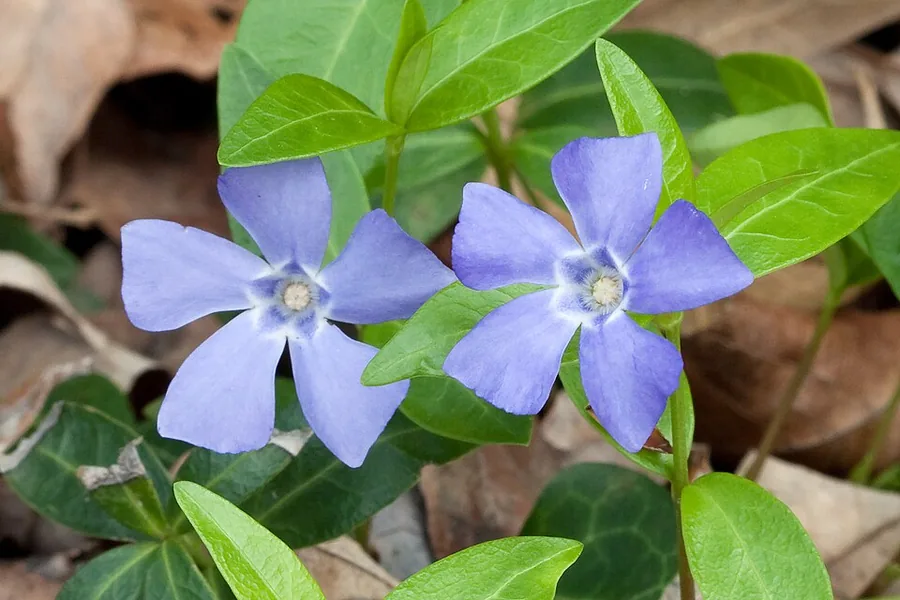
Common periwinkle is a low, evergreen perennial in the dogbane family (Apocynaceae) that carpets shaded ground with glossy foliage and blue spring flowers. It retains its leaves through winter and spreads by trailing stems that root at the nodes, a vegetative habit that lets a single plant colonize wide areas without seed. That rooting-as-it-runs growth is the source of both its value and its problems.
Its tolerance of dry shade, poor soils, and eroding slopes explains its long use as a groundcover. Because it spreads into a dense, flat mat, it excludes weeds by occupying the ground they would otherwise take, and once its root system is established it withstands drought. Few groundcovers combine coverage and low input to this degree.
The same vegetative vigor drives its invasion of woodlands, where rooting stems let it escape cultivation and displace native wildflowers and tree seedlings. Confinement to a defined bed away from natural areas is therefore a horticultural necessity, not a preference. Every part also contains toxic alkaloids, a further reason to site it deliberately.
Care
The short version: grow it in part to full shade and average well-drained soil, water deeply only during drought, and shear it each spring to renew growth and contain the spread.
Light
Periwinkle performs best in part to full shade, which is why it succeeds under tree canopies where turfgrass fails for lack of light. Full sun is tolerated in cooler regions, but in hot-summer climates strong sun scorches the leaves unless soil moisture is maintained, the same heat and drought stress that damages foliage in exposed sites.
Water
Keep the soil moist but well drained during establishment, watering every 7 to 14 days in dry spells and more often in full sun, where evaporative demand is higher. Once the root system is established the plant tolerates drought. Direct water to the base rather than the foliage, since persistent leaf wetness favors the fungi behind stem canker and leaf spot.
Soil
Average, well-drained soil suits it, and it tolerates clay, loam, sand, and dry rocky ground because it makes few demands on fertility. Growth is strongest in moist, humusy soil at a pH of 6.0 to 7.5, spanning slightly acidic to slightly alkaline.
Temperature
Cold hardiness is a defining trait, with a tolerance from -29°F to 95°F (-34°C to 35°C). The evergreen foliage persists through severe winters, and the only real limitation is the combination of high summer heat with dry, sunny exposure.
Humidity
Ambient outdoor humidity is sufficient, so no target range applies. Air circulation matters more than atmospheric moisture, because the stem canker and leaf spot fungi establish where crowded, poorly drained plantings hold moisture around the stems.
Feeding
Fertility requirements are low, and the plant grows adequately on poor soil, so feeding is rarely warranted. Where growth is genuinely weak, a single light spring application of balanced all-purpose fertilizer addresses it.
Pruning
Shear or mow established stands in early spring to renew growth and restrain lateral spread before the season's extension begins. The same operation removes winter-damaged and diseased foliage, reducing the inoculum that would otherwise carry disease into the new growth.
Repotting
In the ground it never requires repotting, and in a container it seldom does. The reliable indicators of a rootbound plant are roots circling the pot, slowed growth, and roots emerging from the drainage holes, at which point a larger container is due.
Size & spacing
Mature height stays low at 3 to 6 inches (8 to 15 cm), while lateral spread reaches 6 to 18 inches (15 to 46 cm) and continues by rooting stems. Spacing plants at that width closes the canopy into a continuous mat within a season or two.
When to plant
Periwinkle is hardy across zones 4 through 9 and is best planted in spring or early fall, when cool, moist soil favors root establishment before heat or hard frost. Flowering runs from spring into early summer, roughly May to June, with sporadic rebloom afterward as conditions allow.
Northern hemisphere
Southern hemisphere
Typical months for a temperate climate: start earlier in warm zones, later where spring frosts linger.
- Plant: Spring or early fall
- Harvest: Spring into early summer (May to June), with sporadic rebloom through summer and fall
Hardiness
USDA hardiness zones: 4–9
Temperature: down to -34°C
Troubleshooting
Most disorders in periwinkle stem from one of two conditions: excessive vegetative vigor or excess moisture around crowded stems. The early indicators below let you distinguish a spreading problem from a fungal one. Identify the cause first, then intervene while control is still practical.
Node-rooting stems forming an expanding mat
The mechanism here is invasive spread through vegetative node-rooting, the identical trait that makes periwinkle so effective as a groundcover. Each trailing stem roots on contact with soil, so the colony advances into lawns, beds, and adjacent woods and displaces the existing vegetation. Dig and pull the advancing runners, install an edging barrier, and discard every rooted fragment in the trash rather than composting it, because a single rooted node reestablishes the colony.
Fix:
- Pull, dig, or cut back escaping stems and remove rooted fragments
- Mow or shear to contain edges and install an edging barrier
- Dispose of clippings and pulled plants in the trash, not in yard waste or woods, to prevent spread
- Repeat removal over several seasons since regrowth is common
Dieback with sunken stem cankers at the soil line
This is fungal stem canker and dieback, the most common disease of the species, and it establishes where crowding, moisture, and poor drainage keep the stem bases wet. The diagnostic signs are sunken, wound-like lesions on the lower stems and brown circular to oval spots on the leaves within a declining patch. Thin the stand to restore air movement, water at the base to keep foliage dry, and rake out infected debris to remove the overwintering inoculum.
Fix:
- Thin and remove affected stems and leaves to improve air circulation
- Avoid overhead irrigation and water at the base
- Rake out and discard infected debris
- Reduce overcrowding when replanting
Foliar scorch in hot, dry, full-sun sites
The disorder is heat and drought stress, confined to plants in full sun where soil moisture is inadequate, while shaded or irrigated plantings remain green. Irrigate deeply during drought and mulch to conserve soil moisture and moderate root temperature. In hot-summer regions, siting in part to full shade removes the cause rather than treating the symptom.
Fix:
- Water deeply during dry periods
- Mulch to conserve soil moisture
- Site in partial to full shade where summers are hot
Toxicity
Regard periwinkle as toxic in all parts. The active compounds are vinca alkaloids, the same class used in chemotherapy drugs, and ingestion produces drooling, vomiting, and diarrhea, progressing to low blood pressure, tremors, and seizures as the dose increases. Keep the plant and its trimmings away from cats, dogs, horses, livestock, birds, and children, and contact a veterinarian or poison control after any ingestion.
Toxic to
Cats · Dogs · Horses · Rabbits · Livestock · Birds · People
Cats Moderate
Even a small quantity of leaves or stems induces drooling, vomiting, and diarrhea. With larger ingestion the alkaloids can lower blood pressure, produce tremors, and at high dose provoke seizures.
Dogs Moderate
Chewing the foliage produces drooling, vomiting, and diarrhea within a short interval. The principal concern is a large ingestion, which can depress blood pressure and induce tremors or seizures.
Horses Moderate
Grazing causes drooling, vomiting, and diarrhea, and the animal's mass confers no protection. Larger doses lead to low blood pressure, tremors, and seizures.
Rabbits Toxic
The vinca alkaloids render every part of the plant unsafe as forage. Expected effects are drooling and marked gastrointestinal upset, progressing to tremors and collapse with substantial ingestion.
Livestock Toxic
Cattle, goats, and sheep respond to the alkaloids in the leaves and stems with drooling, vomiting, and diarrhea. Heavier grazing brings falling blood pressure, tremors, and seizures.
Birds Toxic
No part of the plant is safe for birds. Small quantities cause drooling and gastrointestinal upset, and larger amounts can produce tremors and seizures.
People Caution
The plant is not edible in any part, making it a hazard to young children in particular. Ingested leaves or stems cause drooling, vomiting, and diarrhea, and a large amount may lower blood pressure or induce tremors.
Keep plants and trimmings away from pets and children; wash hands after handling and dispose of clippings where animals cannot reach them.
Helpline numbers

United States
ASPCA Animal Poison Control: (888) 426-4435 (fee applies)
Poison Control: (800) 222-1222



Canada
Poison Centres: 1-844-764-7669
Varieties
Selection extends well beyond the species' plain blue, encompassing white and burgundy flowers and variegated foliage. The cultivars below are the ones most worth distinguishing.
Bowles (Bowles' Variety / 'La Grave')
A vigorous selection distinguished by larger, deep lilac-blue flowers, and one of the most widely grown periwinkle cultivars in the trade.
'Atropurpurea' (sold as 'Burgundy')
Distinguished by deep reddish-purple to burgundy flowers in place of the usual blue.
'Alba'
A white-flowered form of the species, offering the same trailing habit without the blue pigment.
'Illumination'
Grown primarily for its bright gold-and-green variegated foliage, complemented by blue flowers.
'Jekyll's White'
A compact, white-flowered selection with a tidier habit than the more spreading forms.
Vinca major (Bigleaf/Greater Periwinkle)
A larger, more aggressive relative that mounds to about 2 feet with larger 1 to 2 inch blue flowers, and it becomes markedly more invasive in mild climates.
Vinca major 'Variegata'
A variegated form of bigleaf periwinkle margined in creamy white, commonly used to trail from containers and hanging baskets.
How to propagate
Periwinkle propagates readily by vegetative means, and the same node-rooting habit that makes it invasive also makes cuttings, division, and layering nearly effortless.
Stem cuttingsEasy
Late spring to summer · A few weeks to root; full groundcover in 1-2 seasons
Tip cuttings taken from non-flowering stems in late spring or summer root with little difficulty, since the stems are already primed to produce roots. Rooting takes a few weeks, and the cuttings develop into complete groundcover within one to two seasons.
DivisionEasy
Throughout the growing season · Establishes quickly; complete cover in 1-2 years
A rooted clump or a rooted trailing stem can be lifted at any point in the growing season and replanted where additional cover is wanted. It reestablishes rapidly and closes into full cover within a year or two.
LayeringEasy
Growing season · Roots where stems touch soil within weeks
Periwinkle layers on its own throughout the growing season, since any trailing stem resting on moist soil roots at the node within weeks. Once rooted, the new plant can be severed from the parent and transplanted.
Myths
Trailing groundcover periwinkle is the same species as the annual bedding vinca.
The shared common name conceals two distinct species. The trailing evergreen perennial groundcover is Vinca minor, whereas the upright bedding annual is Madagascar periwinkle, Catharanthus roseus, formerly classified as Vinca rosea. Both are in the dogbane family and both are toxic, but the annual contains the more potent vinca alkaloids vincristine and vinblastine.