Ornamental · Poaceae
Annual Ryegrass
Lolium multiflorum
Sow it in fall and annual ryegrass delivers fast cover, nitrogen-scavenging roots, and a stand that mostly self-terminates by spring.
Full sun
Every 3–7 days
50–120 days
USDA 6–9
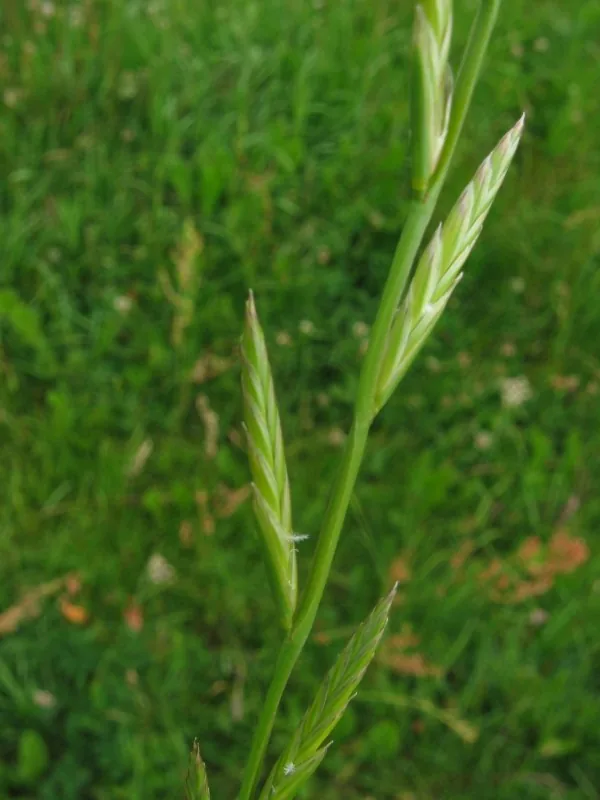
Overview
Annual ryegrass is the cover crop of choice where ground must be protected quickly. A cool-season bunchgrass in the genus Lolium with bright, glossy leaves, it germinates and roots faster than nearly any other sowable species, which is precisely why it suits short establishment windows. Growers use it to hold soil through winter, recover residual soil nitrogen, and provide grazing.
It should not be conflated with cereal rye or with its perennial relative. This is a true annual that completes its life cycle in one season, raising flower spikes in spring and dying back as heat or cold arrives. That brevity is functional, because a cover that terminates itself eliminates a kill pass.
Its limitation is reproductive aggressiveness. Annual ryegrass sets seed heavily and resists easy control, so a stand left to mature persists as a weedy volunteer in fields and margins. Managed on time it performs as intended; left unmanaged it becomes a liability.
Care
The short version: sow it shallow into moist soil in full sun, maintain moisture through establishment, and it accommodates most soils unaided. Mow no closer than 3 to 4 inches, and terminate at early bloom before seed set.
Light
Annual ryegrass performs best in full sun while tolerating partial shade. Higher light supports a denser, faster-closing stand, the response a cover crop relies on to occupy bare ground before weeds can.
Water
It requires consistent soil moisture for rapid germination and establishment and declines under drought. Prolonged heat and dry conditions are lethal, yet it withstands wet and even briefly flooded soils better than most cover crops because it tolerates the resulting low-oxygen conditions.
Soil
Its adaptability is unusual among grasses. It establishes on clay, loam, sand, rocky, and high-organic soils across a broad pH of 5.0 to 7.5, though growth peaks on rich, moist, well-drained loam where nutrients and aeration are highest.
Temperature
This cold-tolerant grass functions from roughly 10°F to 81°F (-12°C to 27°C). Cool conditions drive its growth and summer heat suppresses it, which is the physiological reason it is timed to fall and spring.
Humidity
Ambient outdoor humidity is irrelevant to its performance, so no target applies. The determining factor is soil moisture, which governs germination speed and early development.
Feeding
It generally needs no fertilizer, since it scavenges residual soil nitrogen rather than depending on applied nutrients. Reserve a nitrogen application at planting for genuinely poor soils.
Pruning
Mow to maintain it as living mulch or temporary turf, but never closer than 3 to 4 inches, since the growing points must remain above the cut. To end the stand, terminate at early bloom by mowing, tilling, or a contact herbicide, because mowing alone seldom kills established crowns.
Repotting
none
Size & spacing
Established as a stand rather than spaced plants, it reaches 1 to 3 feet (30 to 91 cm) in height, with individual plants occupying only about 8 to 12 inches (20 to 30 cm). Stand density is governed by seeding rate, not plant spacing.
When to plant
As a cool-season species, annual ryegrass performs in the cooler shoulders of the year rather than midsummer. Direct sow it from late summer into fall to overwinter in mild zones, or in early spring, and in cold regions place the seed at least 40 days before the first killing frost so crowns establish first. Flower spikes emerge in spring, marking the window to terminate before seed set.
Northern hemisphere
Southern hemisphere
Typical months for a temperate climate: start earlier in warm zones, later where spring frosts linger.
- Sow: not typically started indoors; direct sown
- Plant: Late summer to early fall (late July through October) for overwintering in mild zones, or early spring; in zone 5 and colder sow at least 40 days before first killing frost
- Harvest: Flower spikes in spring; terminate before seed set. As a cover crop, biomass is produced over fall, winter and spring.
Hardiness
USDA hardiness zones: 6–9
Temperature: down to -23°C
Troubleshooting
Problems with annual ryegrass arise from timing and control rather than pathogens. The principal risks are uncontrolled seed set, stand loss to winter or drought, and weak establishment from dry soil. Identify the disorder below and intervene early, before it carries into the following crop.
Persistent reseeding from a matured stand
Once a stand reaches reproductive maturity it sows the next generation itself, which is why volunteer pressure follows any crop that was allowed to head out. Each plant returns about 300 seeds of very high viability, and mowing alone leaves established crowns alive because the growing points sit below the cut, a problem compounded where populations carry glyphosate resistance. The control that works is termination at early bloom, before pollination and seed fill, by disking, plowing, or a contact herbicide.
Fix:
- Terminate at early bloom before seed set by disking, plowing, or a non-persistent contact herbicide
- Use a chaff/seed collection system at harvest if grown to seed nearby
- Repeat control passes since seeds germinate in both fall and spring across a wide temperature range (36 to 104 degrees F)
Crown loss to cold or heat stress
Gapping over winter is winterkill, the death of unprotected crowns in zone 5 and colder where absent snow cover removes the insulation that buffers lethal soil temperatures. The same thinning appears under summer heat and drought once temperatures hold above roughly 80°F (27°C), the upper limit of this cool-season species. Sowing at least 40 days before the first killing frost lets roots and crowns develop enough reserves to survive, while in self-terminating systems the dieback is simply the intended endpoint.
Fix:
- Reseed bare areas in mild zones, or accept winterkill where a self-terminating cover is desired
- Plant early enough (at least 40 days before first killing frost) so plants establish before cold
Sparse stand from poor seed-to-moisture contact
Weak emergence traces to inadequate moisture at the seed, because germination depends on continuous imbibition that dry soil cannot supply, and seed set too deep exhausts its limited reserves before the coleoptile reaches light. Sow at 1/4 to 1/2 inch deep to keep the seed in the moist, well-aerated zone, and irrigate if rainfall is absent. Holding the rate near 10 to 20 lb per acre drilled or 20 to 30 lb broadcast supplies the seedling density needed to close the canopy quickly.
Fix:
- Sow at 1/4 to 1/2 inch depth and ensure rainfall or irrigation for good establishment
- Use proper seeding rates (10-20 lb/acre drilled, 20-30 lb/acre broadcast)
Toxicity
As a lawn or cover crop, annual ryegrass is non-toxic to cats and dogs, which at most experience mild gastric upset after chewing grass. The substantive risk falls on horses and grazing livestock: ryegrass colonized by fungal endophytes accumulates alkaloids that induce ryegrass staggers, a neuromuscular tremor and incoordination syndrome. Graze or cut the stand before seedheads form.
Toxic to
Horses · Rabbits · Livestock · Birds · People
Safe for
Cats · Dogs
Horses Moderate
Grazing endophyte-infected ryegrass exposes horses to lolitrem B, the neurotoxin behind ryegrass staggers: muscle tremors, a stiff or spastic gait, and stumbling that intensifies under stress or exertion. Ergovaline from ergot in the seedheads compounds the effect through vasoconstriction.
Rabbits Caution
Vegetative ryegrass is ordinary forage, but the fungal alkaloids that affect grazing livestock can accumulate in mature, seed-bearing growth. Restrict rabbits to young, clean grass and keep them off heading or endophyte-affected stands.
Livestock Moderate
Cattle, sheep, and goats grazing affected pasture develop the same staggers as horses do, lolitrem B driving the tremor and collapse that emerge with excitement or movement. The associated ergovaline narrows peripheral vessels and depresses production.
Birds Caution
Ryegrass seed features in many wild bird diets and carries no recognized toxicity. The reservation is ergot in matured seedheads, so heavy intake of fungus-marked grain is best avoided.
People Caution
No part of the plant is a food crop, so there is nothing to harvest for consumption. The relevant human concern is the wind-borne pollen, a recognized cause of late-spring hay fever.
Cats None
The foliage holds no toxic principle, and the ASPCA records no hazard for cats. Ingesting a few blades may at most provoke a single regurgitation from mechanical irritation, with no systemic effect.
Dogs None
As a lawn or cover crop the grass poses no risk to dogs. Chewing the leaves produces nothing beyond the brief, self-limiting gastric upset common to any grass.
Safe as a lawn, forage, or cover-crop grass around pets; the foliage itself is non-toxic to cats and dogs. For pastured horses and livestock, manage endophyte- and ergot-affected seedheads - cut or graze before heading and avoid feeding affected, mature ryegrass.
Helpline numbers

United States
ASPCA Animal Poison Control: (888) 426-4435 (fee applies)
Poison Control: (800) 222-1222



Canada
Poison Centres: 1-844-764-7669
Varieties
Several distinct types share the ryegrass name yet differ agronomically. These are the ones to distinguish before selecting seed.
Annual / Italian ryegrass (Lolium multiflorum)
This is the rapid cover-crop and forage type, a short-lived cool-season bunchgrass bearing bright, glossy leaves that typically succumbs to winterkill in cold zones.
Perennial ryegrass (Lolium perenne)
A closely allied species grown for turf and pasture that persists from year to year, in contrast to the annual Lolium multiflorum that completes its cycle and dies each season.
Westerwolds annual ryegrass
A true-annual form of Lolium multiflorum that flowers and sets seed within its first season without vernalization, valued for very fast, single-season cover or forage.
Diploid vs tetraploid types
Tetraploid cultivars carry a doubled chromosome complement that yields larger, more succulent leaves and seeds and improved palatability, whereas diploids produce denser, finer stands.
How to propagate
Annual ryegrass is propagated by a single method, direct seeding into the ground, and the process is straightforward.
SeedEasy
Late summer to early fall for overwintering, or early spring; sow at least 40 days before first killing frost in cold zones · Germinates and establishes very quickly, often within 1-2 weeks in moist cool soil
Propagation is by direct seeding alone, with no indoor stage, because the seedling establishes too quickly to warrant transplanting. Sow in late summer to early fall for an overwintered stand or in early spring, and in cold zones place the seed at least 40 days before the first killing frost so crowns harden ahead of cold. Broadcast at 20 to 30 lb per acre or drill at 10 to 20 lb per acre to a depth of 1/4 to 1/2 inch deep in moist soil, where germination and establishment follow within one to two weeks.
Myths
Annual ryegrass is the same plant as cereal rye.
The shared syllable in the common names is the only thing these grasses have in common. Annual ryegrass is Lolium multiflorum, a fine-leaved forage and turf bunchgrass, while cereal rye is Secale cereale, the tall, exceptionally cold-hardy grain milled for bread. Two different grasses from two different genera, so the agronomy, seeding rates, and management of one do not transfer to the other.