Ornamental · Poaceae
Bahiagrass
Paspalum notatum
Tough, drought-proof, and happy in poor sandy soil, bahiagrass holds ground where finer lawns give up.
Full sun
Every 3–7 days
60–90 days
USDA 7–11
Overview
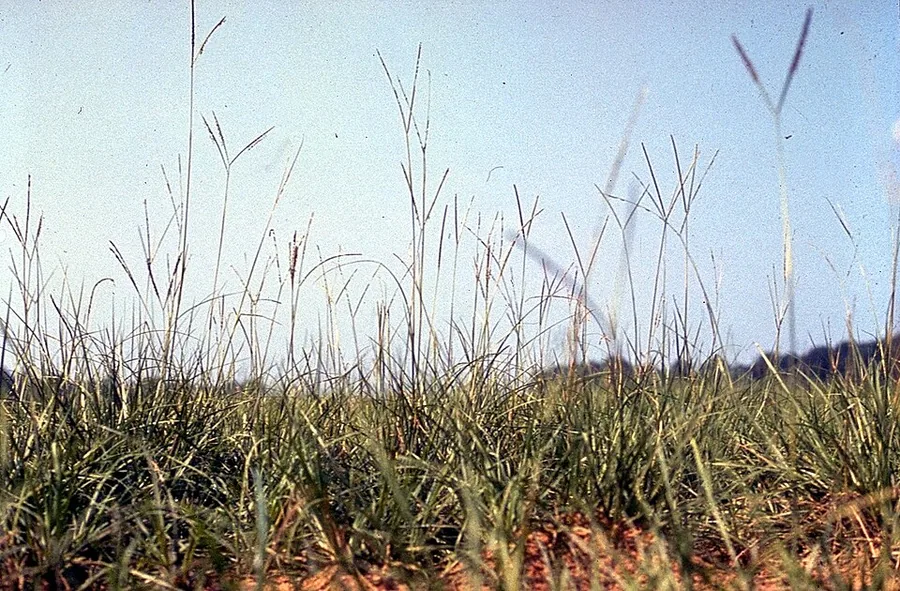
Bahiagrass is a warm-season perennial built on deep, far-ranging roots, and that root system is precisely why it weathers drought so well: it draws moisture from depths shallower grasses cannot reach. It originated in South America and established across the warm, sandy lower South, where it now serves as lawn, pasture, and roadside cover. The tall, two-pronged seedheads that fork into a Y above the turf are its giveaway.
Its defining trait is how little it demands. It performs in infertile, acidic, sandy soil that would starve other grasses, runs on light feeding, and seldom needs water once rooted. The return is an open, coarse, light-green turf rather than a dense carpet, along with a near-continuous flush of seedheads through summer.
Treat this as a grass for function over polish. Give it full sun and room to spread and it will crowd out weeds and bind a slope with very little input. Demand a fine-lawn appearance and you will be mowing weekly and still chasing seedheads.
Care
The short version: full sun, infertile acidic sandy soil, and very little water once it has rooted. Mow high at 3 to 4 inches, feed lightly, and expect frequent summer mowing to hold the seedheads in check.
Light
Bahiagrass demands full sun and will not hold a stand under shade, because the species relies on high light to sustain its density. The more direct sun it receives, the thicker and more weed-resistant the turf remains.
Water
Once rooted, this ranks among the most drought-tolerant lawn grasses available, a direct result of its deep root system reaching moisture below the surface. Irrigate only as needed, roughly half to three-quarters of an inch per application, and let it brown off into dormancy through a dry spell rather than forcing growth. New plantings are the exception, since their roots are shallow, and they need regular water for the first 2 to 3 weeks.
Soil
It genuinely favors infertile, sandy, acidic ground where finer grasses falter, with an optimum near pH 5.5 to 6.5. Lift the pH much beyond that and the grass yellows and stalls, because the higher pH locks up the iron it needs, so keep the soil on the acidic side.
Temperature
As a warm-season grass it greens in heat and browns in cold, tolerating a span of about 19°F to 100°F (-7°C to 38°C). Across its hardiness range it enters dormancy in winter rather than dying back, then resumes growth as warmth returns.
Humidity
Outdoor humidity poses no concern for an established lawn. What counts more is allowing the blades to dry between waterings, since prolonged leaf wetness is the condition that invites dollar spot.
Feeding
Bahiagrass is a light feeder, requiring only about 1 to 2 pounds of nitrogen per 1000 square feet a year through the spring and summer growing season. On high-pH soils, where iron becomes unavailable, a dose of iron as ferrous sulfate corrects the yellowing that lime-heavy ground produces.
Pruning
Mow high, at 3 to 4 inches, and never remove more than a third of the blade in a single pass, since deeper cuts stress the plant. Through summer the tall Y-shaped seedheads rise within days, so expect to mow often to keep them down, and maintain a sharp blade because the fibrous stalks dull it fast.
Repotting
none
Size & spacing
The mown turf stays low at 3 to 4 inches (8 to 10 cm), while individual plants spread 1 to 3 feet (30 to 100 cm) to weave a stand together. Set plants or sprigs with that spread in mind so the cover closes in without leaving long bare gaps.
When to plant
Bahiagrass requires warm soil to break dormancy and grow. Sow seed or lay sod from spring into early summer so the stand has the full warm season to root and fill in before cooler weather slows it.
Northern hemisphere
Southern hemisphere
Typical months for a temperate climate: start earlier in warm zones, later where spring frosts linger.
- Plant: Seed or sod in spring to early summer once soil is warm, allowing establishment before cool weather
- Harvest: Summer; tall two-spike Y- or V-shaped seedhead racemes
Hardiness
USDA hardiness zones: 7–11
Temperature: down to -18°C
Troubleshooting
Most bahiagrass problems are cosmetic and straightforward to diagnose once you recognize the signs. Seedheads, yellowing, thin patches, and small bleached spots each trace to a distinct cause. Match the symptom below, then act before it spreads.
Fast-wilting patches over soft, tunneled ground
The culprit is mole crickets, the most damaging insect bahiagrass contends with. They tunnel through the root zone and sever roots as they move, which is why the turf wilts so quickly and the soil feels spongy underfoot. A soap flush confirms them: blend 1 to 2 ounces of lemon dish soap into 2 gallons of water, pour it over a 2-square-foot patch, and the irritant drives the crickets up within minutes. Target the nymphs in early summer before populations climb, and keep the stand vigorous so it can outpace minor feeding.
Fix:
- Treat for mole crickets when young nymphs are active in summer
- Keep turf healthy so it can outgrow light feeding
Bleached coin-sized circles dotting the turf
Those pale circles are dollar spot, a disease that gains a foothold when nitrogen runs low and the blades sit wet under dew. Confirm it by the hourglass-banded lesions on the leaves. A light dose of nitrogen, about half a pound of nitrogen per 1000 square feet, pushes new growth that grows past the infection, and watering early enough that the canopy dries by evening removes the leaf wetness the fungus depends on.
Fix:
- Apply a light nitrogen feeding (about 0.5 lb N per 1000 sq ft)
- Water early in the day so blades dry quickly and avoid evening irrigation
Forked seedheads returning within days of each cut
Those two-pronged stalks are standard for the species, not a defect, and the long photoperiod of summer drives them up fastest. A mowing interval of 7 to 14 days keeps them at bay, and a sharp blade matters here because the fibrous stems blunt the cutting edge in short order. For a cleaner stand, the Argentine type carries fewer and shorter seedheads than the common selections.
Fix:
- Mow frequently in summer (every 7 to 14 days) to keep seedheads down
- Keep a sharp, heavy-duty rotary blade because the tough seedstalks dull blades
- Choose Argentine for fewer, shorter seedheads if a tidier look is wanted
Pale blades with darker veins over alkaline ground
The pattern points to iron chlorosis. When soil pH rises past 7.0, iron shifts into forms the roots cannot take up, so the blades pale while the veins hold their color. Ferrous sulfate at roughly 2 ounces per 1000 square feet restores green within days because it delivers iron the plant can use directly, and it can be repeated every 6 weeks if the symptom recurs. The durable correction is to hold the soil acidic and skip liming altogether.
Fix:
- Apply ferrous sulfate at about 2 oz per 1000 sq ft, repeating roughly every 6 weeks as needed
- Avoid raising soil pH; do not over-lime
Toxicity
A bahiagrass lawn is safe for pets and people and does not appear on the ASPCA toxic-plant lists. The genuine cautions apply to grazing animals, since the summer seedheads can carry an ergot fungus, and to hay-fever sufferers reacting to the pollen. Cutting the seedheads off removes the grazing risk entirely.
Safe for
People · Cats · Dogs · Horses · Rabbits · Livestock · Birds
Cats None
A bahiagrass lawn poses no risk to cats. As with any grass, a few chewed blades may trigger a small hairball, but the plant holds no toxin of its own.
Dogs None
Dogs can play and roll across a bahiagrass lawn freely. Nothing in the blades is poisonous, and the turf stands up to heavy paw traffic.
Horses Moderate
The grass makes sound forage and grazes safely on its own. The exception is the summer seedheads, which may host an ergot fungus capable of producing tremors and an unsteady, staggering walk. Mow the seedheads away and the hazard goes with them; an affected horse recovers once removed from the pasture.
Rabbits Safe
Rabbits can graze bahiagrass freely, as neither the leaves nor the roots hold any toxin.
Livestock Moderate
Cattle, goats, and sheep graze bahiagrass widely as pasture. The only problem arises from ergot-infected seedheads, which can bring on paspalum staggers, a tremoring and off-balance condition. Mowing the seedheads down removes the danger.
Birds Safe
Birds take the seed and forage across bahiagrass with no ill effect.
People Safe
A bahiagrass lawn is fine to walk, sit, and play on. The single caveat is its pollen, which can aggravate hay fever, so sensitive gardeners may prefer to mow before the seedheads open.
Safe as a lawn for pets and people. Two grazing-only nuances: grass pollen is allergenic to sensitive people, and for livestock the Paspalum seedheads can be infected with ergot (Claviceps paspali) whose sclerotia cause paspalum staggers (tremors and incoordination) in grazing cattle and horses. Mowing off seedheads removes this risk; it does not affect pet or human safety of the lawn.
Varieties
A handful of named types account for most plantings, and the right one turns on whether you want a tidier lawn or a tougher pasture. These are the ones worth knowing.
Pensacola
The most widely planted type, narrow-leaved and notably cold-hardy; the cost of that hardiness is tall, abundant seedheads.
Argentine
A broader-bladed selection that forms denser, more uniform sod and throws fewer, shorter seedheads, which makes it the cleaner choice for lawns despite weaker cold tolerance.
Tifton 9
An improved Pensacola selection bred by USDA-ARS and the University of Georgia for stronger seedlings and longer leaves, grown mainly for pasture and forage.
TifQuik
A quick-germinating member of the Pensacola line that reaches establishment rapidly for pasture and forage.
How to propagate
Bahiagrass is among the more forgiving warm-season grasses to start, whether sown from seed or laid as sod. Either route rewards patience, because the grass is slow to knit into full cover.
SeedEasy
Spring to early summer when soil is warm · Several weeks to a few months; scarified seed speeds germination
Bahiagrass ranks among the few warm-season turf grasses that establish directly from seed, which is why most new stands start that way. Sow from spring into early summer once the soil has warmed, and allow several weeks to a few months for it to fill in, as germination is slow. Scarified seed emerges faster where you can source it, since abrading the seed coat lets water reach the embryo sooner.
DivisionModerate
Warm season; spring to summer · A few weeks for sod to root; plugs and sprigs are slow to fill in
Sod, sprigs, and plugs set through the warm months give cover sooner than seed, with sod rooting in a few weeks. The catch is that bahiagrass never knits into tight, even sod slabs, and plugs are slow to merge into a continuous stand.
Myths
Bahiagrass makes a fine, manicured lawn like Bermuda or St. Augustine.
It produces open, coarse, light-green sod and keeps sending up tall Y-shaped seedheads through the whole summer, so it never reads as a carpet lawn however often it is cut. Its real value lies in large, low-input ground such as pastures, roadsides, and erosion control, where its durability and drought resistance matter more than a polished finish.