Ornamental · Poaceae
Buffalo Grass
Bouteloua dactyloides
A native shortgrass-prairie turf that holds green on a fraction of the water conventional lawns demand.
Full sun
Every 14–28 days
28–120 days
USDA 3–9
Overview
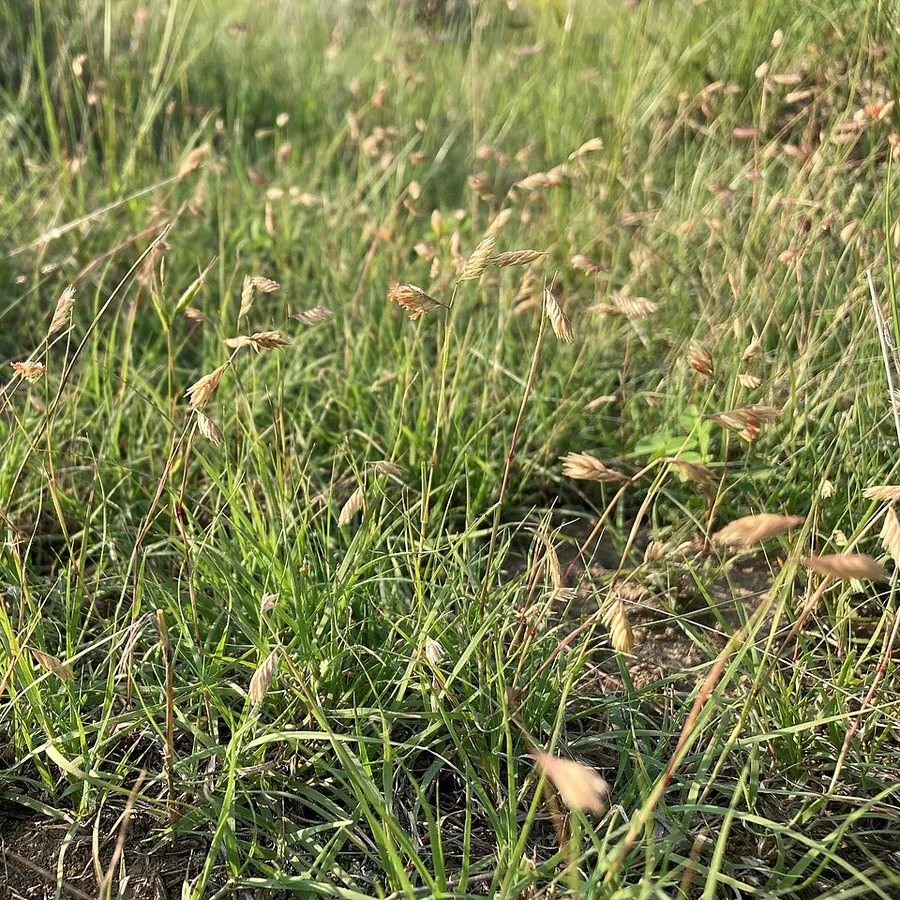
Buffalo grass is a warm-season native of the shortgrass prairie, with a range that runs from central Canada south to Mexico. Its stoloniferous habit, spreading by surface runners rather than seed alone, is what lets it close into a soft, blue-green to gray-green sod that sits low to the ground. That same low, drought-evolved physiology explains why it asks so little where summers are dry and soils lean toward clay.
The defining trait is its low water demand: it holds color on 50 to 75 percent less water than Kentucky bluegrass because it is adapted to a region that survives on roughly an inch and a half of rainfall per month. The corollary is that it sheds the conventional lawn calendar, wanting little fertilizer and only optional mowing. The same prairie adaptation, though, explains its winter and drought dormancy and its low tolerance for shade and traffic.
Manage it as the lean native it is and it performs. Full sun, well-drained ground, and restrained water and nitrogen keep the stand dense and competitive against weeds. Excess inputs reverse that advantage, since the surplus moisture and nutrients favor cool-season weeds, which is precisely the weeds and disease pressure the grass is built to avoid.
Care
The short version: full sun and well-drained, heavier soil, minimal water once established, light feeding at most, and mowing that is optional rather than required.
Light
Buffalo grass requires at least 6 to 8 hours of direct light a day because its prairie physiology is built for open, unshaded ground. Its poor shade tolerance is why it thins under trees and on north-facing exposures, where reduced light cannot sustain the canopy, while open, sunny ground stays dense.
Water
The species needs only 1 to 2 inches of rain or water every 2 to 4 weeks in summer once established, a reflection of its drought-adapted root system. Additional water does not improve it and instead favors weeds and disease by relieving the moisture stress that normally keeps competitors out. Irrigate freely only during establishment, before that root system is in place.
Soil
It performs best in well-drained, heavier clay or clay-loam soils of low-rainfall regions, matching its native upland habitat, and does poorly in sand. On high-pH soils it can develop iron chlorosis, a yellowing of the blades caused by reduced iron availability, yet it still tolerates a wide pH range from 6.0 to 8.5.
Temperature
Cold and heat hardiness is broad, from about -29°F to 104°F (-34°C to 40°C) across USDA zones 3 to 9. Because it is warm-season, growth depends on soil warmth, so it greens up later in spring and browns earlier in fall than cool-season lawns, entering dormancy rather than dying back.
Humidity
It belongs in low-humidity, low-rainfall regions and declines where rainfall is high, because surplus moisture relieves the competitive stress that normally suppresses cool-season weeds. In damp, muggy sites those weeds crowd it out, which is why dry climates suit it and wet ones do not.
Feeding
Nitrogen needs are minimal at 0 to 2 lbs of nitrogen per 1000 sq ft a year, applied between late May to mid-June and again in late July to coincide with active growth. Over-fertilizing is counterproductive because the surplus nitrogen feeds invading weeds faster than it benefits the stand.
Pruning
Mowing is optional and tied to use. Managed as a lawn it is cut to about 2 to 3 inches every 7 to 14 days, while as a meadow it is held at 4 to 8 inches or mown once or twice a year. Once established it requires no mowing, since its low stature does the work for you.
Repotting
none
Size & spacing
Mature stature stays low at 2 to 8 inches (5 to 20 cm) tall, and lateral spread by stolons reaches 6 to 12 inches (15 to 30 cm) per plant. That runner growth is the mechanism by which individual plants knit into a continuous mat over time.
When to plant
As a warm-season grass, its establishment windows track soil and air temperature rather than the calendar alone. Seed from spring through late July, or dormant-seed in late fall so the burrs germinate once spring soils warm, and set plugs or sod after the last frost, with June ideal. Its inconspicuous flowers appear from June to August and have no bearing on management.
Northern hemisphere
Southern hemisphere
Typical months for a temperate climate: start earlier in warm zones, later where spring frosts linger.
- Plant: Seed treated burrs in spring through late July, or dormant-seed October to December for spring germination; set plugs or sod after the last spring frost and at least 6 weeks before the first fall frost (June is ideal).
- Harvest: Inconspicuous green flowers June to August; dioecious, with male plants holding small comb-like spikes above the turf.
Hardiness
USDA hardiness zones: 3–9
Temperature: down to -40°C
Troubleshooting
Most failures in buffalo grass come down to a mismatch between management and its low-input, full-sun biology, or to a site it is not suited to. Diagnose before intervening, since browning is far more often dormancy than mortality. Match the symptom below, then correct either the inputs or the placement.
Thinning turf taken over by weeds
A lush, weed-ridden buffalo grass stand is the signature of conventional-lawn management applied to a low-input native. Too much water and nitrogen supply cool-season weeds the moisture and fertility they need to outcompete it, and a damp, high-rainfall site compounds the effect. Reduce irrigation to 1 to 2 inches every 2 to 4 weeks in summer, lower the nitrogen, and remove weeds by hand while the stand recovers its density.
Fix:
- Cut back irrigation to only what is needed (about 1 to 2 inches every 2 to 4 weeks in summer)
- Reduce nitrogen to 0 to 2 lbs per 1000 sq ft per year
- Remove weeds by hand or spot-treat, especially in the first one to two years
- Avoid scalping; mow at 2 to 3 inches or leave unmowed
Patches that fade out under trees and in shade
Because buffalo grass requires full sun and has poor shade tolerance, it cannot maintain a canopy below roughly 6 hours of direct light, so it thins under trees and on shaded exposures. The contrast is diagnostic: open, sunny portions of the same lawn stay dense. Reserve the species for bright ground and substitute a shade-tolerant groundcover beneath trees and on north-facing sides of structures.
Fix:
- Relocate buffalo grass to full-sun areas
- Use a shade-tolerant grass or groundcover under trees and on the north sides of structures
Bare, worn tracks where the lawn gets used hard
Buffalo grass has poor wear and traffic tolerance, so wear concentrates exactly where foot and vehicle traffic recurs. Paths and play areas thin while the surrounding turf, under lighter use, holds. Reroute the traffic or install a more wear-tolerant grass in those zones, and avoid the species altogether for small, heavily used lawns and athletic fields.
Fix:
- Limit concentrated traffic on buffalo grass
- Reroute paths or use a more wear-tolerant grass in high-traffic zones
Straw-brown lawn that is slow to wake up
Brown buffalo grass almost always reflects normal dormancy, not death. As a warm-season grass it browns after the first hard frost and can also enter drought-induced dormancy in prolonged summer dry spells, then resumes growth with warmth or water. The crowns remain alive throughout, so the response is to wait for mid- to late spring or apply light irrigation to break drought dormancy if color is wanted sooner.
Fix:
- Wait for warm temperatures in mid- to late spring for green-up
- Apply light irrigation to break drought dormancy if green color is desired
- Accept brown dormancy as normal for this species
Toxicity
For households with animals, the record is clear: buffalo grass is non-toxic and absent from the ASPCA's list of poisonous plants. As established range forage it is grazed by livestock and is safe around cats and dogs. The only caveat is allergenic, not toxic, since grass pollen can provoke hay fever in sensitive people or animals.
Safe for
People · Cats · Dogs · Horses · Rabbits · Livestock · Birds
Cats Safe
Buffalo grass is safe for cats. A cat that nibbles a few blades may occasionally regurgitate one, the mechanical effect any grass can have on the stomach, but the plant carries no toxin.
Dogs Safe
Dogs can run, roll, and graze on it without risk. The only thing to monitor is the occasional bout of grass-eating that ends in mild vomiting, an effect of the blade texture rather than any poison.
Horses Safe
It is a recognized pasture grass, and horses graze it freely with no toxic risk.
Rabbits Safe
Rabbits can browse it as part of a normal forage diet, since it contains nothing that would disturb them.
Livestock Safe
Cattle, goats, and sheep have grazed buffalo grass across the plains for generations. It functions as nutritious range forage, not a hazard.
Birds Safe
Birds are unaffected and feed on the seed, with no component of the plant posing a threat.
People Safe
The grass is harmless to people. The single qualification is allergenic rather than toxic, since grass pollen can trigger hay fever in sensitive individuals.
Like any grass, pets may nibble it and occasionally vomit, and grass pollen can trigger allergies in sensitive people or animals, but the plant itself is not poisonous.
Varieties
Named cultivars fall into two breeding lines: vegetatively propagated female selections established from plugs for fine, dense turf, and seeded types you can sow directly. The selections below are the ones most often encountered.
Legacy
Legacy is a vegetatively propagated female cultivar set from plugs that produces a dark green, dense, low turf of top quality with almost none of the scratchy male flower stalks.
Prestige
Prestige, another plug-established female, brings bright green color, improved chinch bug resistance, an earlier spring green-up, and color that persists longer into fall.
UC Verde
UC Verde is a fine, dense, low female cultivar bred by the University of California specifically for the warm low desert and California heat.
Cody
Cody is a widely adapted seeded cultivar with good density and drought tolerance that breeders frequently use as the benchmark for newer selections.
Bowie
Bowie is a medium green seeded cultivar offering fine texture, good density, rapid establishment, and dependable winter hardiness.
Texoka
Texoka is an older seeded cultivar that remains readily available for both lawn and range plantings.
How to propagate
Two methods are practical: seed, which is economical but slower and more labor-intensive, and vegetative plugs or sod, which establish faster and more uniformly.
SeedModerate
Spring through late July, or dormant-seed October to December for spring germination · Full coverage in one season at higher seeding rates; can be labor intensive
Sow treated seed burrs from spring through late July, or dormant-seed them October to December so they germinate the following spring once soils warm. At the higher end of a 1 to 3 lbs per 1000 sq ft rate the stand can close in a single season, though seeding is labor-intensive. Despite its drought tolerance, irrigate freely during establishment, before the deep root system has formed.
DivisionEasy
After last spring frost, at least 6 weeks before first fall frost (June ideal) · Plugs can fill in within about 4 to 6 weeks when set closely
Set plugs at least 2 inches across and 2.5 inches deep, spaced from 6 to 24 inches apart, after the last spring frost and at least 6 weeks before the first fall frost, with June optimal. Closer spacing accelerates coverage because the stolons bridge shorter gaps, so tight plantings can fill in within about 4 to 6 weeks. Sod provides immediate cover where instant turf is required.
Myths
Buffalo grass needs the same watering and feeding as a Kentucky bluegrass or fescue lawn.
The premise inverts how the species works, because high inputs harm this low-input native. Surplus water and fertilizer open the stand to weeds and disease, the precise outcome the grass is adapted to resist. Once established it gets by on 50 to 75 percent less water than Kentucky bluegrass and only 0 to 2 lbs of nitrogen per 1000 sq ft a year, so restraint is the correct management.