Ornamental · Poaceae
Blue Fescue
Festuca glauca
A compact silver-blue tuft built for hot, dry, lean ground that defeats less frugal plants.
Full sun
Every 7–14 days
USDA 4–8
8–12 in · 20–30 cm
Overview
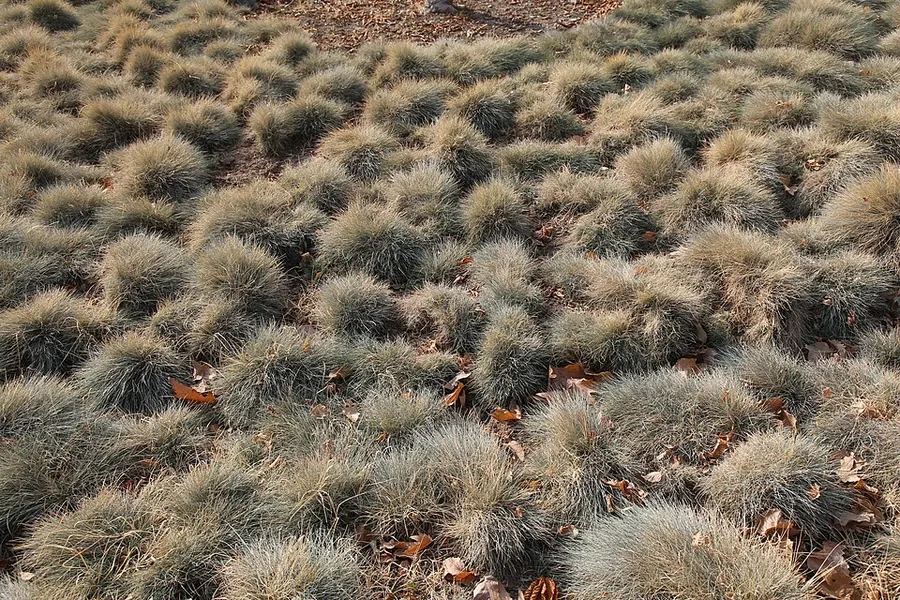
Blue fescue is a small cool-season ornamental grass that forms a rounded silver-blue tuft roughly a foot tall. Native to cooler parts of Europe, it earns its place through foliage color and a self-contained dome habit rather than scale, and it holds that form across the season. Sited against gravel, dark mulch, or greener planting, the silver-blue reads at its strongest.
Its frugality is the point. The waxy bloom that gives the foliage its color develops fullest under full sun and sharp drainage in lean, even rocky soil, conditions that also let it tolerate drought and cold to zone 4. Rich ground drives soft, top-heavy growth, and standing water rots the crown, so a hard, dry site is what keeps the plant tight.
The limiting trait is longevity. A clump is short-lived and the center declines after 2 to 3 years as the oldest tillers exhaust themselves, leaving a bare middle. Pre-empt that on a regular division cycle, hold the plant in full sun, and a planting of blue domes stays uniform from year to year.
Care
The short version: full sun, lean and sharply drained soil, and minimal water once established. Feed almost never, shear back in early spring, and divide the clump every 2 to 3 years to renew it before the center dies out.
Light
Site blue fescue in full sun, because the intensity of the waxy silver-blue depends on it; under shade the bloom thins, the foliage greens, and the clump grows lax and open. It accepts light shade, but at a clear cost to color and habit.
Water
Once established it is drought-adapted, so water sparingly and let the soil dry out between drinks. The crown is intolerant of saturated conditions, and persistent moisture is the principal route to crown rot, which makes restraint the safer error.
Soil
Grow it in average to lean, sharply drained soil, including poor, dry, or rocky ground. Wet or heavy clay holds water around the crown and induces rot, so drainage outranks fertility here. The plant performs across a pH of 5.5 to 7.5.
Temperature
It is markedly cold-hardy, tolerating winter lows near -29°F (-34°C) and summer highs to 86°F (30°C). The decisive stress is not absolute temperature but the combination of heat and humidity in summer, which predisposes the crown to rot and decline.
Humidity
Low humidity suits its dry-soil physiology. Hot, muggy summers are the chief liability, since trapped moisture around the crown promotes rot and fading, so open siting with good airflow and free-draining roots matters.
Feeding
Feed sparingly: a single light application in spring is sufficient. Excess nitrogen produces soft, floppy, weak growth at the expense of color and form, which is why a lean substrate gives the firmest, bluest clump.
Pruning
In early spring, shear or comb the clump to about 3 to 4 inches to clear the previous season's brown blades before new growth emerges. This annual reset removes dead material that would otherwise dull and clutter the tuft.
Repotting
In place of repotting, divide the clump every 2 to 3 years to maintain vigor. A browning, hollow center or a thinning tuft signals exhausted central tillers and is the cue to lift and split.
Size & spacing
Mature plants are compact, reaching about 8 to 12 inches (20 to 30 cm) in height and a comparable width. Spacing of 10 to 12 inches (25 to 30 cm) lets each clump finish as a discrete, well-defined mound.
When to plant
As a cool-season grass, blue fescue puts on growth during the cooler shoulders of the year and idles through summer heat. Establish new plants in spring after the last frost or in early fall, while soil moisture and mild temperatures favor rooting, and expect modest flower spikes from late spring into early summer. Early spring is also the working window for shearing and division.
Northern hemisphere
Southern hemisphere
Typical months for a temperate climate: start earlier in warm zones, later where spring frosts linger.
- Sow: Late winter to early spring (species only; named blue cultivars do not come true from seed)
- Plant: Spring after last frost or early fall
- Harvest: Late spring to early summer (June-July)
Hardiness
USDA hardiness zones: 4–8
Temperature: down to -34°C
Troubleshooting
Nearly every blue fescue problem reduces to excess moisture or insufficient light, the two factors that most directly undermine a dry-adapted, sun-loving grass. Central dieback is the third, and it follows from the clump's natural aging rather than any culture fault. Identify the pattern below, and correction usually amounts to relocation, a hard cutback, or division.
Yellowing, collapse, and a mushy crown
Saturation at the crown is the governing cause. Heavy, rich, or poorly drained soil drives crown and root rot, and the heat-plus-humidity load of a hot summer produces the same decline. Re-site into sharply drained, lean soil in full sun, reduce watering, and cut back the failing foliage so the plant can recover as temperatures fall.
Fix:
- Move or replant in sharply well-drained, lean soil with full sun
- Reduce watering and avoid wet feet
- Cut back declining foliage and allow recovery in cooler weather
Bare, brown center within a ring of living foliage
This is the expected expression of the plant's short life, as the oldest central tillers exhaust themselves and the clump hollows from the middle after 2 to 3 years. An overgrown, long-undivided clump reaches that state faster. Lift the whole plant in early spring, discard the spent center, and replant the vigorous outer divisions.
Fix:
- Dig up the entire clump in early spring
- Discard the dead center and divide the vigorous outer portions into smaller sections
- Replant the divisions in well-drained soil and water in
Blue dulling toward green
The silver-blue is a sun effect produced by the waxy bloom, so insufficient light lets the foliage green and the habit loosen. Age contributes as well, with older clumps shifting to a greener summer tone. Move the plant into full sun and divide tired clumps to restore the strongest blue.
Fix:
- Transplant to a full-sun location
- Divide and replant aging clumps to restore vigor and color
Toxicity
For pet and livestock owners the verdict is clear: blue fescue is not toxic. As a true grass it carries no poisonous compounds and poses no risk to cats, dogs, horses, rabbits, or grazing stock. Overgrazing can trigger the ordinary vomiting any grass provokes, and airborne grass pollen may aggravate existing hay fever, but no part of the plant is poisonous.
Safe for
People · Cats · Dogs · Horses · Rabbits · Livestock · Birds
Cats None
Safe in feline company, as the plant contains nothing toxic. A cat that chews a few blades may regurgitate them, the ordinary response to any ingested grass.
Dogs None
No toxins are present, so a dog can investigate the clump freely. The likely outcome of a large mouthful is later regurgitation of the grass.
Horses Safe
Non-toxic to horses. As a true grass it grazes without consequence.
Rabbits Safe
Rabbits browse fescue without harm; in practice rabbits and deer often graze the clumps, a recognized reason for planting it.
Livestock Safe
Safe for cattle, goats, and sheep. Fescue is a standard pasture grass, and this ornamental form behaves identically.
Birds Safe
Nothing in the plant endangers birds, and the seed heads attract finches and other small feeders.
People Safe
Non-toxic to people. The only consideration is grass pollen, which can provoke hay fever in already sensitive individuals.
Not poisonous, but pets that nibble grass may vomit, and grass pollen can aggravate allergies in sensitive people.
Varieties
Garden blue fescue is mostly a handful of named selections distinguished chiefly by intensity of blue and tolerance of heat. The following are the cultivars worth knowing.
Elijah Blue
Elijah Blue is the dominant cultivar in cultivation, selected for its soft, silvery powder-blue blades.
Boulder Blue
Boulder Blue is a fine-textured selection in steely slate-blue with above-average tolerance of heat and drought.
Cool as Ice
Cool as Ice is grown for its exceptionally icy silver-blue, the coolest tone among these selections.
Beyond Blue
Beyond Blue is a sport of Elijah Blue that retains its blue longer and resists the heat and humidity that fade comparable cultivars.
How to propagate
Division is the principal method, and because it removes spent central growth it serves equally as renewal for an aging clump. Seed reproduces only the species, since the named blue selections do not come true.
DivisionEasy
Early spring · 4-8 weeks
Division is the operative method, since the named blue cultivars do not come true from seed and splitting an established clump preserves both color and form. Lift and divide in early spring, replant the vigorous outer sections, and allow about 4 to 8 weeks for establishment. The same operation rehabilitates a clump that has died out centrally.
SeedEasy
Late winter to spring · 4-8 weeks
The species can be raised from seed sown from late winter into spring, with establishment in roughly 4 to 8 weeks. Because seedlings segregate widely for color and the named cultivars will not come true, seed propagation is appropriate for the species but not for a selected blue clone.
Myths
Blue fescue is a plant-once-and-forget grass that lasts for years.
It is a short-lived cool-season grass whose center characteristically hollows out within 2 to 3 years. Sustained appearance depends on dividing it every few years or replacing it once it declines.