Ornamental · Poaceae
Centipede Grass
Eremochloa ophiuroides
Feed sparingly, withhold lime, and centipede grass holds a low-input lawn green all season.
Full sun
Every 5–7 days
42–56 days
USDA 7–9
Overview
Centipede grass works as a stoloniferous warm-season turf, spreading by above-ground runners rather than rhizomes, which is why it knits into a dense, apple-green mat across the warm Southeast. Its low resource demand earns the name lazy man's grass, since modest feeding and infrequent mowing meet its needs. That same low demand is the basis for nearly all of its care.
The slow growth rate is a functional trait, not a shortcoming. Less top growth means fewer mowings and a stand that maintains density with minimal intervention. Its hardiness sets the boundary: cold tolerance reaches only about 10°F (-12°C), which places it in USDA zones 7 to 9 and explains its poor performance where winter temperatures fall further.
Fertility is where most management fails, and the mechanism is straightforward. The grass is adapted to poor, acidic soil and very little nitrogen, so a bluegrass-style feeding program drives the thatch, high pH, and shallow rooting that bring on decline. Match the inputs to its biology and it sustains itself with little help.
Care
The short version: full sun, deep and infrequent irrigation, acidic soil, and restrained fertility. Mow low, withhold lime, and allow its naturally slow growth.
Light
Centipede grass performs best in full sun, yet it tolerates light or partial shade better than most warm-season turf. Deep shade reduces photosynthate and thins the stand over time, so siting it under as much open sky as the yard permits sustains density.
Water
Irrigate deeply but infrequently rather than in daily increments. Established turf needs about 1 inch (2.5 cm) a week, wetting the soil 5 to 7 inches deep, and allowing slight wilt between irrigations drives roots downward in search of moisture. Apply water before sunrise so foliage dries quickly and disease pressure stays low.
Soil
This grass is adapted to infertile, acidic, sandy ground with good drainage, and a pH of 5.0 to 6.0 supports nutrient availability for it. Avoid heavy clay and poorly drained sites, because saturated soil favors the fungal diseases that attack the stand.
Temperature
Centipede grass withstands heat to about 95°F (35°C) without injury and survives winter lows near 10°F (-12°C), which defines its cold limit. Below that threshold the cold causes real injury, the physiological reason it is confined to the warmer southern zones.
Humidity
Ambient outdoor humidity meets its needs, so no target value applies. Drainage and air movement carry far more weight, since prolonged leaf wetness in humid, slow-drying turf is the precondition for large patch and dollar spot.
Feeding
Restrict nitrogen. The grass needs only about 1 pound of actual nitrogen per 1,000 square feet a year, applied in small splits from spring green-up through fall. When color fades on higher-pH soil, the limiting factor is iron rather than nitrogen, so supply iron, not lime, because added lime raises pH and worsens the deficiency.
Pruning
Mow at 1 to 2 inches (2.5 to 5 cm) and remove no more than a third of the blade per cut to avoid scalping stress. Raise the cutting height a notch during heat or drought so the canopy retains leaf area to shade and cool its own root zone.
Repotting
none
Size & spacing
The mowed canopy stays low, near 1 to 2 inches (3 to 5 cm) tall, while each plant extends laterally by stolons to cover 1 to 3 feet (30 to 100 cm). That slow lateral spread is the mechanism by which plugs and sprigs eventually coalesce into a closed lawn.
When to plant
As a warm-season grass, centipede establishes only after soil warms and with enough remaining season to root before dormancy. Plant from April through July to give the stand a full warm period to establish, and avoid fall planting, because immature turf is prone to winter cold injury.
Northern hemisphere
Southern hemisphere
Typical months for a temperate climate: start earlier in warm zones, later where spring frosts linger.
- Plant: Seed, sod, plug, or sprig from April to July so the grass establishes over a full warm season; avoid fall seeding due to winter cold injury risk.
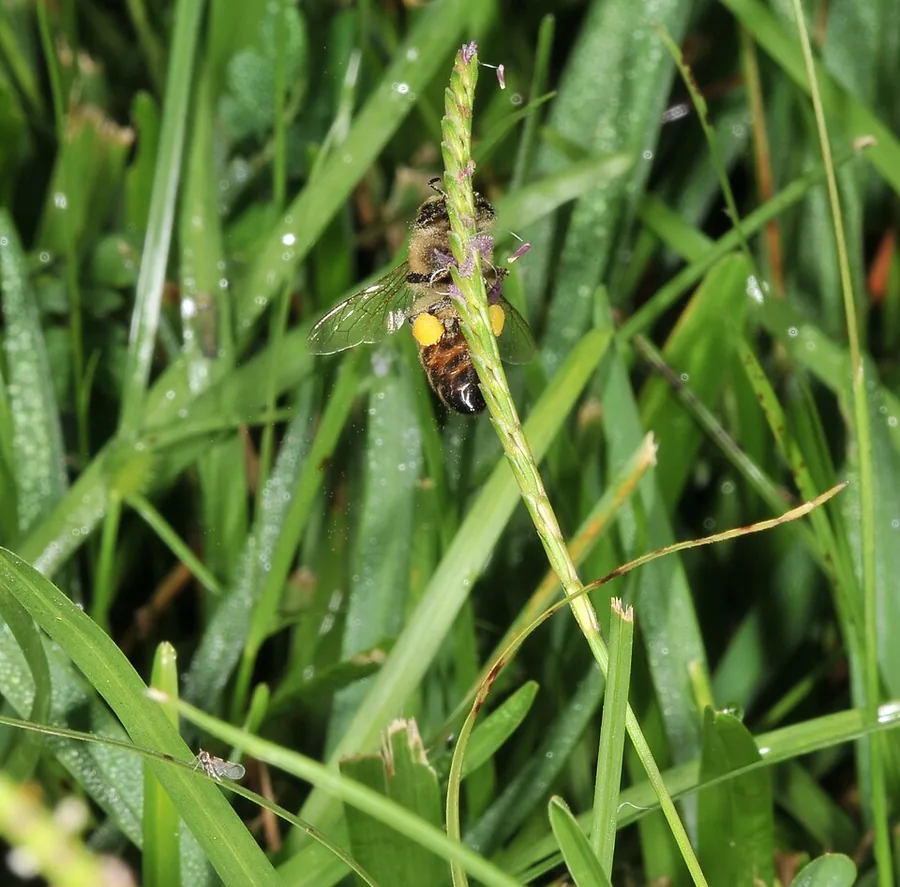
- Harvest: Inconspicuous seedheads on slender spikes in summer; grown for turf, not bloom.
Hardiness
USDA hardiness zones: 7–9
Temperature: down to -18°C
Troubleshooting
Most centipede grass problems trace to a single cause: excess management. Overfertilization, liming, and daily irrigation account for more failures than any pest, because each one undermines the plant's adaptation to lean, acidic conditions. Match the symptom below, then reduce inputs rather than add them.
Delayed spring green-up and loosely rooted failing patches
Delayed spring green-up followed by patchy yellowing and dieback in turf that lifts easily indicates centipedegrass decline, the gradual collapse that follows years of excess fertility. The mechanism runs in sequence: surplus nitrogen builds thatch, high soil pH immobilizes iron, and roots remain shallow until whole patches fail. Reduce nitrogen to about 1 pound per 1,000 square feet a year, hold soil acidic near a pH of 5.5, and dethatch lightly so roots can re-establish depth.
Fix:
- Stop heavy feeding; apply no more than about 1 lb nitrogen per 1,000 sq. ft. per year in small splits
- Correct soil pH toward 5.0-6.0 and base phosphorus and lime only on a soil test
- Reduce thatch with light vertical mowing and core aeration, and raise mowing height during stress
Whole-lawn chlorosis, most pronounced during early spring growth
Uniform paling of the blades in a stand that remains thick points to iron chlorosis rather than nitrogen deficiency. Once soil pH exceeds about 6.5, iron becomes chemically unavailable to the grass, and cold spring soils slow uptake further. A foliar application of ferrous sulfate restores color within days, but the durable correction is to keep the soil acidic and withhold lime.
Fix:
- Apply ferrous sulfate at about 1 tablespoon per 3 gallons of water per 1,000 sq. ft., repeating every 2-4 weeks as needed
- Lower soil pH over time with sulfur per soil-test guidance
- Avoid lime and high-phosphorus fertilizers
Progressive thinning with turf detaching in loose mats
Turf that pulls up as a loose mat and recovers slowly signals root injury below ground. Both ring nematodes and ground pearls feed on the root system, and no foliar or soil treatment cures either in established lawns. Submit a soil and root sample for a nematode assay to confirm the cause, then sustain stand vigor through correct low fertility, consistent moisture, and core aeration to relieve compaction.
Fix:
- Improve overall vigor with proper low fertility, correct pH, and good watering since no rescue treatment cures nematodes or ground pearls in lawns
- Relieve compaction with core aeration
- Reduce thatch to encourage deeper roots
Expanding circular blight during warm, humid periods
Roughly circular dead patches that enlarge during humid spells are the work of large patch, a Rhizoctonia disease, occasionally accompanied by dollar spot. The pathogen is driven by excess nitrogen and by foliage that stays wet overnight, which is why cultural change is the first line of control. Irrigate before sunrise so blades dry quickly, keep feeding low through spring and fall, and apply a labeled fungicide only when damage becomes severe.
Fix:
- Water early in the day so foliage dries quickly
- Avoid excess nitrogen, especially in spring and fall
- Apply a labeled turf fungicide only if the problem is severe
Toxicity
Centipede grass is non-toxic. It appears on no toxic-plant list, so pets, livestock, and people face no poisoning risk from it. The single relevant concern is grass pollen, which can provoke hay fever in sensitized individuals.
Safe for
People · Cats · Dogs · Horses · Rabbits · Livestock · Birds
Cats Safe
A cat may nibble centipede grass without harm. The likely outcome is an occasional hairball or slight vomiting after swallowing a long blade, which represents the grass being regurgitated rather than any toxin.
Dogs Safe
Dogs routinely graze lawn grass, and centipede grass is among the non-toxic species. A dog that swallows a large mouthful may regurgitate it, but the blades contain nothing poisonous.
Horses Safe
Horses may graze it freely with no risk of poisoning.
Rabbits Safe
Rabbits may consume it as part of their forage without harm. Introduce any new green gradually, as with any fresh grass, so a sensitive digestive system can adjust.
Livestock Safe
Cattle, goats, and sheep may graze a centipede grass lawn safely, since none of it is toxic to them.
Birds Safe
Backyard hens and other birds may peck the blades and seedheads without harm.
People Safe
The plant presents no danger to people. The only relevant point is that grass pollen can trigger hay fever in an individual already sensitive to it.
Pets may nibble grass and occasionally vomit, and grass pollen can trigger allergies in sensitive people or animals, but the plant itself is not toxic.
Varieties
Only two types account for most plantings, and they differ in cold hardiness and establishment. Here is how they separate.
TifBlair
An improved cultivar selected for greater cold and freeze hardiness than the standard type, with faster establishment and good green retention into fall.
Common centipede
The standard apple-green form with a low, slow creeping habit, and the type most often installed for a low-maintenance lawn.
How to propagate
Centipede grass establishes economically from seed or more rapidly from sod, plugs, or sprigs. Either route demands patience, because the plant's slow growth governs how fast a stand closes.
SeedModerate
April to July · Slow; full coverage from seed can take 2 to 3 years
Seed is the least costly method and also the slowest to establish. Sow from April through July, and germination follows in about 2 to 3 weeks, but a fully knit stand can take 2 to 3 years to close because of the grass's slow growth.
DivisionEasy
Late spring to summer · One season for sod; longer for plugs or sprigs
Sod, plugs, and sprigs establish faster and more reliably than seed. Install them from late spring through summer, with sod knitting in a single season while plugs and sprigs take longer to fill. Lateral spread occurs only by above-ground stolons, since the species produces no rhizomes to accelerate coverage.
Myths
Like other turfgrasses, centipede grass requires substantial nitrogen and routine liming to maintain its green color.
Its requirements invert the standard lawn program. Centipede grass thrives on low nitrogen and acidic soil, so the heavy feeding and liming that benefit other turf are precisely the inputs that induce iron chlorosis and centipedegrass decline. The agronomically correct approach is deliberate restraint.