Ornamental · Poaceae
Cereal Rye
Secale cereale
Sow it late, let it green up the off-season, and it builds your soil while smothering winter weeds.
Full sun
USDA 3–8
2–6 ft · 0.5–1.8 m
Overview
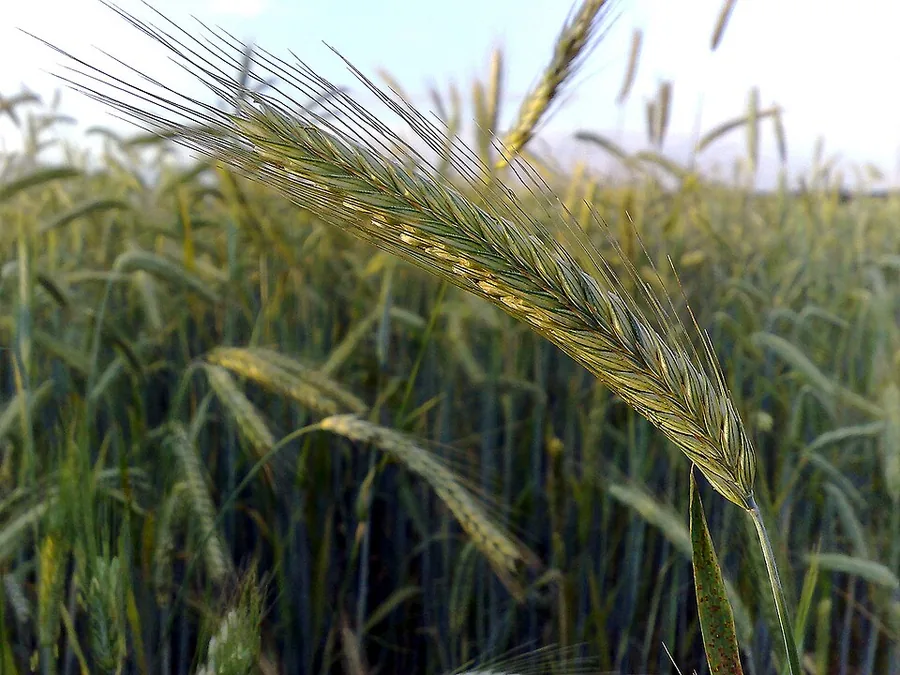
Cereal rye is the reference cover crop, a hardy annual grass in the same family as wheat and barley. Its value rests on a low germination threshold and broad edaphic tolerance: it germinates in cold soil, establishes on poor ground, and overwinters farther north than any other cover crop. Sown over a bare bed in fall, it covers the dormant season and protects the surface until spring.
The agronomic payoff comes from root and shoot working in tandem. A dense fibrous root system scavenges residual soil nitrogen before leaching removes it, while heavy top growth suppresses weeds by shading them out. During spring decomposition the residue returns organic matter and releases allelochemicals that inhibit germinating weed seeds, the effect known as allelopathy.
The same vigor that makes rye productive makes termination timing the controlling variable. Kill it on schedule and the result is clean soil and a uniform mulch; allow it to set seed and it becomes a weed in the next crop. The management burden lies almost entirely in the calendar rather than in day-to-day care.
Care
The short version: direct-sow it in fall into full sun and almost any soil, let rainfall meet its water needs, withhold fertilizer entirely, and terminate at flowering before seed set.
Light
Site rye in full sun for the densest stand and the strongest weed-suppressing canopy. It tolerates some shade, but the open, sunny position is where the crop delivers its full effect.
Water
Rye subsists on natural rainfall and needs almost no supplemental water once established. Its drought tolerance exceeds that of wheat, so once sown it can be largely left to the weather.
Soil
Few cover crops are this broadly adapted. Rye grows in loam, sand, heavy clay, and even shallow rocky or poorly drained ground, and it outperforms other cover crops on infertile, sandy, or acidic soil. It performs across a pH range of 5.0 to 7.0.
Temperature
This is a cool-season grass by physiology. It germinates at temperatures as low as 34°F (1°C) and continues vegetative growth up to roughly 86°F (30°C), the trait that permits very late sowing with reliable establishment before winter.
Humidity
Ambient outdoor humidity is sufficient, so there is nothing to regulate. Good airflow through a dense stand lowers the risk of foliar disease, though rye rarely develops it in the first place.
Feeding
Withhold fertilizer from cereal rye. Grown as a soil-builder it receives no feed at all, and instead scavenges residual soil nitrogen, capturing nutrients that would otherwise leach over winter.
Pruning
Rye is not pruned but terminated. At spring flowering, mow, roll or crimp, or till it under to kill it before seed set, which prevents reseeding and forestalls nitrogen tie-up in the following crop.
Repotting
none
Size & spacing
Drilled thickly as a cover crop, rye forms a continuous stand rather than discrete spaced plants. It elongates from a low fall clump to 1.5 to 6 feet (45 to 180 cm) tall by spring before termination.
When to plant
Rye follows a fall-to-spring phenology, inverse to most garden crops. Sown late, even after the first hard chill, it germinates in cold soil and overwinters as a low vegetative clump. Rapid elongation resumes as spring temperatures climb, and that bolting phase is the signal to terminate before seed heads develop.
Northern hemisphere
Southern hemisphere
Typical months for a temperate climate: start earlier in warm zones, later where spring frosts linger.
- Sow: Not started indoors; direct-sown.
- Plant: Late summer through fall (later than most cover crops); to midwinter in zones 8 and warmer.
- Harvest: Bolts and heads in spring; terminated before seed set rather than harvested.
Hardiness
USDA hardiness zones: 3–8
Temperature: down to -40°C
Troubleshooting
Rye carries little pest or disease load of its own, so nearly every problem in this crop is a timing error rather than a care fault. Terminate too late and an easy cover crop becomes a woody, nitrogen-immobilizing residue that penalizes the following planting. The diagnostics below let you intervene before seed set.
Overmature rye turns woody and resists termination
Past anthesis the stem lays down lignin and cellulose, which is why late rye reads as stiff and fibrous and fights back against a single kill pass. That same shift drives nitrogen tie-up: as the high-carbon residue decomposes, soil microbes immobilize available nitrogen to build their own biomass, and the following crop goes short. Terminate at flowering by mowing, rolling, or tilling, allow at least 10 to 14 days before planting so decomposition can begin, and apply a little starter nitrogen to buffer the immobilization.
Fix:
- Terminate at the right stage by mowing, rolling/crimping, or tilling at flowering before seed set
- Terminate at least 10-14 days before planting the following crop to allow decomposition
- Add starter nitrogen or apply nitrogen early to the following crop to offset immobilization
Rye allelopathy suppresses small-seeded crop stands
The mechanism here is allelopathy: decomposing rye residue releases phytotoxic compounds that inhibit germination, and small-seeded species such as carrots, lettuce, and onions absorb a proportionally larger dose than transplants or large seeds, whose reserves carry them past the effect. Because the compounds break down in the soil, suppression is transient and generally resolves within roughly 30 days. Delay direct-seeding small crops by two to three weeks, or rely on transplants and large-seeded crops during that interval.
Fix:
- Wait about 2-3 weeks (allelopathy generally tapers off within roughly 30 days) before sowing small-seeded crops
- Use transplants or large-seeded crops, which are far less susceptible
- Allow rye residue to decompose before direct-seeding small crops
Living rye bridges pests to the next grass crop
Because rye is a grass, it can host the same insects and pathogens as a following grass crop like corn or wheat, forming a green bridge that carries them across a rotation with no break in living host tissue. The pressure peaks when the interval between termination and planting is only a few days, leaving the pests no time to decline. Terminate well ahead of the next grass crop so the residue senesces and the host bridge collapses before the new stand emerges.
Fix:
- Terminate rye well ahead of planting the next grass crop to break the green bridge
- Allow time between termination and planting so the host residue declines
Toxicity
Cereal rye is a food grain and forage grass with no toxic principle, so it is appropriate around pets, children, and most grazing animals. The one qualifier is ergot, a fungal infection of the seed heads that renders the grain toxic in quantity, a concern concentrated in livestock and horses grazing heavily headed rye. Clean foliage and screened grain carry no such hazard.
Safe for
People · Cats · Dogs · Horses · Rabbits · Livestock · Birds
Cats None
The foliage holds no toxic principle, so a cat that browses the blades faces no poisoning. Cereal rye sits well outside the toxic-plant lists.
Dogs None
As a food-crop grass, rye presents no toxin to dogs. Grazing on it does nothing worse than the transient stomach upset any dog gets from overeating grass.
Horses Caution
Clean rye pasture and forage are appropriate for horses. The qualification is ergot: infected heads carry alkaloids that, consumed in quantity, constrict circulation, cause lameness, and threaten pregnant mares, so exclude horses from heavily headed, ergot-spotted rye.
Rabbits None
The green blades are a safe grass forage for rabbits, carrying no toxic compounds. Grazing them poses no physiological risk.
Livestock Caution
Cattle, sheep, and goats graze rye as a standard forage without issue. The hazard concentrates in ergot in mature seed heads, where dark sclerotia hold the alkaloids responsible for ergotism, so restrict access to ergot-infected grain rather than the leafy growth.
Birds None
Rye grain is an established feed for poultry and wild birds, and the plant carries no toxin to either. Clean seed and foliage present no hazard.
People Safe
Rye is a staple food grain, milled into flour for bread and safe to consume. The sole caution is ergot-contaminated grain, which food-grade screening removes, so any grain bearing dark sclerotia should be rejected.
Like other cereal grasses, rye seed heads can occasionally be infected by ergot (Claviceps purpurea), a fungus whose dark sclerotia produce toxic alkaloids that can cause ergotism in livestock and people if contaminated grain is eaten; this is a grain-consumption concern, not a risk from the cover-crop foliage. Rye pollen can also be a mild seasonal allergen.
Varieties
Most cereal rye moves through the trade as unnamed cover-crop seed, but several cultivars have been selected for specific climates and functions. The following are the ones worth knowing.
Aroostook
An early-maturing northern cultivar selected for exceptional cold hardiness, and among the most widely deployed cover-crop ryes through the mid-Atlantic and cooler regions.
Wheeler
A tetraploid cover-crop type developed in Michigan and favored across the mid-Atlantic.
Elbon
A southern cultivar adapted to Oklahoma and Texas whose root system functions as a trap crop for root-knot nematodes, maturing roughly two weeks before Abruzzi.
Wrens Abruzzi
A Georgia selection adapted to the Southeast, where it performs strongly, though its cold tolerance in the North is poor.
How to propagate
Rye is propagated one way, and it is the straightforward one: direct seeding onto the soil surface. Its cold tolerance is high enough that sowing can extend well past the point at which most species have finished for the year.
SeedEasy
Direct-sow in late summer to fall, later than most cover crops; germinates and establishes in cold soil. · Germinates quickly in fall and establishes before winter; resumes fast growth in spring.
Cereal rye is propagated by direct seeding, and its standing as the most cold-hardy cover crop available comes down to a germination threshold low enough to work in cold soil. Sown in late summer or fall, later than practically any other cover crop, it germinates rapidly and forms a low overwintering clump before the season closes. That same cold tolerance is what allows a very late sowing to still establish and then resume vigorous growth once spring temperatures return.
Myths
Cereal rye and ryegrass are the same plant.
Beyond the shared common name, the two are distinct taxa. Cereal rye is Secale cereale, the tall, cold-hardy species used as both a cover crop and a bread grain, whereas ryegrass belongs to the genus Lolium and is grown chiefly for turf and forage. They are separate grasses, and Lolium has no role in a vegetable rotation.
Sources
- NC State Extension Gardener Plant Toolbox
- USDA SARE - Managing Cover Crops Profitably
- Penn State Extension
- Iowa State University Extension - Integrated Crop Management
- Kansas State University Agronomy eUpdate
- Texas A&M AgriLife Extension - Bexar County
- ASPCA Animal Poison Control - Toxic and Non-Toxic Plants