Bulb · Amaryllidaceae
Nerine
Nerine bowdenii
Held crowded and undisturbed in full sun, nerine rewards the fall border with pink.
Full sun
Every 5–10 days
USDA 7–10
14–20 in · 36–51 cm
Overview
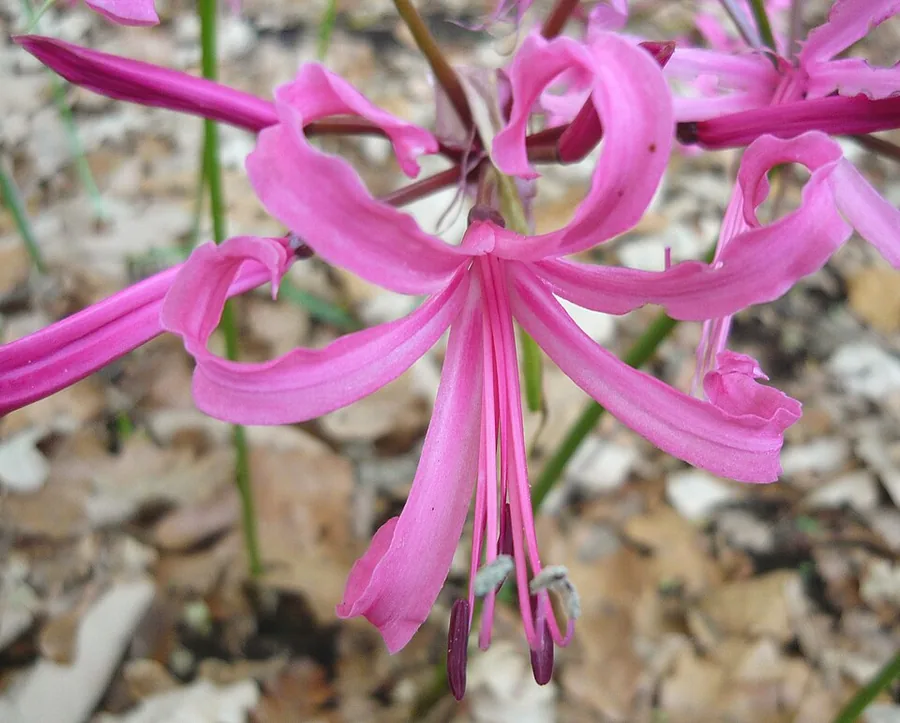
Nerine flowers as the surrounding garden enters decline, which accounts for much of its value. These South African bulbs throw up leafless scapes in fall, each terminating in a loose umbel of pink, lily-like flowers with narrow, faintly undulating tepals. Its strappy leaves are seasonal and often emerge apart from the flowers, either before or after them rather than in concert.
Among its relatives, Nerine bowdenii is the cold-hardy species, tolerating temperatures to roughly 25°F (-4°C) and performing in a sunny border across zones 7 through 10. It arises from a bulb that flowers best when its neck sits above the soil line, because shallow planting exposes the neck to warmth and prevents the burial that suppresses flowering.
Sited correctly, the plant is undemanding. It wants full sun, sharp drainage, and room to crowd into a congested clump, after which minimal intervention serves it best. Frequent lifting and division works against that crowding and sacrifices the flowering it exists to produce.
Care
The short version: full sun, sharp drainage, and a shallow bulb with its neck above the soil. Water through the growing season, hold it dry in dormancy, and keep the clump crowded and undisturbed so it can flower.
Light
Nerine requires full sun for reliable flowering, though it tolerates light afternoon shade. Growing-season light drives the photosynthesis that fills the bulb and initiates the following year's flowers, so a shaded position undercuts bloom at its source.
Water
Irrigate freely while the foliage is in active growth, then withhold water once the bulb goes dormant, since a dormant bulb takes up nothing and standing moisture invites rot. The species is drought tolerant yet still needs consistent moisture in growth, roughly every 5 to 10 days during dry weather.
Soil
Grow it in rich, well-drained loam amended with organic matter. Drainage is the decisive factor, because bulbs held in saturated soil rot rather than store, so a free-draining profile protects the storage organ.
Temperature
As the hardy species, Nerine bowdenii endures cold to about 25°F (-4°C) and heat to roughly 86°F (30°C). Below 25°F (-4°C) the bulb is prone to freezing injury, so apply mulch or grow it in movable containers where winters run colder.
Humidity
Ordinary outdoor humidity is adequate, and the record sets no target figure. As a dry-climate geophyte, the plant depends on soil drainage rather than atmospheric moisture.
Feeding
Apply a dilute balanced fertilizer during active leaf growth, once or twice per season, to support bulb development. Suspend feeding through dormancy, when the bulb is not drawing up nutrients.
Pruning
Cut away the spent flower stalks after bloom, but allow the foliage to yellow and senesce naturally. The fading leaves translocate reserves back into the bulb for next year's flowering, so removing them early depletes that store.
Repotting
Because flowering improves with congestion, leave the bulbs undisturbed for several years at a time. Lift and replant only when the bulbs crowd up to the soil surface or when flowering vigor declines after a long uninterrupted run.
Size & spacing
Scapes reach 14 to 20 inches (36 to 51 cm) in height, while the narrow foliage occupies only 1 to 3 inches (3 to 8 cm) in spread. Space the bulbs closely so they can develop the congested clump that favors flowering.
When to plant
Nerine follows an autumn flowering cycle. Establish the bulbs in spring with the neck proud of the soil, irrigate through the growing season to build the bulb, and the scapes emerge in fall, from September into November.
Northern hemisphere
Southern hemisphere
Typical months for a temperate climate: start earlier in warm zones, later where spring frosts linger.
- Sow: sow fresh seed when ripe; seedlings take 3-4 years to flower
- Plant: spring, with the bulb neck above the soil line
- Harvest: fall (September to November)
Hardiness
USDA hardiness zones: 7–10
Temperature: down to -18°C
Troubleshooting
Nearly every nerine problem originates at the bulb, whether from disturbance, excess moisture, or a pest reaching it. Identify the case below, then intervene while the bulb tissue remains firm and viable.
Softened, hollowed, or rotting bulbs
A bulb gone soft or hollow has generally been colonized by narcissus bulb fly larvae, which bore into the basal plate and consume the storage tissue from within, or it has rotted after standing in wet soil through dormancy. Lift the bulbs and examine each for larval tunnels and softened, decaying tissue. Discard every infested or rotted bulb, suspend irrigation as soon as the bulb enters dormancy, and reset the remainder into a sharper-draining medium.
Fix:
- Discard infested or rotted bulbs
- Withhold water while bulbs are dormant
- Improve drainage of the growing medium
Strong foliage, no flowering
Vigorous leaves paired with no bloom point to a recently lifted or split bulb, because division sets back flowering by about a season while the disturbed bulb rebuilds its reserves. A second explanation is a clump that has not yet grown crowded, since nerine sets the most flowers once the bulbs press against each other. Correct it by leaving the planting intact and keeping it in full sun across the whole growing season, and flowering resumes.
Fix:
- Leave clumps undisturbed and allow them to become crowded
- Site in full sun during active growth
- Avoid unnecessary division
White cottony colonies in the leaf axils
White, waxy masses lodged in the leaf axils and around the bulb neck are mealybugs, and nerine ranks among the most susceptible hosts, so infestations recur readily. Displace the colonies mechanically with a cotton swab charged with rubbing alcohol, then apply insecticidal soap or horticultural oil to reach survivors. Segregate the affected plant until the population is cleared, because the pest spreads to neighboring stock.
Fix:
- Wipe off colonies with a cotton swab dipped in rubbing alcohol
- Treat with insecticidal soap or horticultural oil
- Isolate affected plants
Toxicity
Regard the entire plant as poisonous. In common with its daffodil and amaryllis relatives, nerine contains lycorine and related alkaloids, and these concentrate most heavily in the bulb. Ingestion of any part induces salivation, vomiting, and diarrhea, so keep the bulbs from pets, livestock, and children, and never let anyone mistake them for onions in the kitchen.
Toxic to
Cats · Dogs · Horses · Rabbits · Livestock · Birds · People
Cats Toxic
In cats, ingestion of any part typically provokes salivation followed by vomiting and, shortly after, diarrhea. Because lycorine concentrates in the bulb, an exhumed bulb presents the greatest hazard.
Dogs Toxic
Dogs that excavate and chew the bulbs receive the highest dose, producing pronounced salivation, vomiting, and diarrhea. Ingestion of an entire bulb can sustain emesis over several hours.
Horses Toxic
The same alkaloids irritate the equine digestive tract, eliciting salivation, colic-like discomfort, and diarrhea. Exclude clippings and lifted bulbs from any paddock access.
Rabbits Toxic
Rabbits must be denied the foliage and bulbs, which induce salivation and marked gastrointestinal upset. The plant does not qualify as safe browse for them.
Livestock Toxic
In grazing stock such as cattle, goats, and sheep, the foliage and bulbs cause salivation, vomiting where anatomically possible, and scouring. Fence the bulbs out of any area accessible to stock.
Birds Toxic
The lycorine content renders the plant unsafe for birds, so exclude pet and poultry birds from all contact with the leaves and bulbs.
People Caution
No part of nerine is edible, and the bulb in particular can produce salivation, vomiting, and diarrhea if ingested. Prevent children from confusing the bulbs with onions, and wash your hands after handling.
Keep bulbs and plants away from pets and children; the bulb is the most toxic part.
Helpline numbers

United States
ASPCA Animal Poison Control: (888) 426-4435 (fee applies)
Poison Control: (800) 222-1222



Canada
Poison Centres: 1-844-764-7669
Varieties
Pink dominates the species, but several named selections merit attention for their flower color or size.
Alba
A white-flowered selection that departs from the pink coloration typical of the species.
Mark Fenwick
A vigorous cultivar valued for its robust flowering stems and deeply pink flowers.
Pink Triumph
Distinguished by flowers appreciably larger than those of the unimproved species.
How to propagate
Nerine is increased vegetatively from its offset bulbs, or, for the patient, from seed.
Offsets & pupsEasy
After flowering or during dormancy · May delay blooming for a year after separation
The most dependable method is vegetative: lift a crowded clump after flowering or during dormancy and detach the offset bulbs from the parent. Because nerine flowers best when crowded and resents disturbance, separate only when the clump is genuinely congested, and anticipate that the divided offsets will forgo a season of bloom before flowering resumes.
DivisionModerate
After flowering or during dormancy · Often skips a year of bloom after division
An overcrowded clump may be split after bloom or during dormancy, but do so infrequently. Since flowering peaks in undisturbed plantings, a divided clump often skips a year of bloom while it re-establishes before returning to form.
SeedDemanding
Sow fresh seed when ripe · 3-4 years until seedlings flower
Seed propagation demands patience. The large, fleshy seeds are recalcitrant and will not store, so sow them fresh at ripening, then allow 3 to 4 years for a seedling to attain flowering size.
Myths
Nerine bulbs must be divided regularly to keep them blooming.
The record shows the opposite: these bulbs resent disturbance and flower most freely when crowded. Scheduled division interrupts that crowding and generally forfeits a year of bloom while the split bulbs recover. Reserve division for a clump that has genuinely outgrown its space.