Bulb · Amaryllidaceae
Red Spider Lily
Lycoris radiata
Seat each bulb with the neck above the soil, and leafless scapes will lift fiery red flowers in early fall.
Partial shade
Every 7–14 days
USDA 6–10
12–24 in · 30–61 cm
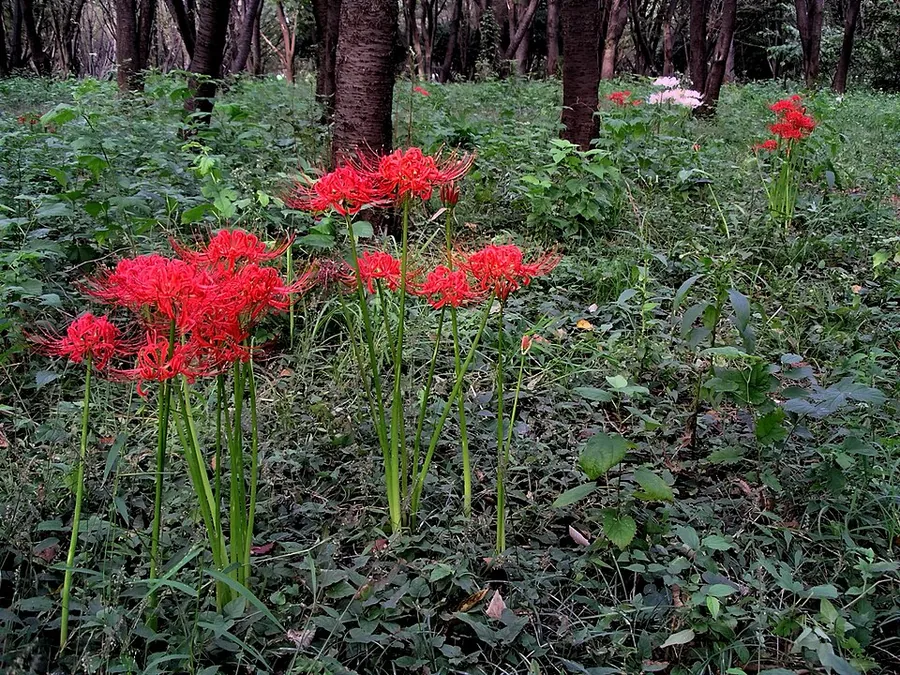
Overview
Lycoris radiata is a fall-flowering bulb in the amaryllis family whose display depends on leafless scapes that push up after the first cool rains and open into clusters of scarlet, spidery flowers. The leaves and flowers run on separate cycles, so the foliage has already died down by the time the scapes appear, and the flowers seem to rise straight from open soil.
The plant follows what amounts to a reversed calendar. Strappy leaves emerge in fall and photosynthesize through winter, then die back by late spring, and the bulb passes the summer heat dormant. That inverted rhythm is exactly why leafless scapes break ground as summer turns to fall, and it explains the names naked lily and surprise lily.
Hardy across roughly zones 6 to 10, the bulbs naturalize readily, returning each year and forming progressively wider clumps as offsets accumulate. The single limiting factor is drainage, since a dormant summer bulb held in wet soil rots. Site the bulbs in well-drained ground with the neck above the surface, and little further intervention is required.
Care
The short version: set the bulbs in fall with the neck exposed in rich, well-drained soil, provide partial shade to full sun, water through leaf growth and bloom, then withhold water so the bulb stays dry through its summer dormancy.
Light
Partial shade suits Lycoris radiata best, though it tolerates full sun to partial sun. Dappled light beneath high-canopy trees mimics its preferred exposure, and because flower initiation depends on adequate light, a clump sunk in deep shade will often produce leaves but stop blooming.
Water
Supply medium moisture through leaf growth and bloom, roughly every 7 to 14 days as the surface dries, since the active foliage needs water to build bulb reserves. Once summer dormancy begins, withhold irrigation and let the soil stay fairly dry, because a resting bulb in saturated soil is the direct path to rot.
Soil
Grow it in organically rich, well-drained loam or sand. It is indifferent to pH across 6.0 to 8.0, so that is rarely limiting, but drainage is decisive, since standing water around a dormant bulb causes decay, so amend heavy ground with grit or compost to move water through.
Temperature
The bulb is hardy over a broad thermal range, enduring winter lows near -9°F (-23°C) and summer highs around 86°F (30°C). That span brackets most temperate gardens within its zones, so once established the plant is rarely limited by ambient temperature.
Humidity
Ambient outdoor humidity is sufficient, and no target level applies. Soil drainage governs its health far more than air moisture, because the determining risk is a waterlogged root zone rather than dry or humid air.
Feeding
Apply a balanced bulb fertilizer in fall and again in spring, timed to the foliage phase when the plant is photosynthesizing and loading the bulb for next season's flowers. A seasonal feed during that leaf growth meets its full nutritional need.
Pruning
Formative pruning is unnecessary. Allow the foliage to die back on its own after bloom, since the senescing leaves are translocating reserves into the bulb, and remove only the spent scapes and withered leaves once that process is complete.
Repotting
This bulb flowers best when undisturbed, so lifting sets it back. Divide only every 3 to 5 years, or sooner when the diagnostic signs appear: crowded bulbs, declining flower count, or bulbs heaving above the soil surface.
Size & spacing
12–24 in (30–61 cm) tall
When to plant
This bulb keeps an inverted seasonal cycle. Plant in late summer to fall, allow the leaves to work through winter and fade by spring, and expect leafless scapes to emerge in late summer or early fall as the reserves built by that foliage drive the bloom.
Northern hemisphere
Southern hemisphere
Typical months for a temperate climate: start earlier in warm zones, later where spring frosts linger.
- Plant: Plant bulbs in late summer to fall with the bulb neck exposed above soil level
- Harvest: Late summer to early fall (August to September)
Hardiness
USDA hardiness zones: 6–10
Temperature: down to -23°C
Troubleshooting
Nearly every spider lily problem originates at the bulb, which either rots in saturated soil or sits at an incorrect depth. Because the causes are physical rather than infectious, a single lift usually reveals and corrects them. Read the signs, identify the mechanism, then act before the whole clump declines.
Soft, decaying bulbs that fail to resume growth
The disorder is bulb rot, a physiological breakdown driven by excess water rather than a pathogen you can treat with a spray. A bulb held in saturated soil through summer dormancy decays from the interior, turning brown and foul. Lift the clump, cull every softened bulb, and reset only the firm ones in well-drained soil with the neck exposed.
Fix:
- Lift affected bulbs and discard any that are soft or rotted
- Replant healthy firm bulbs in well-drained soil with the neck exposed
- Withhold water during the summer dormant period
Hollowed, tunneled bulbs with weak or absent growth
The agent is the narcissus bulb fly, whose larva tunnels into a bulb and consumes its center, so the growing point is destroyed from within. A dissected bulb typically shows one large grub in a soft, hollowed core. Destroy infested bulbs, replant only firm stock, and cultivate the surrounding soil to expose pupae and break the cycle.
Fix:
- Lift and destroy infested bulbs
- Replant only firm, healthy bulbs
- Cultivate soil around plantings to expose pupae
Vigorous foliage yet few or no flowers
Healthy leaves with absent bloom point to bulbs set too deep, since this species initiates flowers only when the neck sits at or above the soil line. Reset the bulbs shallow with the neck exposed and thin any overcrowding. A recently lifted clump also needs a season or two to re-establish reserves before it flowers reliably.
Fix:
- Replant bulbs with the top of the neck exposed above soil level
- Allow a few seasons for clumps to establish before expecting bloom
- Thin overcrowded clumps and site in full sun to partial shade
Toxicity
Regard the entire plant as poisonous. Every part carries lycorine and related Amaryllidaceae alkaloids, concentrated most heavily in the bulb, so it is unsafe for cats, dogs, horses, rabbits, livestock, birds, and people. Wear gloves when handling the bulbs, since that is where the alkaloid load is highest, and keep them beyond the reach of pets and children.
Toxic to
Cats · Dogs · Horses · Rabbits · Livestock · Birds · People
Cats Mild
A cat ingesting any part typically shows salivation, vomiting, and diarrhea from the lycorine. The bulb holds the highest alkaloid concentration, so a large dose can escalate to tremors or convulsions.
Dogs Mild
A dog that chews foliage, or ingests a bulb it has dug up, commonly drools, vomits, and passes loose stools. Because alkaloid content peaks in the bulb, a substantial dose can progress to tremors or seizures.
Horses Toxic
The same lycorine in leaves and bulbs affects horses strongly, producing heavy salivation, colic-like abdominal pain, and diarrhea. Exclude grazing animals from any planting.
Rabbits Toxic
Rabbits are not exempt, since even a small quantity of leaf or bulb can cause salivation, appetite loss, and gastrointestinal upset, so exclude them from the plants entirely.
Livestock Toxic
Cattle, goats, and sheep that graze the foliage or unearth bulbs may salivate, scour, and weaken as the alkaloids act. Keep stock off ground planted with these bulbs.
Birds Toxic
The alkaloids are toxic to birds as well, so a parrot or backyard fowl pecking any part risks vomiting and digestive distress. Deny birds access to the plant and its bulbs.
People Caution
No part of the plant is edible. Ingesting foliage or, most seriously, the bulb produces nausea, vomiting, and diarrhea, so wash hands after handling and keep children away from the bulbs.
Wear gloves when handling and dividing bulbs and wash hands afterward; keep bulbs out of reach of pets and children.
Helpline numbers

United States
ASPCA Animal Poison Control: (888) 426-4435 (fee applies)
Poison Control: (800) 222-1222



Canada
Poison Centres: 1-844-764-7669
Varieties
Most gardens hold a single form of the red spider lily, yet a second exists whose reproductive biology sets it apart around seed production.
Lycoris radiata var. radiata
This is the common garden form, a sterile triploid that rarely sets seed and increases instead through the steady multiplication of offset bulbs.
Lycoris radiata var. pumila
This is a smaller, fertile diploid that does set viable seed, which is why it is the form breeders select for crosses.
How to propagate
The reliable route is vegetative, since the bulbs increase by offsets and a crowded clump can be divided into new plants. Seed works only on fertile forms and demands patience, because the common garden type does not set viable seed.
Offsets & pupsEasy
Early summer when foliage has died back and bulbs are dormant · One to a few growing seasons before reliable bloom
Offsets are the most dependable method, because the bulbs naturalize and multiply on their own. In early summer, once the foliage has died back and the bulbs are dormant, lift a clump, detach the offset bulbs, and replant each with the neck exposed. Expect one to a few growing seasons before the young bulbs bloom reliably, since they must first rebuild reserves.
DivisionEasy
Summer dormancy after foliage dies back · One to a few growing seasons
Divide a clump once it becomes crowded, working during summer dormancy after the leaves have withered, and replant the sections immediately to limit desiccation. Flowering commonly pauses for a season or two while the divisions regenerate roots and reserves.
SeedDemanding
When ripe, on fertile diploid forms only · Several years to flowering
Seed is the demanding route and seldom practical. The common garden triploid is sterile and rarely sets viable seed, so this method applies only to fertile diploid forms, and even then the seedlings need several years of growth before the first flower.
Myths
The red spider lily is merely another name for the surprise lily.
The two are distinct species with different hardiness. Lycoris radiata bears red flowers and tolerates far less cold, whereas Lycoris squamigera blooms pink-lilac and is markedly hardier, so their cold limits and culture should not be treated as interchangeable.
The plant is safe because pets generally avoid it.
Avoidance is behavioral chance, not a safety margin. All tissues contain toxic lycorine alkaloids, with the bulb the most concentrated, so a cat or dog that does ingest it can develop salivation, vomiting, and diarrhea. Site and store it accordingly.