Vegetable · Apiaceae
Carrot
Daucus carota subsp. sativus
Build it deep, loose soil and a steady drink of water, and the carrot answers with sweet, straight roots.
Full sun
Every 3–7 days
41–77°F · 5–25°C
60–80 days
Overview
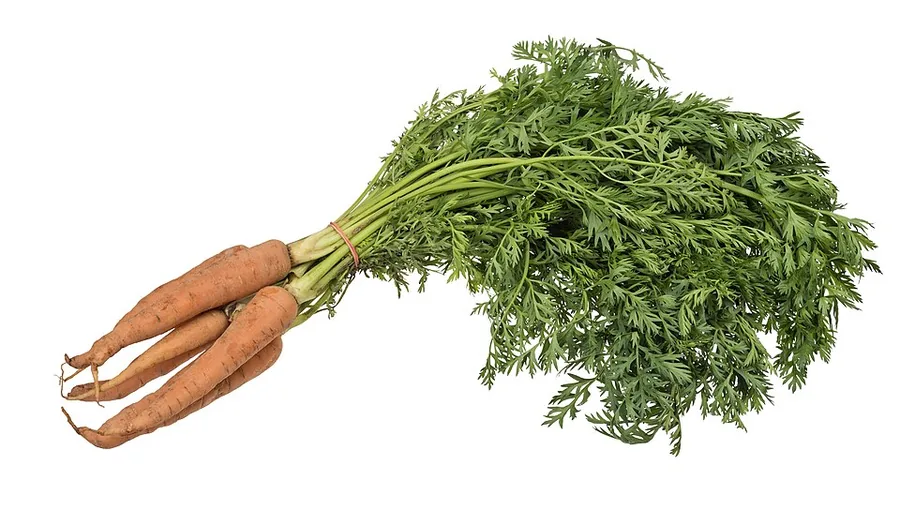
The carrot is a cool-season root crop, all feathery foliage above and a long, sweet taproot doing its work below the surface. It shares the Apiaceae family with parsley and dill, and its wild ancestor traces to Central Asia. Orange is only the familiar form, since the crop also runs to purple, red, yellow, and white.
Whether a carrot is easy or troublesome comes down to the medium it grows in. Deep, loose, stone-free ground lets the taproot drive straight, while heavy clay or buried rock turns it into a forked, stubby root. Prepare the bed properly and the rest of the job is largely waiting.
Treated as an annual, the carrot is in fact a biennial: you lift the root in its first year and never see a flower unless a plant overwinters into a second season. Sow the seed in its final spot, thin the stand, water without lapses, and aim the crop at cool weather for the sweetest roots.
Care
The short version: full sun and deep, loose, rock-free soil, even moisture of about an inch a week, seedlings thinned to give every root its space, and a low-nitrogen feed mixed in before sowing.
Light
Give carrots full sun, six hours or more daily, though a little afternoon shade is acceptable where summers turn hot. Heavy shade pushes lush foliage at the cost of root size, since the leaves drive root growth.
Water
Hold the soil evenly moist at about an inch (2.5 cm) of water a week, and water deeply so it reaches the whole root zone. Letting the bed cycle from bone dry to saturated stresses the root and is what produces bitter, tough, or split carrots.
Soil
This is where success is won or lost. Carrots need deep, loose, well-drained sandy loam clear of rocks, clods, and debris, at a pH of 6.0 to 6.8, because any heavy or compacted layer obstructs the taproot and forks or stunts it.
Temperature
As a cool-season crop the carrot is happiest from 41°F and 77°F (5°C to 25°C). It takes frost in stride, and a late-season chill converts stored starch into sugar, which is why cold sweetens the root.
Humidity
Ambient outdoor humidity is plenty, so there is no target to chase. What governs quality is even soil moisture at the root, not anything in the air.
Feeding
Mix a low-nitrogen balanced fertilizer such as 5-10-10 into the bed before sowing, with an optional side-dress at midseason. Too much nitrogen, or fresh manure, backfires by driving forked, hairy root growth.
Pruning
There is no pruning, but thinning is essential rather than optional. Once the tops reach about 2 inches (5 cm), thin the seedlings to 2 to 3 inches (5 to 8 cm) apart, snipping instead of pulling so the roots left behind are not disturbed.
Size & spacing
The foliage stands about 8 to 16 inches (20 to 40 cm) tall over the roots packed beneath it. Thin each plant to 2 to 3 inches (5 to 8 cm) apart so every root has the room to fill out.
When to plant
Carrots favor cool conditions and crop best at the ends of the season. Put in the first sowing a couple of weeks before the last spring frost, repeat every few weeks into midsummer, and the roots come in from early summer through fall, gaining sweetness from any frost they meet.
Northern hemisphere
Southern hemisphere
Typical months for a temperate climate: start earlier in warm zones, later where spring frosts linger.
- Plant: Direct sow outdoors 2-3 weeks before the last spring frost once soil is workable and at least 7°C (45°F); succession sow every 2-3 weeks through midsummer for a fall crop
- Harvest: Harvest roots at any usable size, typically 60-80 days after sowing; fall crops can stay in the ground into cool weather, which improves sweetness. Flowers only appear in the second year if roots are overwintered.
Hardiness
USDA hardiness zones: 3–10
Temperature: down to -40°C
Troubleshooting
Because most carrot faults develop out of sight in the root, the tops give little warning before harvest. Read the few signals that do appear above ground, and pull a sample root whenever something seems off. Match it to an entry below, then correct the bed ahead of the next sowing.
Rust-filled tunnels bored into the roots
Those narrow channels packed with rusty waste are larval feeding galleries left by carrot rust fly, whereas clean, rounded holes instead suggest wireworms. Lightly affected tissue cuts away, but heavily mined roots are best discarded. Because the adult fly lays eggs near the plants, a floating row cover from sowing blocks access, crop rotation breaks the cycle, and delaying the sowing past the first flight sidesteps the worst egg-laying.
Fix:
- Harvest promptly and discard heavily damaged roots
- Cut away lightly damaged tissue and use the remainder
Yellow contorted new leaves with bushy, hairy roots
These symptoms identify aster yellows, a phytoplasma moved from plant to plant in the saliva of feeding leafhoppers. The pathogen disorders growth, so inner foliage yellows and twists while outer leaves redden, and the root responds with a mass of hairy secondary roots and bitter flavor. No treatment exists, so pull and destroy infected plants, then exclude leafhoppers with row cover and strip out the weed hosts that harbor them.
Fix:
- Remove and destroy infected plants; there is no cure
Roots that turn bitter, woody, or small
Flavor and texture in a carrot track water and spacing directly. Swings between dry and wet soil stress the root and lay down bitter, fibrous tissue, while seedlings left unthinned compete for room and finish thin and tangled. Heat during the sizing phase compounds both faults. Restore a steady 2.5 cm (1 in) of water per week, thin to 5-8 cm (2-3 in) apart, and time the crop into cool weather for the best eating quality.
Fix:
- Resume deep, even watering of about 2.5 cm (1 in) per week
- Thin remaining seedlings to 5-8 cm (2-3 in) apart
Roots that fork, twist, or grow misshapen
A carrot root is a single taproot, so anything solid in its path forces it to divide and snake around the obstruction, which is why rocks, clods, and packed ground produce crooked, split roots. Fresh manure or surplus nitrogen triggers the same forking by overstimulating side-root growth, and root-knot nematodes will do it too. Open the bed up, lift out the stones before sowing, and the following crop runs straight down.
Fix:
- Harvest and use affected roots normally; flavor is unaffected by simple forking
- Deeply loosen and rake the bed, removing rocks and clods, before the next sowing
Greened crowns at the top of the root
Green shoulders are simply chlorophyll developing where the root crown emerges above the soil line and meets sunlight. The greening reaches only the top inch or so, and the remainder of the root stays sound once you cut that part off. Draw a little soil or mulch over the crowns as the roots fatten, and you block the light that starts the process.
Fix:
- Trim off the green portion before eating; the rest of the root is fine
Toxicity
Few garden plants are safer than the carrot. Root and feathery tops are both food, with nothing poisonous to pets, livestock, or children. The single caution is a large raw chunk, which can choke, so cut it down for small mouths.
Safe for
People · Cats · Dogs · Horses · Rabbits · Livestock · Birds
Cats None
There is nothing toxic in carrot for a cat, so a bit of cooked or grated raw root makes an innocuous treat. Most cats show little interest, and the one real concern is a large raw piece, which is a choking hazard, so reduce it to small bits.
Dogs None
A dog can take carrot raw or cooked without any difficulty, and a cold whole one serves as a low-calorie chew that many enjoy. Cut larger sections down so they are gentle on the teeth.
Horses None
Carrots have long been a standard horse treat and do no harm in reasonable quantities. Split them lengthwise into strips rather than coin-shaped rounds, which can lodge in the throat, and keep portions modest for an easy keeper.
Rabbits None
For a rabbit the feathery tops are the more suitable food, since the root carries a lot of sugar and suits only an occasional nibble. None of it is toxic, just rich, so keep the orange part to a small amount.
Livestock None
Cattle, goats, sheep, and pigs eat carrots and their tops with no poisoning risk at all. Bring them in gradually and chop them so a greedy animal cannot choke on a whole root.
Birds None
Backyard hens and parrots may eat carrot freely, and the deep-colored flesh supplies vitamin A. Grate or finely chop it so smaller birds can handle it, and the feathery tops are fine to offer as well.
People None
Carrots are a routine vegetable that all ages eat raw or cooked with nothing to monitor. Consuming a great many over time can lend the skin a faint orange cast, which is harmless and fades once intake drops.
No special handling required.
Varieties
Carrot cultivars are shaped to suit different soils, from the long supermarket types down to stubby roots that cope with heavy ground. These are the selections worth knowing by name.
Danvers 126
A tapered root of about 6 to 7 inches (15 to 18 cm) that handles dense, heavier ground far better than the long, slender types.
Scarlet Nantes
The standby home-garden carrot, prized for sweet, crisp, cylindrical roots that finish in a blunt tip and eat well fresh from the row.
Imperator types
The long, tapering supermarket carrot, which only sizes up straight where the soil is deep, loose, and clear of stones.
Red Cored Chantenay
A short, broad-shouldered root suited to shallow or heavy ground where longer carrots would fail to develop.
Thumbelina
A round, golf-ball carrot that performs in containers and in the clay or stony beds where standard roots fork and stall.
Companions
Carrots do best beside onion-family plants that throw off the carrot rust fly, and quick crops like radish that share the row while the slow seed germinates.
Plant near
onion: Onion-family plants interplanted with carrots are traditionally used to help deter carrot rust fly
leek: Like onions, leeks are used in extension companion guides to help confuse and deter carrot rust fly
radish: Fast-germinating radishes sown beside slow carrots mark rows and save space; cited as a space-saving intercrop by UMN Extension
lettuce: Shallow-rooted lettuce shares bed space without competing with the deep carrot taproot
Keep apart
dill: Some extension companion guides advise keeping dill away from maturing carrots; the related species may cross-react and dill can attract pests of the carrot family
How to propagate
Carrots increase by one route only, seed sown directly into the ground, since the taproot will not put up with being lifted and moved.
SeedEasy
Early spring through midsummer, once soil is at least 7°C (45°F) · Germination in 1-3 weeks; roots reach usable size in about 60-80 days
Seed is the only route to more carrots, sown straight into the bed because the taproot will not survive transplanting. Set it about a quarter inch (6 mm) deep any time from early spring through midsummer once the soil reaches 45°F (7°C), and hold the surface evenly damp across the slow 1 to 3 weeks it takes to germinate. After emergence the roots size up to harvest over roughly 60 to 80 days.
Myths
Carrots can be started indoors and set out as transplants the way tomatoes are.
Lifting a young carrot interferes with the slender taproot at the very moment it is trying to push straight down, which leaves you with a forked or stunted root. The taproot will not recover from the move, so carrots are sown directly in their final position and thinned in place rather than relocated.
Every carrot must be dug before the first frost or it is spoiled.
Fall carrots shrug off a light frost without harm. Cold actually prompts the root to convert stored starch into sugar, so the longer the roots sit in cool soil the sweeter they get, and across many regions digging can continue well into late fall.