Herb · Apiaceae
Dill
Anethum graveolens
Sow it once and let it run: dill germinates fast, flowers in heat, and seeds the next crop for you.
Full sun
Every 3–7 days
50–77°F · 10–25°C
40–90 days
Overview
Dill is a cool-season crop, and that single fact drives most of its care. The reason is physiological: rising heat and lengthening days signal the plant to switch from leaf to flower, the change called bolting, with drought and root stress hurrying it along. Spring and early fall keep it in the leaf-making phase, so a steady spring and fall rhythm gives you the longest harvest.
The plant grows a deep taproot, and that anchors the whole approach. A taproot stores reserves and drives straight down, but it has few fine roots to recover from being lifted, so disturbance shocks the plant and often triggers early bolting. That is why dill goes straight into the ground where it will finish, rather than being raised in cells and moved.
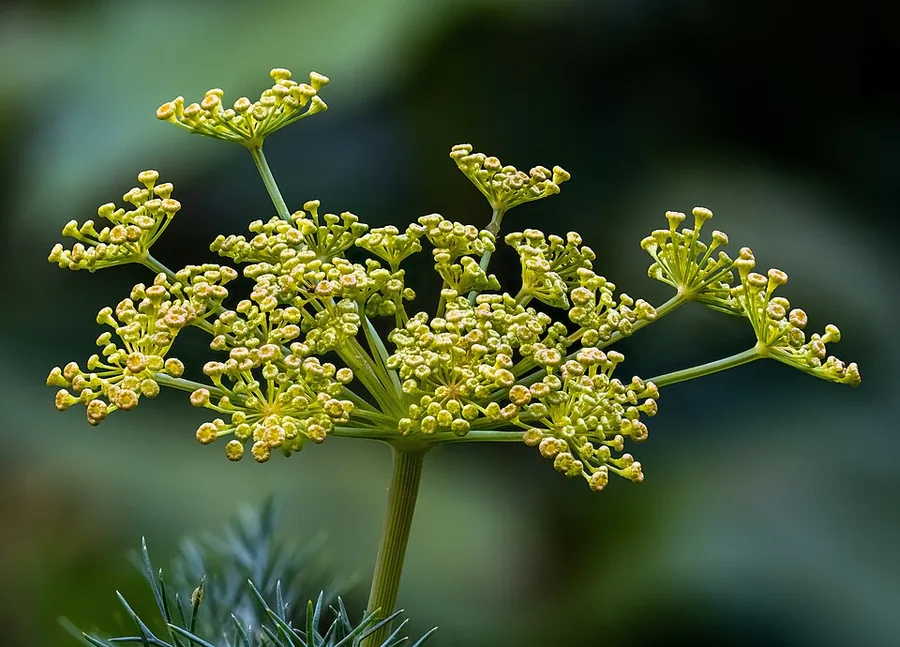
To keep tender leaf coming, sow in succession every couple of weeks through the cool season. Each fresh sowing replaces a stand that is starting to stretch toward flower. If you let a few plants run all the way to mature umbels, the ripe seed drops and stands in for next year's sowing.
Care
The short version: dill wants full sun, cool temperatures, and evenly moist, well-drained soil, sown directly because the taproot resents being moved. Pinch the foliage often to slow the flowering response, feed it lightly, and succession-sow every couple of weeks for a steady leaf supply.
Light
Dill performs best in full sun, six or more hours of direct light, which keeps the plant dense and leafy. A little afternoon shade is acceptable in hot summers and can even take the edge off the heat that triggers bolting. Starve it of light and the cost shows quickly: the plant turns thin and floppy, flowers early, and yields far less foliage.
Water
Aim for even moisture, roughly an inch of water a week, with the closest attention during germination and the seedling stage while the root system is still shallow. The reason matters: drought is a direct bolting trigger, so a plant that dries out repeatedly flowers before it has made much leaf. Steady soil moisture keeps it in the leafy phase longer.
Soil
Plant into well-drained, fertile loam enriched with organic matter, holding the pH between 5.5 to 6.5. Texture counts as much as fertility, because loose, open ground lets the taproot run straight down and anchor the tall stems. Compacted soil checks that root, and a checked root tends to bolt early.
Temperature
Dill holds its leafy phase between 50°F to 77°F (10°C to 25°C), the band where it stays focused on foliage. Climb past that range and the plant reads the heat as a cue to reproduce, shifting from leaf to flower and bolting. Keeping it inside the cool window is the most reliable way to stretch the harvest.
Humidity
Average outdoor humidity of 40% to 70% suits dill, and the exact figure barely matters. Airflow does the real work. Crowded, still plantings keep the foliage damp and set up fungal trouble, so spacing for air movement does more good than any attempt to manage humidity itself.
Feeding
Dill is a light feeder, and one balanced feed or a dose of compost worked in at planting carries it through. Pushing it backfires: excess nitrogen drives soft, leggy stems that flop, a real liability on a plant this tall and hollow-stemmed. Modest fertility, not abundance, is what it wants.
Pruning
Pinch or cut the foliage often, because removing growing tips redirects energy back into leaf and keeps the plant bushy while delaying bolting. Whether you take off the flower heads is a deliberate choice: remove them for continued leaf, or leave the umbels to mature when seed is the goal.
Repotting
Dill is not repotted. As a direct-sown annual with a taproot that resents moving, it has no place in a repotting cycle, and confining that root to a pot risks stunting and fast bolting. Sow it where it will finish, and skip the container unless you choose a dwarf type bred to handle it.
Size & spacing
Expect 2 to 4 feet (60 to 120 cm) of height over a spread of 12 to 18 inches (30 to 45 cm), all carried on tall, hollow stems. Those hollow stems are exactly why you plant close: neighbors brace one another, and a stand holds up against wind far better than isolated plants do.
When to plant
Timing is the lever that decides whether you get leaf or seed, because temperature governs which phase the plant is in. Anchor sowings to the cool weather of spring and early fall, stagger them, and you keep the plant making foliage rather than racing to flower. Each window below works with that cool-season biology rather than against it.
Northern hemisphere
Southern hemisphere
Typical months for a temperate climate: start earlier in warm zones, later where spring frosts linger.
- Plant: Direct-sow in early spring after danger of hard frost; cool-season crop that bolts quickly in summer heat. Succession-sow every 2-3 weeks for continuous leaf harvest.
- Harvest: Cut leaves anytime once plants are established; yellow flower umbels form in summer, followed by seeds harvested as they ripen and turn brown.
Hardiness
USDA hardiness zones: 2–11
Temperature: down to -46°C
Troubleshooting
Most dill problems come from one of two roots: heat and stress that push the plant to flower, or soft, overfed growth that cannot hold itself up. The notes below name the mechanism behind each symptom, so the fix targets the cause and not just the surface sign. Match what you see, then act while it still changes the outcome.
Bolting: the plant runs to flower instead of leaf
Heat and long days are the bolting trigger, with drought or root stress speeding it further. The central stalk elongates and forms flower umbels while leaf growth slows to a halt. Counter the mechanism directly: harvest leaves early, sow in succession, hold moisture steady, and offer light afternoon shade in heat.
Fix:
- Harvest leaves promptly before flowering
- Succession-sow new plantings
- Provide consistent moisture and light afternoon shade in heat
Black swallowtail caterpillars feeding on the foliage
Green caterpillars marked with black bands and yellow spots are black swallowtail (Papilio polyxenes) larvae, and dill is one of their favorite host plants. The feeding looks dramatic but rarely sets a healthy plant back, since the foliage regrows. Relocate them or simply grow a few extra plants, because they finish as butterflies.
Fix:
- Hand-pick and relocate caterpillars if foliage loss is a concern
- Plant extra dill to share with larvae as a pollinator host
Aphids clustering on tender shoots
Small green or gray soft-bodied insects gather on new shoots and leave a sticky honeydew that signals aphids. Knock them off with a strong jet of water, and step up to insecticidal soap only when the infestation is severe. Easing off the nitrogen and encouraging ladybugs and other beneficials keeps later populations low.
Fix:
- Spray with a strong jet of water
- Apply insecticidal soap if severe
Lodging: tall stems bending or snapping at the base
A tall plant carried on hollow stems in an open, windy spot bends or snaps near the base, and rich soil worsens it by producing soft, leggy growth. Stake the tall plants, choose a sheltered position, and space them close so neighbors brace one another against the wind.
Fix:
- Stake taller plants
- Plant in a sheltered location
Toxicity
Dill is a culinary herb regarded as safe for people and pets, leaf and seed alike. The ASPCA does not list it among plants that poison cats or dogs, so household animals are not at risk. The one technical caveat is livestock: the foliage carries furanocoumarins, and very heavy grazing can cause mild photosensitivity.
Safe for
People · Cats · Dogs · Horses · Rabbits · Livestock · Birds
Cats None
Cats are safe around dill, since the ASPCA does not list it as toxic and the occasional nibble does no harm.
Dogs None
Dogs are safe, and the soft leaves are mild enough that some owners fold a little into homemade treats.
Horses Safe
Horses are safe, and dill sometimes appears as an ingredient in herbal feed blends.
Rabbits Safe
Rabbits are safe and tend to enjoy fresh dill as a treat, feathery leaves and all.
Livestock Mild
Livestock can eat dill safely, with one caveat: very heavy grazing of the furanocoumarin-bearing foliage may cause mild photosensitivity in some animals.
Birds Safe
Birds are safe, and both pet birds and backyard hens will peck at the leaves and ripe seeds.
People Safe
People are safe to use both leaves and seeds as a kitchen herb, with a rinse before use.
Edible herb safe to handle and consume; wash before use. Sap and furanocoumarins can rarely cause mild skin photosensitivity in sensitive individuals.
Varieties
Cultivar choice comes down to what you want most from the plant: leaf, seed, or a frame compact enough for a container. Some selections are bred to resist flowering, while others are grown for sheer yield. The four below cover the slow-bolting leaf types and the heavy croppers grown for seed.
Bouquet
Bouquet is the popular compact selection, carrying a heavy crop of seed heads on a plant with strong, classic dill flavor.
Fernleaf
Fernleaf is a dwarf, slow-to-bolt type that fits a container and keeps producing leaves longer than most.
Mammoth (Long Island Mammoth)
Mammoth, also sold as Long Island Mammoth, is a tall heirloom that delivers the biggest yields of both foliage and seed.
Dukat
Dukat is a slow-bolting variety with sweet, aromatic leaves that make it a favorite for fresh use.
Companions
Dill earns its keep near other crops by drawing in pollinators and the predatory insects that hunt garden pests.
How to propagate
Dill is grown from seed alone, and the method follows directly from that taproot. There is no division and no transplanting of started cells, because a moved root tends to bolt. Sow it where it will stand, keep it evenly moist as it establishes, and let a few plants finish to self-seed.
SeedEasy
Direct-sow in early spring and succession-sow through the cool season · 7 to 21 days to germinate; harvestable leaves in about 40 to 60 days
Sow seed straight into the garden where it will finish, pressing it shallowly into the surface, since the taproot resents transplanting. Germination runs 7 to 21 days, and harvestable leaves follow in about 40 to 60 days. Sow a fresh row every couple of weeks through the cool season, and let a few plants flower so they self-seed for next year.
Myths
Dill transplants easily like any other seedling.
Its deep taproot resents being moved, and the disturbance often shocks the plant into bolting before it makes much leaf. Direct-sow dill where it will grow rather than starting it in cells, and you sidestep the setback entirely.
Dill is toxic to cats and dogs.
It is a culinary herb regarded as safe, and the ASPCA does not list it among plants that poison cats or dogs. A nibble is nothing to worry about, so a curious pet sampling a leaf is no cause for alarm.