Herb · Apiaceae
Lovage
Levisticum officinale
Rooted in rich, moist soil under full sun, a single lovage crown yields celery flavor across many seasons.
Full sun
Every 3–7 days
90–120 days
USDA 3–9
Overview
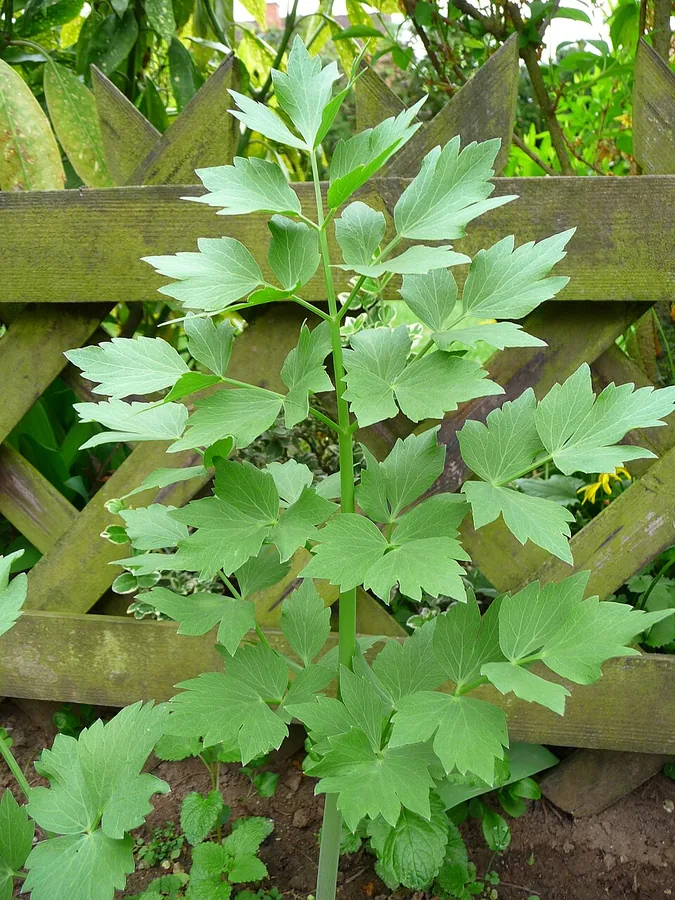
Lovage is a tall, hardy perennial in the carrot and parsley family, prized for foliage that carries an emphatic celery flavor. It grows from a persistent deep crown, which is why it returns each spring, throwing up hollow stems and glossy, divided leaves. Because a single crown is so productive, one plant supplies most kitchens.
Allow generous space, since this is a large herb by any measure. By midsummer it reaches 4 to 6.5 feet (120 to 200 cm) and spreads roughly two feet, then lifts airy yellow-green flower umbels on stalks that overtop the surrounding planting. Position it at the back of a border or in a corner, where its stature will not overshadow lower plants.
Lovage is undemanding once the crown establishes. It withstands severe winters by dying back and regenerating from the crown, returns with greater vigor each spring, and tolerates the lapses of an inexperienced grower. Maintain rich soil and even moisture at the roots, and the leaves, stems, and seeds all repay the space they occupy.
Care
The short version: full sun or light shade, deep fertile soil held evenly moist, and ample room for a herb that reaches shoulder height. A single spring feeding meets its nutrient demand, and dividing the crown every few years renews vigor as the clump ages.
Light
Lovage performs best in full sun, which drives the fullest growth, but it accepts partial shade without loss of health, a useful margin in hot climates. Light afternoon shade limits scorch on the large leaves during peak heat, while an open, sunny site yields the most vigorous plant.
Water
Hold the soil consistently moist, because a herb of this size transpires heavily and wilts quickly once the root zone dries. Water deeply during dry spells, on the order of every 3 to 7 days depending on heat, but stop short of waterlogging, which excludes oxygen from the roots and invites crown rot.
Soil
Grow it in deep, fertile, moisture-retentive loam rich in organic matter, which both feeds the plant and buffers the root zone against drying. Lovage is tolerant of pH across 6.0 to 7.5, so reaction is rarely limiting provided fertility is high and the roots stay damp without standing in water.
Temperature
This is an exceptionally cold-hardy herb, enduring winter lows to -29°F (-34°C) and summer highs to 86°F (30°C). It survives the cold by retreating to the crown, from which it regenerates fresh growth once temperatures rise in spring.
Humidity
Ordinary outdoor humidity in the range of 40% to 70% satisfies the plant, and no specific target need be met. Root-zone moisture and adequate air movement around the foliage matter far more to its condition than ambient humidity.
Feeding
A single feeding in spring, using a balanced fertilizer or a top-dressing of compost or aged manure, matches its seasonal demand. That one application supplies the nutrients this heavy feeder draws on to build its broad leaves and tall stems through the year.
Pruning
Cutting back the flowering stalks redirects the plant's energy into tender leaf production, and removing the flower umbels before seed set prevents self-sowing. Harvest the outer leaves progressively, and shear the whole plant after bloom to stimulate a flush of new foliage.
Repotting
Its ultimate size makes lovage poorly suited to long-term container culture, so it belongs in open ground. Renew it instead by dividing the crown every 3 to 4 years, which relieves crowding and sustains full leaf size and stem thickness.
Size & spacing
Anticipate a substantial plant, 4 to 6.5 feet (120 to 200 cm) tall and 2 to 3.3 feet (60 to 100 cm) wide at maturity. Allocate a clear position at the back of the bed so the canopy does not shade neighboring, lower-growing herbs.
When to plant
Lovage is governed by the growing season and is markedly cold-tolerant, hardy from zone 3 to zone 9. Sow it indoors in late winter or fresh in autumn, transplant in spring once frost risk has passed and the soil has warmed, and harvest leaves and stems throughout the season as the tall umbels develop from early summer.
Northern hemisphere
Southern hemisphere
Typical months for a temperate climate: start earlier in warm zones, later where spring frosts linger.
- Sow: Late winter to early spring, 6-8 weeks before last frost (fresh seed germinates best)
- Plant: Spring, after the last frost when soil has warmed
- Harvest: Harvest leaves and stems through the growing season; tall yellow-green flower umbels appear early to mid summer, followed by seed
Hardiness
USDA hardiness zones: 3–9
Temperature: down to -40°C
Troubleshooting
Lovage is largely trouble-free, and the disorders that do arise concentrate on the foliage or the tall stems. Diagnosed early, most resolve with a single corrective step. Read the symptom against the entries below, then intervene before the problem advances.
Wilting canopy above a soft, browning crown
A wilting canopy over a soft, brown crown signals crown and root rot, a decay that follows when saturated, poorly drained soil starves the roots of oxygen. The crown tissue collapses and turns foul, and the roots blacken and lose their capacity to take up water, which is why the top wilts despite wet ground. Rotted tissue does not regenerate, so correct the drainage, excise or replace the affected plant, and reduce irrigation to keep the crown from standing wet.
Fix:
- Improve drainage
- Remove affected tissue or replace plant
- Avoid overwatering
Tall stems lodging or fracturing after wind and rain
Lovage produces hollow stems whose walls, however tall, offer limited resistance to bending. As the flower umbels mature and gain mass, the load shifts high on the plant, so wind and rain lever the stems over or fracture them at the base. Support the stems with stakes or a cage before they reach full height, thin some of the flowering shoots to lower the crown's mass, and site the plant out of the strongest wind to reduce the leverage that causes lodging.
Fix:
- Stake or cage tall stems
- Cut back flowering stalks to reduce height and weight
Winding pale mines and grazed holes across the foliage
The pattern of damage names the culprit. Serpentine pale tunnels are excavated by leaf miner larvae feeding within the leaf tissue itself, whereas irregular holes are grazed out by celery worms, the swallowtail caterpillars, and soft clusters on the youngest growth are aphids drawing sap. Because miners sit inside the lamina where sprays cannot reach, remove and destroy the affected leaves outright, lift the caterpillars by hand, and dislodge aphids with a firm water spray or insecticidal soap.
Fix:
- Remove and destroy mined or infested leaves
- Handpick caterpillars
- Spray aphids off with water or use insecticidal soap
Toxicity
Lovage is a culinary herb and is safe for people and pets alike, with no toxin in the leaves, stems, or seeds. The one qualification concerns the sap, which contains furanocoumarins capable of leaving susceptible skin photosensitive after handling, so wear gloves and rinse off when working with quantity in strong sun.
Safe for
People · Cats · Dogs · Horses · Rabbits · Livestock · Birds
Cats Safe
Lovage presents no toxic hazard to cats. The strong aromatic oils are the only issue at play, so a cat that consumes a large quantity of leaves may show brief digestive upset and nothing beyond that.
Dogs Safe
The herb carries no compound that harms dogs. A large mouthful acts only as a dietary irritant, producing mild flatulence or a loose stool that resolves without intervention.
Horses Safe
Grazing lovage poses no toxic risk to horses, as the foliage holds no equine poison. The pungency of the leaves is self-limiting, and a horse tends to reject the plant before it eats enough to matter.
Rabbits Safe
Rabbits can consume the leaves without toxic effect. As with any unfamiliar green, introduce it gradually so the gut flora adjusts and digestive upset is avoided.
Livestock Safe
Goats, sheep, and cattle may browse lovage without injury. The plant contains no principle known to poison ruminants or other grazing stock.
Birds Safe
Neither poultry nor pet birds face any poisoning risk from the plant. Sampling of the foliage or the ripe seed is without consequence.
People Safe
The leaves, stems, and seeds are edible and long established in the kitchen. The sole reservation is the furanocoumarins present in the sap, which can photosensitize susceptible skin, so glove up and rinse the skin after handling volumes of foliage in strong sun.
The foliage and sap contain furanocoumarins; skin contact with the sap followed by sun exposure can cause mild phytophotodermatitis (photosensitivity) in sensitive handlers. Wear gloves and wash hands after handling large quantities, especially in bright sun.
Helpline numbers

United States
ASPCA Animal Poison Control: (888) 426-4435 (fee applies)

United Kingdom
Animal PoisonLine: 01202 509000 (fee applies)

Australia
Animal Poisons Helpline: 1300 869 738
Varieties
Lovage is represented in cultivation by a single species rather than a range of named selections, so there is effectively one plant to know.
Levisticum officinale (species)
Cultivation rests on the single widely grown species, the standard culinary form, recognized by hollow stems with an intense celery flavor and glossy, deeply divided leaves.
How to propagate
Lovage propagates readily, either from fresh seed or by dividing an established crown into new plants.
SeedEasy
Late summer/early autumn when seed is fresh, or late winter to early spring indoors · 2-3 weeks to germinate; one full season to establish
Lovage seed is short-lived and loses viability quickly, which is why it germinates best when fresh, sown in late summer or early autumn, or started under cover from late winter to early spring. The seed needs light to break dormancy, so press it onto the surface rather than covering it, and expect emergence in 2 to 3 weeks and one full season for the plant to establish.
DivisionEasy
Early spring or autumn · One growing season
A mature crown divides cleanly when growth is slow, in early spring or autumn. Lift the clump and cut it so that each section retains both roots and viable growth buds, since a division without buds cannot regenerate, and allow the pieces one single growing season to reestablish.
Myths
Lovage is simply celery under another name.
A shared celery flavor masks the fact that these are botanically distinct plants. Lovage is the tall perennial Levisticum officinale, whereas true celery is the annual Apium graveolens, a separate genus and species united with lovage only at the family level, in the Apiaceae. In habit and appearance the two are entirely different plants.