Herb · Apiaceae
Garden Angelica
Angelica archangelica
A towering Apiaceae herb whose monocarpic habit trades candied stems and architectural umbels for a single, final flowering.
Partial shade
Every 3–7 days
41–77°F · 5–25°C
USDA 4–9
Overview
Garden angelica reaches its size as one of the larger herbs in cultivation, lifting hollow ridged stems and broad domed umbels well above head height. As a member of the carrot family native to the cool, moist margins of northern Europe, its provenance dictates its culture, which is why it performs in rich, moist ground with some shade rather than in hot open beds. Generations of growers have raised it both for the candied stems and for the structural mass it brings to the back of a border.
Its life cycle is the single fact that governs everything else. Angelica is a biennial of monocarpic habit, investing its first year or two in a deep taproot and a basal mound of broad foliage before committing all that stored energy to one flowering stalk, after which seed ripens and the crown dies. Removing the stalk before anthesis withholds that signal and can extend the plant by a season, but flowering, once it occurs, commits the plant to senescence.
Handling carries a real, identifiable risk grounded in the plant's chemistry. The sap holds furanocoumarins, photoactive compounds that can burn skin when it is then exposed to sunlight, and the species is morphologically close to poison hemlock, so accurate identification and protected handling are not optional precautions but the conditions for safe use.
Care
The short version: part shade and rich, deep soil held moist but never waterlogged, with consistent water through the first season so the developing taproot is never allowed to dry.
Light
Partial shade matches the plant's woodland-edge habitat and is where it performs best. Full sun is tolerated in cooler regions or where soil moisture is reliable, because adequate water buffers the heat load, whereas hot, dry sun raises transpiration stress and abbreviates an already short life.
Water
Hold the soil consistently moist and prevent it from drying, most critically during the first season while the taproot is forming and the root system cannot yet draw on reserves. A mulch layer conserves that moisture and moderates root-zone temperature, reproducing the cool, damp conditions of its native woodland edge.
Soil
The plant demands rich, deep, moist loam that nonetheless drains, with a high organic fraction to feed its considerable biomass. A pH of 6.0 to 7.0 suits it, and incorporating compost or well-rotted manure supplies both the nutrients and the structure its heavy growth requires.
Temperature
Angelica is a cool-climate species, performing across roughly 41°F to 77°F (5°C to 25°C), and its cold hardiness extends to USDA zone 4 at the lower end. Heat is the limiting factor at the warm end of its range, which is precisely why some shade becomes necessary in warmer gardens to keep tissue temperatures within tolerance.
Humidity
Average humidity of about 40% to 60%, the ambient condition of most outdoor gardens, is sufficient. The cool, moist air characteristic of a woodland margin approximates its native environment more closely than a hot, dry, exposed site.
Feeding
Apply a balanced fertilizer in spring, or top-dress the crown with compost or well-rotted manure, to meet demand as growth resumes. A monthly feed through the growing season sustains the large leaf area and tall stems the plant produces.
Pruning
Deadheading the spent flower stalks before seed set delays the plant's senescence by withholding the flowering signal and restrains its self-sowing, and clearing tired foliage maintains the stand. Because flowering and seed set trigger death, however, pruning postpones rather than prevents that outcome.
Repotting
Angelica is rarely repotted, since its deep taproot resents disturbance and the species is direct-sown into its final position for that reason. Leaving it in place allows the taproot to develop undamaged through its short life rather than risking the transplant shock that lifting would impose.
Size & spacing
This is a large herb, attaining 5 to 8 feet (150 to 250 cm) in height with a spread of 2 to 4 feet (60 to 120 cm), so it requires a position that accommodates that scale. Placed at the back of a bed, its height reads as structure and its umbels have the room they need to expand.
When to plant
Two physiological facts set the schedule: the seed is short-lived and the embryo needs cold to break dormancy. Sow in late summer or fall while the seed remains viable, or supply that cold artificially and sow in early spring, and expect vegetative growth the first year and flowering in the second or third before seed set and death.
Northern hemisphere
Southern hemisphere
Typical months for a temperate climate: start earlier in warm zones, later where spring frosts linger.
- Plant: Sow fresh seed where it is to grow in late summer to fall, or cold-stratify and sow in early spring; direct-sow because the taproot resents transplanting.
- Harvest: Large greenish-white compound flower umbels appear in early to mid summer of the second (or third) year, after which the plant dies; harvest tender young leaf stems and leaves in year one to two.
Hardiness
USDA hardiness zones: 4–9
Temperature: down to -34°C
Troubleshooting
Angelica presents few cultural problems, and its most conspicuous decline, death following flowering, is a programmed life-cycle event rather than a disorder. The genuine issues localize to the foliage or to the crown. Identify which of the following you are seeing before intervening.
Flowering and seed set precede yellowing and crown death
This is the plant's biology, not a pathogen. As a monocarpic species, angelica flowers a single time in its second or third year, matures seed, and then the entire crown senesces because reproduction exhausts its stored reserves. Allow some seed to drop and self-sow, or save fresh seed for replacements, and remove the spent plant once the seed has been collected.
Fix:
- This is normal; allow some seed to ripen and self-sow, or save fresh seed to start replacements
- Remove the spent plant after seed harvest
Wilt accompanied by a blackened, softened crown at soil level
Persistent water around the base creates the anaerobic conditions that drive crown and root rot, and the stem bases turn soft and dark at the soil line as the tissue breaks down. A rotted crown cannot be salvaged, so removing and destroying the worst plants limits spread of the pathogen. Improved drainage and irrigation that holds the soil moist but never saturated prevents the problem at its source.
Fix:
- Improve drainage and reduce watering
- Remove and destroy badly affected plants to limit spread
Deformed sticky foliage bearing serpentine mines and grazed margins
Soft, nitrogen-rich new growth attracts aphids, which feed on the undersides and excrete the sticky honeydew you see as a film. The pale serpentine lines are the feeding tracks of leaf miners mining the leaf tissue, while irregular holes indicate the green-and-black celery worm, the larva of the black swallowtail. Dislodge aphids with a water jet or insecticidal soap, remove mined leaves, and either hand-pick the larvae or leave them to complete their development into butterflies.
Fix:
- Dislodge aphids with a strong jet of water or treat with insecticidal soap
- Remove and destroy mined or heavily chewed leaves
- Hand-pick caterpillars (or tolerate them, as they become swallowtail butterflies)
Toxicity
The cautions here rest on a specific chemistry. The sap and foliage contain furanocoumarins, photosensitizing compounds that blister skin once sunlight reaches it, and the same mechanism produces photosensitization in grazing animals across their lighter-skinned areas. The decisive hazard, however, is misidentification, since angelica is easily confused with deadly poison hemlock or water hemlock, so consume no part without certain identification.
Toxic to
Cats · Dogs · Horses · Rabbits · Livestock · Birds · People
Cats Mild
Ingestion of the foliage can cause a cat to drool or vomit, and dermal contact with the sap may leave the skin sore, both consistent with the plant's irritant chemistry. The effects are generally self-limiting, but a curious cat should be kept away from cut stems.
Dogs Mild
A dog that chews the leaves may show drooling and gastric upset, usually with no further effect. Sap reaching the muzzle or paws can irritate the skin through the same compounds, so it should be rinsed off promptly.
Horses Caution
The furanocoumarins in the leaves and sap photosensitize a horse's skin, producing redness and soreness on the muzzle and any unpigmented areas after sun exposure. Excluding angelica from grazing paddocks removes the risk.
Rabbits Caution
Angelica should not be offered as forage, since the sap compounds responsible for human skin reactions can disturb a rabbit's gut and suppress its appetite. Confine the diet to greens of known safety.
Livestock Caution
Grazing cattle, goats, and sheep are subject to photosensitization from the furanocoumarins, which manifests as scabbing and peeling on light-skinned areas following a day in sun. Fencing the plant out of pasture prevents exposure.
Birds Caution
There is no basis for including angelica in an avian diet, and the sap compounds make it unsuitable in any case. Pet birds should be kept away from the fresh foliage and stems.
People Caution
The young leaf stems are traditionally candied and eaten, yet the fresh sap can blister skin subsequently exposed to sunlight, a reaction termed phytophotodermatitis. The greater danger is confusing angelica with deadly poison hemlock or water hemlock, so no part should be eaten without certain identification.
Wear gloves and long sleeves when cutting or handling fresh stems and foliage, and wash skin promptly; avoid sun exposure on sap-contacted skin to prevent phototoxic burns. CRITICAL: Angelica closely resembles deadly poison hemlock (Conium maculatum) and water hemlock (Cicuta spp.); never forage or eat a plant unless its identity is absolutely certain.
Helpline numbers

United States
ASPCA Animal Poison Control: (888) 426-4435 (fee applies)
Poison Control: (800) 222-1222



Canada
Poison Centres: 1-844-764-7669
Varieties
Cultivation centers on the true species, though a distinct coastal subspecies is worth recognizing for gardens near the sea.
Angelica archangelica (species)
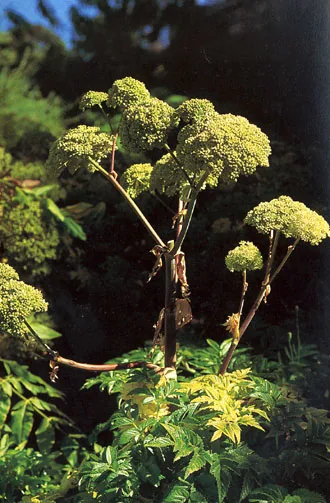
This is the type species of garden angelica, identifiable by the hollow ridged stems long candied in the kitchen and the large domed umbels of greenish-white flowers.
Angelica archangelica subsp. litoralis
This is a slender coastal subspecies from northern Europe, adapted to shoreline conditions of salt and wind that exclude most other herbs.
How to propagate
Angelica is propagated by seed exclusively, and success hinges on a single physiological constraint: the seed must be sown fresh, before its viability is lost.
SeedModerate
Sow fresh seed in late summer to fall, or cold-stratify and sow in early spring. · 1 to 2 years to reach flowering size
Use fresh seed only, because viability is lost within months of ripening as the seed deteriorates. The embryo requires both light and a period of cold to break dormancy, so sow on the surface and leave it uncovered, sowing fresh in late summer or cold-stratifying for an early spring start to satisfy that requirement. Direct-sow into the final position, since the deep taproot does not tolerate transplanting, and allow 1 to 2 years for the plant to reach flowering size.
Myths
Since angelica is a culinary herb, handling the plant carries no risk.
The candied stems have been eaten for centuries, yet the fresh sap and foliage contain furanocoumarins that sensitize skin and blister it once sunlight reaches the exposure. Wear gloves and long sleeves when cutting it, and wash off any sap before going into the sun, because the reaction depends on that subsequent light exposure.
Any large white-flowered Apiaceae resembling angelica can be foraged safely.
Within the Apiaceae, gross resemblance is no guide to safety: angelica is closely matched by poison hemlock and water hemlock, and a single error can be fatal. Never eat a wild plant unless its identity is certain, and leave the foraging of these umbellifers to those who can distinguish them with confidence.