Herb · Apiaceae
Parsley
Petroselinum crispum
Provide rich soil, steady moisture, and patience at sowing, and parsley supplies the kitchen with fresh leaves.
Full sun
Every 2–4 days
50–75°F · 10–24°C
70–90 days
Overview
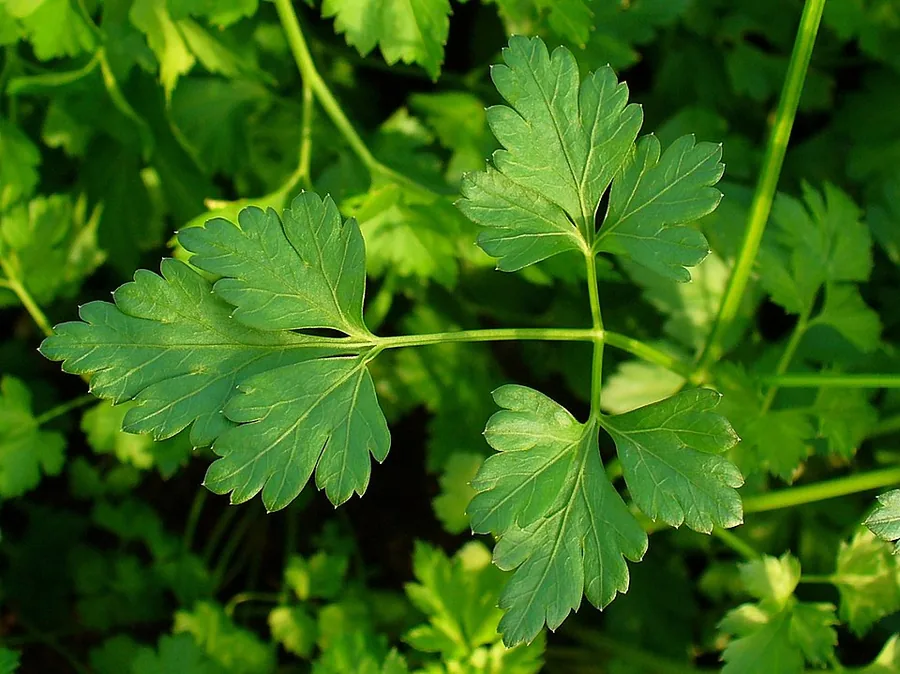
Parsley is a mainstay culinary herb of the kitchen garden and a member of the carrot family, grown for its bright, clean-tasting foliage. Two principal forms are cultivated: the tightly ruffled curly type and the bolder flat-leaf Italian type, the latter holding the stronger flavor. Both perform well in a bed or in a container on a sunny sill.
Its biennial life cycle governs how it is managed. In the first year the plant invests in vegetative growth, and that leafy phase is the intended harvest. In the second year it shifts to reproduction, elongating a flower stalk while the foliage turns tough and bitter, which is why most growers restart from seed each spring rather than carry plants over.
Once established, parsley makes few demands, but establishment itself is the slow part. The seed is notoriously slow to germinate, often taking weeks, and the developing taproot resents disturbance. Sowing in the final position and keeping the soil evenly moist supports months of cutting.
Care
The short version: full sun to part shade, a rich well-drained soil held evenly moist, and a monthly feed through the season to sustain steady leaf production.
Light
Parsley performs best in full sun yet tolerates partial shade, which makes it workable in a position that loses afternoon light. Where summers are hot, midday shade limits heat load and keeps the leaves tender.
Water
Hold the soil evenly moist and avoid letting the plant dry out fully, a point that matters most in containers and during hot weather when the substrate dries quickly. Watering every 2 to 4 days meets that need, but stopping short of waterlogging is essential because saturated roots invite rot.
Soil
Grow it in rich, well-drained loam amended with compost so the medium retains moisture without becoming saturated. A pH of 6.0 to 7.0, from slightly acidic to neutral, suits nutrient availability for parsley.
Temperature
Parsley favors cool to mild conditions, with best growth from 50°F to 75°F (10°C to 24°C). It withstands light frost, but a prolonged hot spell is a common stress trigger for bolting and the loss of leaf quality.
Humidity
Average humidity of 40% to 60% is adequate for parsley. Air movement matters more than the humidity figure, since foliage that stays wet in still, crowded air is where leaf spot establishes.
Feeding
Feed monthly during the growing season with a balanced fertilizer or a side-dressing of compost. That regular nutrient supply is what sustains fresh leaf production after each cutting.
Pruning
Harvesting is the pruning operation. Cutting the outer stems at the base on an established plant, and picking regularly, drives new growth from the center. In the second year, removing flower stalks as they appear delays the shift to bolting.
Repotting
Container parsley is repotted about once a year, because the taproot soon fills the pot. Roots circling the medium, rapid drying, and pale, stunted top growth are the reliable signs that it is time to pot on or, more commonly, resow.
Size & spacing
Parsley remains compact, reaching 8 to 16 inches (20 to 40 cm) in height with a spread of 8 to 12 inches (20 to 30 cm). Allotting that spacing keeps air moving and lets the foliage dry between waterings.
When to plant
Parsley is cold-hardy and can be started early. Sow indoors in late winter or direct-sow in early spring a few weeks ahead of the last frost, and the plant supplies leaves through the first season. Flowering and seed set follow in the second year.
Northern hemisphere
Southern hemisphere
Typical months for a temperate climate: start earlier in warm zones, later where spring frosts linger.
- Sow: 8-10 weeks before the last spring frost
- Plant: Early spring, a few weeks before the last frost; parsley is cold-hardy
- Harvest: Harvest outer leaves once plants are full in the first year; flowers and seeds form in the second year
Hardiness
USDA hardiness zones: 4–9
Temperature: down to -34°C
Troubleshooting
Parsley is an undemanding herb whose problems concentrate on the foliage or trace back to excess soil moisture. Recognizing the few common signs allows early intervention. Match the symptom below, then act while a response still changes the outcome.
Stems collapse at the crown and roots turn soft and discolored
The cause is stem and root rot, which develops in poorly drained, overly wet soil because saturated conditions deprive roots of oxygen and favor rot organisms. Once the crown and roots have broken down the plant cannot recover, so it should be removed and discarded. Correcting drainage before replanting, and easing off irrigation in containers, removes the waterlogging that drives the problem.
Fix:
- Remove and discard affected plants
- Improve drainage before replanting
Tan to brown lesions with dark margins spreading across the foliage
The disorder is Septoria leaf spot, a fungal disease that establishes under wet, humid conditions because prolonged leaf wetness lets the pathogen infect and spread. Lesions typically begin on lower and inner leaves, then enlarge and coalesce the longer the canopy stays damp. Thinning to improve air circulation, watering at the soil line, and removing infected leaves all cut the leaf wetness the fungus depends on.
Fix:
- Remove and discard affected leaves
- Improve air circulation by thinning plants
- Avoid overhead watering
A central flower stalk elongates and the leaves turn tough and bitter
This is bolting, and in parsley it reflects the normal biennial life cycle expressing itself in the second season, when the plant diverts energy from foliage into flowering and seed. Heat and stress can advance the process, and once the seed stalk elongates the flavor decline is irreversible. Growing parsley as an annual, replanting each spring, and harvesting heavily before the stalk forms all capture leaf quality before the plant reproduces.
Fix:
- Start new plants from seed each year rather than maintaining biennials
- Harvest heavily before bolting
- Remove flower stalks to briefly prolong leaf production
Foliage chewed by large green caterpillars banded in black and yellow
The feeder is the parsleyworm, the larval stage of the eastern black swallowtail, and because it targets outer foliage it strips a plant fast. Handpicking removes them, though most growers transfer the larvae to a spare plant so they can complete development into adult butterflies. Sowing surplus parsley works because it leaves enough foliage to spare while the larvae feed.
Fix:
- Handpick caterpillars if leaf supply is limited
- Relocate caterpillars to a sacrificial plant since they become swallowtail butterflies
- Cover plants with row cover if protection is needed
Toxicity
Parsley is a safe culinary herb for people, and a sprig in food carries no meaningful risk. The relevant compounds are the furanocoumarins it shares with the rest of the carrot family, which can cause gastrointestinal upset or sun-sensitive skin in pets and grazing animals that consume a substantial quantity. Cats, dogs, and especially birds warrant a light touch, so harvested bunches are best kept out of reach.
Toxic to
Cats · Dogs · Horses · Rabbits · Livestock · Birds
Safe for
People
Cats Mild
A nibble does little harm because the dose is small, but a cat that ingests a genuine mouthful can develop a queasy stomach and loose stools. The furanocoumarins it carries can also leave the skin reactive in sunlight.
Dogs Mild
Small culinary amounts are tolerated by most dogs since the exposure stays low. A large helping is the tipping point, because the same furanocoumarins then produce drooling, gastrointestinal upset, and skin that reddens or burns in the sun.
Horses Mild
Grazing a large stand of parsley delivers enough furanocoumarins to render a horse photosensitive, so light-skinned areas redden and chap after exposure to sun.
Rabbits Mild
A few leaves serve as a sound treat because the quantity stays modest. Beyond that the furanocoumarins can disturb the gut, so parsley belongs in the diet as an occasional share of the greens rather than a staple.
Livestock Mild
Goats, sheep, and cattle can develop sun-triggered skin irritation where heavy grazing raises furanocoumarin intake, though an isolated plant in the pasture rarely reaches a meaningful dose.
Birds Mild
Birds are the most sensitive group, so even modest amounts of the concentrated furanocoumarins can irritate the gut and skin. Parsley is best offered sparingly and never as a staple green.
People Safe
Parsley is a culinary staple and safe to eat, since ordinary portions pose no meaningful risk. Handling large quantities of the fresh plant in bright sun is the exception, because contact plus UV can leave sensitive skin prone to a rash, an occupational hazard rather than a dietary one.
Furanocoumarins can cause sun-triggered skin and eye irritation in animals that ingest substantial amounts; small culinary garnish quantities are typically low-risk.
Helpline numbers

United States
ASPCA Animal Poison Control: (888) 426-4435 (fee applies)

United Kingdom
Animal PoisonLine: 01202 509000 (fee applies)

Australia
Animal Poisons Helpline: 1300 869 738
Varieties
A small set of parsley types is grown in gardens, separated mainly by whether the leaves or the root is the crop. These are the ones worth knowing by name.
Curly parsley (var. crispum)
Its tightly curled, ruffled leaves are what make it the standard choice for garnish and for edging the front of a bed.
Italian flat-leaf parsley (var. neapolitanum)
The flat, deeply cut leaves hold the strongest flavor of the group, which is the reason cooks prefer this variety.
Hamburg parsley (var. tuberosum)
This variety is cultivated for its thick, parsnip-like taproot rather than for the foliage above ground.
How to propagate
Parsley is raised from seed, which is effectively the only method most gardeners use. Success turns on working with its slow germination and its intolerance of transplanting.
SeedModerate
Spring; start indoors 8-10 weeks before the last frost or direct-sow when soil can be worked · About 3-4 weeks to germinate, plus several more weeks to establish
Parsley is propagated from seed, and its chief demand is patience. Sow indoors 8 to 10 weeks before the last frost, or direct-sow once the soil can be worked, and allow 3 to 4 weeks for germination plus several more weeks for the seedlings to establish. Soaking the seed overnight softens the coat and speeds emergence. Because parsley develops a taproot that resents disturbance, sowing in the final position, or transplanting young seedlings with care, prevents the check a damaged root would cause.
Myths
Parsley is a safe culinary herb, so it poses no risk to pets.
Garden parsley does carry furanocoumarins, the same family of compounds found across the carrot family, and a pet that eats a large amount can get an upset stomach or skin that burns in the sun. Small garnish-sized portions are low-risk, and the toxic 'spring parsley' on the ASPCA list is a different plant entirely, Cymopterus watsonii.
Parsley seed simply will not germinate.
It germinates reliably, only slowly, so the interval can extend to several weeks before seedlings emerge. An overnight soak of the seed before sowing shortens that lag and brings sprouting on faster.