Vegetable · Brassicaceae
Radish
Raphanus sativus
A radish rewards even moisture and cool air by driving its energy into the root, not the tops: fast, but exacting.
Full sun
Every 3–5 days
39–75°F · 4–24°C
22–60 days
Overview
Radish, a member of the family Brassicaceae, completes its cycle faster than almost any other garden crop. The quick salad types reach harvest in three to five weeks, a pace set by rapid germination and equally rapid root expansion. That speed makes it a practical gap-filler between slower vegetables and a dependable first crop for a new grower.
The species spans a wide range of forms. At one end sit the small round spring radishes; at the other, the long white daikon, which needs a full season and deep, loose soil to develop its length, along with types selected for edible seed pods rather than a swollen root. What unites them is a cool-season habit, because high temperature drives bolting and turns root texture woody and flavor harsh.
The plant asks little, but the margin for error is real. Hold even soil moisture, thin to spacing so each root has room to expand, and harvest on time. Miss any of these and the result is predictable: cracked skins from moisture swings, sharp pithy flesh from delay, or leafy tops with no root when fertility or spacing is off.
Care
The short version: site radishes in full sun and cool conditions, hold the soil evenly moist at about an inch of water a week, keep the ground loose and low in nitrogen, and lift the roots at maturity before texture and flavor decline.
Light
Radish requires full sun, at least 6 hours daily, and tolerates only light afternoon shade in warmth. Ample light drives assimilate into the root; under heavy shade the plant favors foliage and the root fails to size.
Water
Maintain even moisture, roughly an inch of water a week, with more in sandy soils or heat. A consistent supply lets the root expand at a steady rate, whereas fluctuating moisture cracks the skin and drives the woody, hot-tasting flesh.
Soil
Grow in loose, well-drained sandy loam cleared of stones and compaction, since any obstruction deforms or checks the swelling root. Target a pH of 6.0 to 7.0.
Temperature
The optimal range runs about 39°F to 75°F (4°C to 24°C). Above it, heat triggers bolting and shifts the root toward a sharp, pithy character, which is why culture is timed to the cool shoulders of the season.
Humidity
Ambient outdoor humidity is sufficient, so no target applies. Root quality depends on soil moisture, not the atmospheric moisture around the foliage.
Feeding
Incorporate compost or well-rotted manure before sowing; this alone usually meets demand. Keep nitrogen low, because excess nitrogen promotes vegetative growth, yielding heavy tops and undersized roots.
Pruning
No pruning applies. Thinning is the operative task: once seedlings emerge, thin to about 2 inches apart, or 4 to 6 inches for daikon, so competition does not limit root diameter.
Size & spacing
Mature height ranges 6 to 35 inches (15 to 90 cm) by type, with daikon at the upper end. Thin to about 2 inches apart, wider for winter types, to give each root room to expand and to keep airflow through the stand.
When to plant
Radish is a cool-season brassica, and its quality tracks temperature closely. Direct sow the fast salad types in early spring once the soil can be worked, then again from late summer into fall as heat eases; the daikon and winter types are timed to mature in the cooler fall.
Northern hemisphere
Southern hemisphere
Typical months for a temperate climate: start earlier in warm zones, later where spring frosts linger.
- Plant: Direct sow in early spring (April-May) as soon as soil can be worked, and again in late summer to early fall (August-September); winter/daikon types are sown for fall harvest
- Harvest: Spring/salad types harvested 3-5 weeks after sowing; daikon and winter types harvested in fall
Hardiness
USDA hardiness zones: 2–11
Temperature: down to -46°C
Troubleshooting
Most radish faults resolve to the same driver: conditions that pull the plant away from steady root formation. Read the symptom, identify the cause behind it, and correct the timing, moisture, or fertility.
Internal tunneling and rot in the root
White legless larvae and brown internal galleries indicate cabbage root maggot, and an infested root is not salvageable. Remove and destroy affected roots, rotate away from brassicas, cover the bed at sowing, and avoid recently manured ground.
Fix:
- Remove and discard affected roots
- Practice crop rotation away from brassicas
Vigorous foliage with negligible root formation
The mechanism is nutritional: excess nitrogen favors vegetative growth over root storage, and unthinned rows compound it through competition. Heat, long days, and low light push the same imbalance. Withdraw the nitrogen, thin to spacing, and sow into cool weather with at least 6 hours of sun.
Fix:
- Thin seedlings to recommended spacing
- Stop applying high-nitrogen fertilizer
- Sow during cool spring or fall weather in full sun
Premature flowering stalk (bolting)
Bolting is the plant's reproductive response to heat and lengthening photoperiod, and drought or crowding that checks growth can hasten it. Once the central stem elongates, the root turns woody and pungent. Harvest what remains, then resow under the cooler conditions of spring or fall.
Fix:
- Harvest promptly before quality declines
- Replant in cooler spring or fall conditions
Woody, pithy, or sharply pungent roots
Roots held beyond maturity lignify and grow pithy while the flavor sharpens, and drought and heat accelerate the decline. The change is not reversible once texture degrades. Harvest at peak size and hold even soil moisture through development.
Fix:
- Harvest at peak size
- Keep soil consistently moist during growth
Longitudinal cracking of the roots
Splitting follows abrupt changes in soil moisture, typically a heavy irrigation onto dry ground, and worsens in roots held past maturity. Even watering keeps expansion gradual and the tissue intact, so supply consistent moisture and lift the roots at size.
Fix:
- Harvest at proper size
- Maintain even watering
Shot-hole feeding damage on seedling leaves
The small round perforations are flea beetle feeding, and seedlings are the vulnerable stage. Exclude the beetles with a floating row cover over young plants, and rotate brassicas to break the local population.
Fix:
- Use floating row covers over seedlings
- Monitor and manage early pressure
Toxicity
Radish carries no toxic principle of concern: the root, leaves, flowers, and seed pods are all edible, and the plant poses no risk to pets or livestock. The only caveat is chemical rather than toxic. Isothiocyanates in the tissue give the raw root its pungency and can irritate sensitive skin on handling.
Safe for
People · Cats · Dogs · Horses · Rabbits · Livestock · Birds
Cats None
Radish is nontoxic to cats. Ingestion of leaf or root may cause minor gas or a loose stool, with no further effect.
Dogs None
Radish is nontoxic to dogs. Plain pieces are well tolerated in moderation, though a large serving of the pungent root can cause flatulence.
Horses Safe
Horses tolerate both tops and roots without adverse effect. Offer moderate quantities so radish remains a minor part of the ration.
Rabbits Safe
Rabbits tolerate the leafy tops well and the root in small amounts, with the foliage being the more suitable portion.
Livestock Safe
Cattle, goats, and sheep consume tops and roots without harm, and radish is cultivated as a forage crop in some systems.
Birds Safe
Poultry consume radish greens and roots without harm, and the foliage supplies useful green matter.
People Safe
Radish is a common food crop eaten raw or cooked; root, leaves, flowers, and seed pods are all edible. Handling the cut root may irritate sensitive skin owing to its isothiocyanates.
Leaves and roots contain isothiocyanates that may cause mild skin irritation in sensitive individuals when handling, and the raw root is pungent.
Varieties
Radish runs to hundreds of cultivars, but a short list accounts for most of what gardeners actually grow. The distinctions worth knowing are in form, color, and season.
Cherry Belle
The standard round, bright red salad radish, maturing in roughly three to four weeks.
Easter Egg
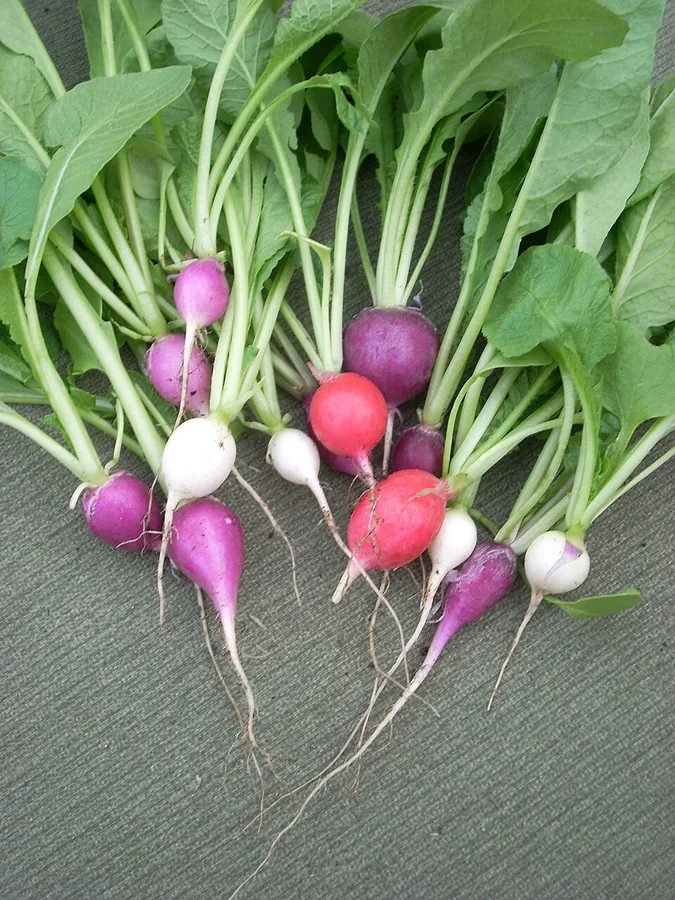
A single sowing yields a mix of white, pink, red, and purple roots.
Sparkler
A round red radish distinguished by a clean white tip at the base.
Daikon (var. longipinnatus)
A long white winter radish that requires a longer season and deep, loose soil to elongate.
Rat's Tail (var. caudatus)
Grown for its edible, pungent seed pods rather than a storage root.
Companions
Radishes earn their keep beside slower crops, holding space and marking rows before they're pulled and the neighbors fill in.
Plant near
Lettuce: Quick-maturing radishes interplant well with lettuce, using space before the lettuce fills in.
Carrots: Radishes are sown as a fast marker crop with slow-germinating carrots and are pulled before the carrots need the room.
Cucumbers: Radishes are commonly interplanted with cucumbers as an early quick crop in the same bed.
How to propagate
Radish is propagated by seed alone, sown in place because the taproot does not tolerate transplanting.
SeedEasy
Direct sow in early spring and again in late summer/fall · Germinates in about 3 to 7 days under cool, moist conditions
Radish is sown directly where it will grow, because the taproot does not transplant reliably. Sow seed about 1/4 to 1 inch deep in early spring and again in late summer or fall; under cool, moist conditions germination follows in 3 to 7 days. Thin seedlings early so each root has room to reach full diameter.
Myths
Large roots demand rich, heavily fertilized soil.
The opposite holds: surplus nitrogen produces a flush of foliage and a negligible root. Radishes perform best in moderately fertile, well-prepared soil, not a heavily fed bed.
Mature radishes can be left in the ground and harvested at leisure.
Held past maturity, roots turn woody, pithy, and cracked, and flavor intensifies unpleasantly. Harvest promptly at size to capture peak texture and taste.