Vegetable · Brassicaceae
Bok Choy
Brassica rapa subsp. chinensis
Sow it in cool weather, keep it watered and growing fast, and bok choy fills the bed in barely six weeks.
Full sun
Every 2–4 days
50–77°F · 10–25°C
40–55 days
Overview
Bok choy is a member of the cabbage family selected for crisp petioles and tender leaves rather than a dense head. Its short cycle, 40 to 60 days from seed to a full plant, lets a grower slot it into a bed in early spring or late fall when warm-season crops are absent. The plant tolerates repeated outer-leaf harvest because new leaves keep forming from the center, or it can be cut whole at the 10 to 15 leaf stage.
Temperature governs the outcome with this crop. It grows best between 50°F and 77°F (10°C to 25°C), and a cold exposure in its first weeks vernalizes the plant while the heat and long days of summer also drive it toward flowering, both ending in a bitter, seedy plant. Confining sowings to spring and fall keeps the plant within its preferred range.
Once established it has modest requirements. Supplied with steady moisture, fertile soil, and full sun, with partial shade still acceptable, it produces crisp, mild greens suited to stir-fries and soups within a few weeks.
Care
The short version: full sun and cool weather, even moisture at about an inch of water a week, fertile soil enriched with compost, and a prompt harvest at the 10 to 15 leaf stage before heat induces bolting.
Light
Bok choy is most productive in full sun, which drives the rapid leaf expansion that builds a full plant. It still forms usable heads on as little as 2 hours of direct sun a day, simply more slowly because growth scales with available light, so a part-shade bed remains workable.
Water
Maintain even soil moisture at about 1 inch (2.5 cm) of water a week from rain or irrigation, increasing it in sandy soils that drain quickly. Consistent water keeps the petioles turgid and crisp and reduces the moisture stress that helps trigger bolting, so a bed should not cycle between dry and saturated.
Soil
Grow it in fertile, well-drained soil that still retains moisture, amended with compost or well-rotted manure to supply the steady nitrogen a fast leaf crop draws on. A pH of 6.0 to 7.5 suits it, and holding near the upper end toward 7 suppresses clubroot, whose spores germinate readily in acid soil.
Temperature
This is a cool-weather crop with an optimum between 50°F and 77°F (10°C to 25°C). Exposure below 50°F in the early weeks vernalizes young plants and primes them to bolt, while summer heat pushes the plant to flower and concentrate the bitter compounds in its tissue.
Humidity
Ambient outdoor humidity meets its needs, so there is no target to manage. The practical concern is the warm, humid weather that favors pest and pathogen activity, so adequate spacing for air movement matters more than any humidity figure.
Feeding
Incorporate generous compost or well-rotted manure into the bed before planting, which supplies most of the nitrogen this crop needs. On poor soils a light nitrogen side-dress during growth sustains leaf production through to harvest.
Pruning
No structural pruning applies. Remove outer leaves for the kitchen as they mature, or cut the whole head at the 10 to 15 leaf stage, and excise any flower stalk as soon as bolting begins so the plant is not lost to seed.
Size & spacing
Mature plants reach 6 to 12 inches (15 to 30 cm) in height and a comparable spread. Thin dwarf types to roughly 12 inches apart and full-size plants somewhat wider, since adequate spacing supports full sizing and the airflow that limits foliar disease.
When to plant
Bok choy is a cool-season brassica that bolts under summer heat, so it is grown in the cooler shoulders of the year. Sow indoors a few weeks before the last spring frost or direct-sow around it, then sow again in midsummer so the fall crop matures as temperatures fall.
Northern hemisphere
Southern hemisphere
Typical months for a temperate climate: start earlier in warm zones, later where spring frosts linger.
- Sow: 4-5 weeks before the last spring frost for an early crop
- Plant: Set transplants out around the last spring frost once hard freezes have passed; direct-sow in midsummer (July) for a fall crop that matures in cool weather
- Harvest: Harvest 40-60 days after seeding at the 10-15 leaf stage, before hot weather triggers bolting; spring and fall crops
Hardiness
USDA hardiness zones: 2–11
Temperature: down to -46°C
Troubleshooting
Most bok choy problems present as foliage damage, slime at the stalk base, or a plant that abruptly switches to flowering. Reading these signs early lets a grower intervene before the crop is lost. Match the symptom below, then act while the response still changes the outcome.
Wilting and chlorosis despite adequate soil moisture
Wilting and yellowing in moist soil points to a compromised root system. Clubroot, a soilborne pathogen, swells and distorts the roots into clubs that cannot move water, while cabbage maggots tunnel and sever feeder roots. Clubroot cannot be cured in an infected plant, so the plant should be pulled and destroyed rather than composted, which would spread the resting spores.
Fix:
- Remove and destroy infected plants; do not compost them
- There is no cure for clubroot in an infected plant
A tall central flower stalk elongates and leaf growth ceases
A rapidly elongating central stalk with stalled leaf production is bolting, the plant's reproductive switch. It follows either a cold spell that vernalizes young plants or the heat and lengthening days of late spring, after which the plant directs its resources to seed rather than foliage. Cutting the head before the buds open salvages an edible crop, though bitterness increases as flowering advances.
Fix:
- Harvest the head immediately, before the flowers open; it is still edible though it may be slightly bitter
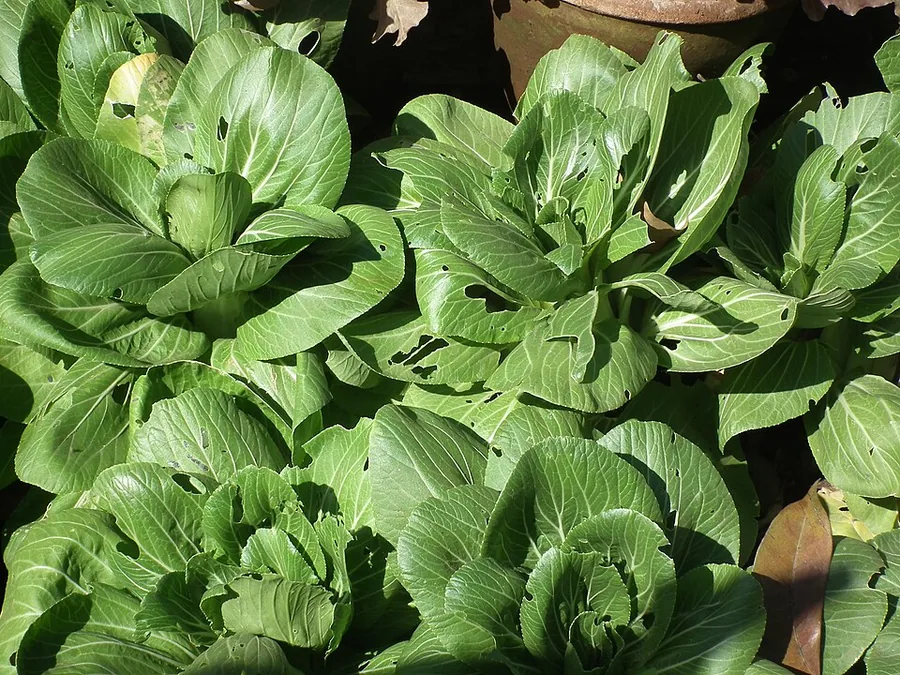
Fine round shothole punctures across the foliage
Numerous small round punctures are feeding damage from flea beetles, shiny black beetles that spring away when disturbed and concentrate on seedlings whose limited leaf area they can quickly overwhelm. A floating row cover applied at sowing excludes them physically. Sustained moisture and rapid growth let plants build leaf area faster than the beetles remove it.
Fix:
- Cover plantings with floating row cover at seeding
- Keep plants growing fast with steady water so they outgrow damage
Irregular chewed holes accompanied by dark green frass
Ragged holes with dark frass indicate cabbage caterpillars, a complex that includes imported cabbageworm, cabbage looper, and diamondback moth larvae. They feed and rest on the leaf undersides, where inspection and handpicking remove them. Where pressure is high, Bacillus thuringiensis applied to small larvae works because the toxin acts in the caterpillar gut before much damage is done.
Fix:
- Handpick caterpillars
- Apply Bacillus thuringiensis (Bt) while caterpillars are small
Slime trails and erosion at the lower leaf stalks
Silvery trails and eroded stalk bases mark slugs and snails, which feed nocturnally in the moist, sheltered interior at the plant's crown. Handpicking after dark or iron phosphate bait around the plants reduces the population. Removing mulch and debris near the stems eliminates the cool, damp daytime refuge they require.
Fix:
- Handpick at night
- Use iron phosphate slug bait around plants
- Reduce mulch and debris immediately around stems
Toxicity
Bok choy is a culinary vegetable, safe for people and absent from the ASPCA list of plants toxic to cats and dogs. The only real qualification is dose, because the goitrogenic glucosinolates common to all brassicas can interfere with digestion and cause gas or mild upset when an animal eats large raw amounts repeatedly. Horses are the notable exception, since extension guidance treats brassicas as poorly suited to the equine diet.
Safe for
People · Cats · Dogs · Horses · Rabbits · Livestock · Birds
Cats None
Bok choy does not appear on the ASPCA toxic list, so an exploratory bite poses no risk to a cat. A large quantity of raw leaves may produce some gas or mild gastrointestinal upset and nothing more serious.
Dogs None
A dog can be given a small amount of cooked or raw bok choy without concern. The only likely effect is gas or loose stools if a dog consumes a large raw portion in a single sitting.
Horses None
NC State Extension identifies this plant as one to exclude from a horse's diet, because brassicas are poorly tolerated by equines in quantity. An incidental leaf is harmless, but it should not become a regular feed.
Rabbits None
Rabbits tolerate small servings of the leafy greens well. The greens should be introduced gradually and kept in modest portions, since an abrupt load of rich brassica can leave a rabbit gassy.
Livestock None
Cattle, goats, and sheep can graze the leaves without real hazard. As with any brassica, a sole diet of it can disrupt rumen function, so it is best offered as one component of a mixed ration.
Birds None
Backyard hens and other birds readily peck at both the leaves and the bolted flowers. In moderation it serves as a wholesome green.
People Safe
Bok choy is cultivated for consumption and is safe in the kitchen, whether raw in salads or cooked in a stir-fry. Only a sustained habit of large raw amounts warrants attention, owing to the natural goitrogens shared across the cabbage family.
No special handling needed; safe to grow in household gardens.
Varieties
Bok choy is grown in white-stemmed and green-stemmed forms and in full-size and baby types. The following cultivars are the ones worth distinguishing.
Shanghai (green-stem) type
The Shanghai type, known as Shanghai Qing in China, bears spoon-shaped leaves on pale green petioles rather than white ones and is commonly harvested young as baby bok choy.
Dwarf types
Dwarf types are compact selections that reach roughly 6 inches, tolerate spacing as close as 12 inches apart, and mature quickly in confined plantings.
'Joi Choi'
'Joi Choi' is a vigorous white-stemmed hybrid valued for slow bolting and a wide tolerance of both cold and warm conditions.
'Mei Qing Choi'
'Mei Qing Choi' is a green-stemmed baby pak choi hybrid selected for strong resistance to bolting.
Companions
Bok choy grows best beside onions and aromatic herbs that throw pest-laying moths off the scent, and it shares a cool-season bed comfortably with beets.
Plant near
Onions: Extension companion-planting guides note onions get along well with all cabbage-family crops, and onion interplanting helped reduce cabbage looper and imported cabbageworm damage in brassica trials
Aromatic herbs (dill, sage, thyme, chamomile, rosemary): Cole crops do well planted with aromatic herbs; sage and thyme reduced diamondback moth pressure on brassicas in studies
Beets: Extension companion charts list beets as compatible neighbors for cabbage-family crops in the cool-season bed
How to propagate
Bok choy is propagated only from seed, among the most straightforward of garden sowings, with successive rows feasible every couple of weeks.
SeedEasy
Direct-sow or start indoors in early spring, and again in mid-to-late summer (around July) for a fall crop · Seed germinates in about 4-10 days in cool soil; plants reach transplant size in 3-4 weeks and harvest size in 40-60 days
Bok choy is raised exclusively from seed. Sow it a quarter to half an inch deep in early spring or again around July for a fall crop, and it germinates in 4 to 10 days in cool soil. Thin to one plant every 6 to 12 inches according to variety, after which the plant takes 3 to 4 weeks to reach transplant size and 40 to 60 days to a full head. Successive sowings every couple of weeks maintain a continuous supply.
Myths
Once bok choy starts to bolt, the plant is ruined and must be thrown out.
A bolting plant remains edible if it is harvested before the flowers open. Cut at that stage it eats much like a young one, only slightly more bitter as glucosinolates rise, and the developing flower stalks are themselves a worthwhile vegetable.
Bok choy needs full sun all day to make a crop.
Full sun maximizes growth rate and head size, but the plant does not require it. As little as 2 hours of direct sun a day still yields usable heads, since reduced light slows growth without preventing it.