Vegetable · Apiaceae
Florence Fennel
Foeniculum vulgare
Hold the plant in cool, even conditions and the leaf bases swell into a crisp, anise-sweet bulb.
Full sun
Every 2–4 days
50–77°F · 10–25°C
65–90 days
Overview
Florence fennel is the cool-season selection of the species, grown for the swollen leaf bases that form a white bulb at the crown rather than for the foliage. It belongs to the carrot family, the Apiaceae, which accounts for the finely divided, feathery leaves and their clean licorice scent. The bulb takes well to raw use in a salad or to roasting, where its sugars caramelize and turn sweet.
Success rests on timing more than labor, because the plant responds to daylength and temperature. The bulb sizes properly only under steady, mild conditions, and warmth combined with long summer days triggers the reproductive phase, sending the plant to flower before the leaf bases enlarge. For that reason a fall crop is the reliable choice, and even, sustained soil moisture lets the leaf bases stack into a firm bulb.
One trait separates fennel from its bed-mates. It is allelopathic, releasing compounds from roots and foliage that suppress the growth of nearby plants, so isolation serves it best. Sited apart from the main beds, it also functions as a larval host, drawing swallowtail butterflies that oviposit on the fronds.
Care
The short version: full sun, sustained moisture, and cool temperatures. Direct-sow into rich, well-drained soil, irrigate on a regular schedule so moisture stress does not provoke bolting or splitting, and time the crop for fall across most regions.
Light
Fennel requires full sun, six or more hours daily, to drive the photosynthate that fills the bulb. In hot-summer regions it tolerates light afternoon shade, and that shade moderates canopy temperature enough to delay the onset of bolting.
Water
Hold the soil consistently moist, irrigating every 2 to 4 days in dry weather. Moisture stress is a direct trigger for bolting and for small, split bulbs, so the watering regime carries more weight here than with most vegetables.
Soil
Use a fertile, well-drained loam amended with ample organic matter. A pH of 5.5 to 6.8 keeps nutrients available, and an open, friable structure lets the enlarging leaf bases expand without resistance.
Temperature
The crop performs in cool conditions, 50°F to 77°F (10°C to 25°C). Above that range heat shifts the plant into flowering at the expense of bulb formation, which is the physiological basis for favoring a fall crop over a summer one.
Humidity
Ambient outdoor humidity of 40% to 60% is adequate, so there is no target to manage. Air movement around the canopy contributes more to plant health than atmospheric moisture by suppressing foliar disease.
Feeding
Apply a balanced 10-10-10 or a low-nitrogen vegetable fertilizer monthly through the growing season. Excess nitrogen favors vegetative top growth and diverts resources from the leaf bases that form the bulb.
Pruning
Remove emerging flower stalks as soon as they appear to delay bolting and retain assimilate in the bulb. Harvest outer fronds for culinary use as needed, and mounding soil around the developing bulb blanches the tissue and tempers its flavor.
Repotting
Repotting does not apply. Fennel is direct-sown and left undisturbed, since the bulb type resents root disruption and any move tends to induce bolting.
Size & spacing
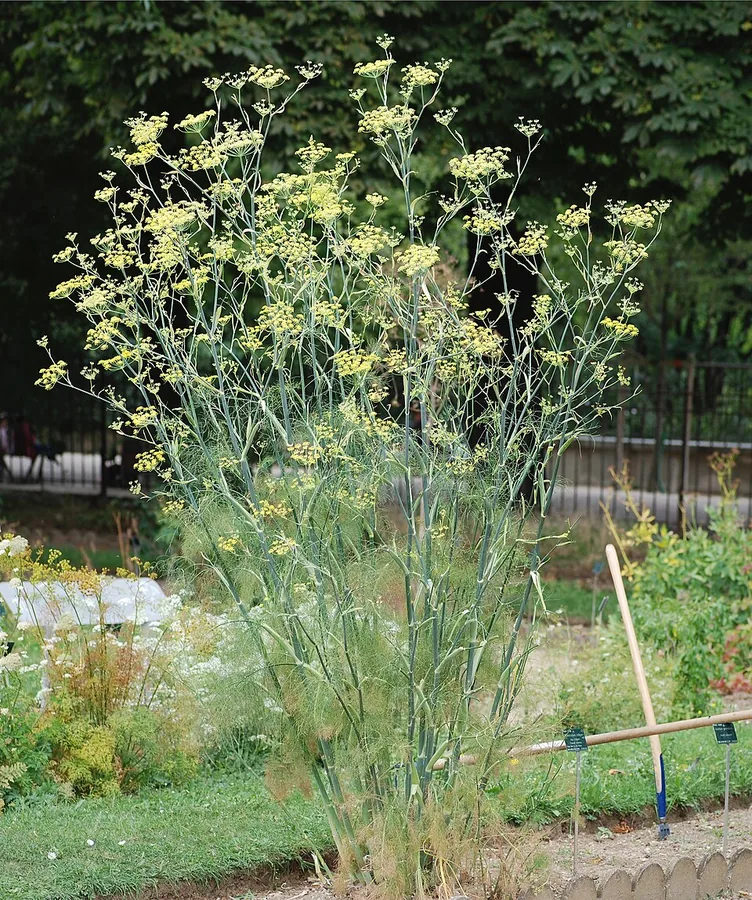
Mature plants stand 2 to 6 feet (60 to 180 cm) tall, taller if allowed to flower. Allot each plant 12 to 18 inches (30 to 45 cm), which gives the bulbs room to expand and maintains airflow through the stand.
When to plant
Fennel is a cool-season crop whose reproductive phase is cued by heat and long days, so timing governs the outcome. Direct-sow in late summer to size the bulb through a mild fall, or in early spring where the climate remains gentle, and harvest each bulb once it reaches fist size.
Northern hemisphere
Southern hemisphere
Typical months for a temperate climate: start earlier in warm zones, later where spring frosts linger.
- Sow: Not recommended; bulb fennel resents transplanting and root disturbance, so direct-sowing is preferred.
- Plant: Direct-sow in late summer for a fall crop to avoid heat- and long-day-induced bolting; can also be sown in early spring in mild regions.
- Harvest: Harvest the bulb when fist-sized (about 7-10 cm) and firm; alternatively allow the herb form to flower and set seed for culinary seed/frond use.
Hardiness
USDA hardiness zones: 4–9
Temperature: down to -34°C
Troubleshooting
Most fennel disorders trace to two drivers: temperature that initiates bolting, and inconsistent soil moisture that yields a small or split bulb. The symptoms appear early enough to correct the crop's course. Identify the pattern below, then intervene while the response still matters.
Premature flower stalk, no swelling at the base
This is bolting, the reproductive response in which heat and the long days of summer cue flowering before the leaf bases enlarge. Once the central stalk elongates the bulb will not develop, so the practical course is to harvest the fronds and seeds and sow a fresh crop in late summer for cooler fall maturation. A bolt-resistant cultivar paired with steady moisture limits recurrence.
Fix:
- Harvest fronds and seeds for culinary use since the bulb will no longer develop
- Sow a fresh crop in late summer for cooler fall maturation
Bulbs remaining undersized, loose, or split
Inconsistent moisture is the primary cause, because fennel depends on steady irrigation to develop a dense, firm bulb. Overcrowding and harvest delayed past maturity produce the same outcome, leaving the leaf bases thin and stringy or splitting the swollen bulb vertically. Thin seedlings to spacing, irrigate on a fixed schedule, and harvest as the bulbs reach fist size.
Fix:
- Maintain steady, even soil moisture
- Thin seedlings to recommended spacing
- Harvest promptly once bulbs reach fist size
Aphid colonies or banded larvae on the foliage
The soft new growth attracts aphids, while the conspicuously banded larvae are black swallowtail (Papilio polyxenes), for which fennel is a recognized host plant. Dislodge aphids with a water jet or treat with insecticidal soap. The caterpillars cause only cosmetic damage and many growers tolerate or relocate them, since they mature into swallowtail butterflies.
Fix:
- Spray aphids off with water or use insecticidal soap
- Hand-pick caterpillars (or relocate them, as they become swallowtail butterflies)
Toxicity
Fennel is safe across the board, both as food and around animals. The ASPCA classifies it as non-toxic to cats and dogs, and the entire plant is a recognized food for people and grazing livestock. The one qualification concerns the sap, which carries furanocoumarins that can render sensitive skin briefly photosensitive, so washing after prolonged handling is prudent.
Safe for
People · Cats · Dogs · Horses · Rabbits · Livestock · Birds
Cats None
The ASPCA records fennel as non-toxic to cats, so ingestion of the fronds carries no poisoning risk. As with any unfamiliar plant food, a large quantity may transiently loosen the stomach.
Dogs None
Dogs are unaffected by fennel, which appears on the non-toxic list. Some individuals are drawn to the licorice-scented foliage and consume it without consequence.
Horses Safe
Horses can graze fennel without harm, and it is sometimes offered as a flavorful supplement. No toxic constituent is present to cause concern.
Rabbits Safe
Rabbits tolerate the feathery fronds when fed in moderate amounts alongside their staple greens. Introduce it gradually, as with any fresh leaf, and the bulb is equally acceptable.
Livestock Safe
Goats, sheep, and cattle may browse fennel safely. The entire plant is edible, with no toxic parts to exclude from the herd.
Birds Safe
Backyard hens and companion birds consume the seed and foliage without harm. Fennel seed is in fact incorporated into some commercial bird feed mixes.
People Safe
Fennel is a dietary staple consumed raw, roasted, or as a seasoning, with every part usable. The single qualification is the sap, whose furanocoumarins can leave sensitive skin briefly photosensitive, so washing after extended handling is advisable.
Like other Apiaceae, fennel foliage and sap contain furanocoumarins that can cause mild photosensitivity or phytophotodermatitis in sensitive people after skin contact and sun exposure.
Varieties
Several fennels recur in cultivation, divided by whether they are grown for the bulb, the seed, or the foliage. The distinctions below are the ones worth keeping straight.
Florence fennel (var. azoricum)
This is the culinary type, selected for the broad white bulb of overlapping leaf bases that is sliced and used as a vegetable.
Zefa Fino
A Florence type selected for bolt resistance, which lets it set a solid bulb far more dependably under marginal or fluctuating weather.
Sweet fennel (var. dulce)
Selected for its anise-scented fronds and seed rather than a bulb, this is the fennel used to season sausage, bread, and tea.
Bronze fennel
An ornamental herb form with feathery bronze-purple foliage suited to the border and the butterfly garden, though it never forms a usable bulb.
Companions
Fennel is the rare plant that grows best with no company at all. Its allelopathic roots and foliage hold back most vegetable neighbors, so the best place for it is a bed of its own.
Keep apart
tomato: Fennel produces allelopathic compounds that can suppress tomato growth; it should be planted well away from the vegetable garden.
beans: Fennel's allelopathic root and foliage exudates inhibit beans and other legumes growing nearby.
most garden vegetables: Fennel inhibits the growth of most neighboring vegetables and is generally grown by itself, apart from the main garden.
How to propagate
Fennel is propagated by seed, the only practical method, because the taproot resents disturbance and transplanting reliably provokes bolting.
SeedEasy
Late summer for a fall crop, or early spring in mild climates · 7-14 days to germinate; about 65-90 days to a harvestable bulb
Sow fennel in situ, since the taproot resents disturbance and transplant shock frequently induces bolting. Time the sowing for late summer to yield a fall crop, or for early spring in mild climates. Germination occurs in 7 to 14 days, and a harvestable bulb develops in 65 to 90 days.
Myths
The edible bulb is a subterranean root or tuber.
The structure resembles a root but is not one. The edible bulb is a cluster of swollen, overlapping leaf bases at the base of the stem, positioned at or slightly above the soil surface. That anatomy is precisely why mounding soil around it blanches the tissue, the same principle applied to leeks.
Fennel acts as a protective companion for adjacent crops.
The evidence points the other way. Fennel is allelopathic, releasing compounds that inhibit many neighboring crops, including beans and tomatoes. Site it in its own area well away from the main beds rather than interplanting it as a protectant.