Vegetable · Fabaceae
Pea
Pisum sativum
Sow them while the soil is still cold, give them something to climb and steady moisture, and the pods come sweet and early.
Full sun
Every 3–7 days
45–75°F · 7–24°C
55–70 days
Overview
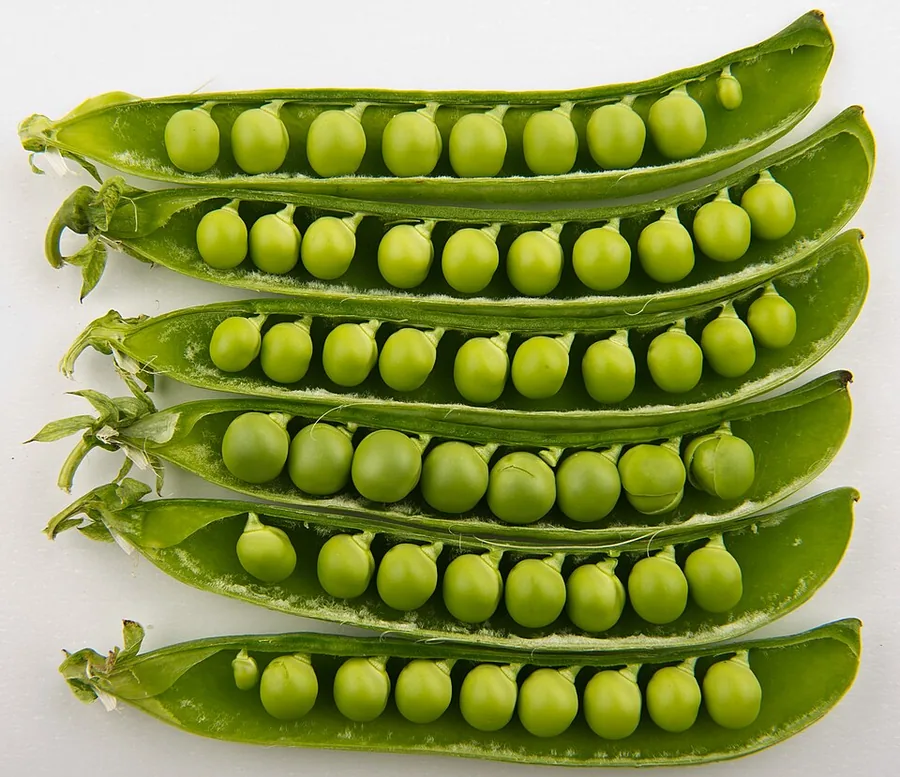
Peas are a cool-season legume, among the earliest sowings the spring garden allows. A member of the bean family, the crop adapts to a wide range of sites and produces climbing vines that anchor to a trellis by means of curling tendrils while carrying plump green pods. The garden pea, Pisum sativum, is the familiar shelling type valued for the sweet seeds borne within each pod.
What defines the crop agronomically is its low input demand. As a legume, the plant fixes atmospheric nitrogen through bacteria resident in its roots, so it supplies much of its own requirement and leaves residual fertility for the following crop. Direct sow the seed, provide support for the vines to climb, and maintain even soil moisture through flowering and pod fill.
Timing governs success more than any other factor. Peas perform in the cool conditions of early spring and decline once summer heat arrives, so the objective is to sow early and complete harvest before high temperatures set in. Meet that window and the yield is sweet, tender pods; miss it, and growth stalls while the seed turns starchy.
Care
The short version: full sun and cool weather, direct sown into rich, well-drained soil as early as the ground can be worked, with even moisture held through flowering, support for the vines, and no nitrogen feed.
Light
Peas set the heaviest crop in full sun, though they tolerate some afternoon shade, which in warmer sites helps by moderating temperature and extending the cool window. Light captured translates fairly directly into pod set, so exposure repays itself.
Water
Supply peas roughly 1 inch of water a week and hold it even, particularly through flowering and pod fill when the developing seed draws heavily on moisture. Wide swings from dry to saturated stress the plant, and waterlogged soil in particular predisposes the roots to rot.
Soil
Grow peas in well-drained loam amended with compost or other organic matter. The crop accepts a broad pH span of 6.0 to 7.5, but drainage outweighs almost every other soil factor, since saturated conditions decay the roots quickly.
Temperature
Peas are cool-season by nature and perform best between 45°F and 75°F (7°C to 24°C). They withstand light frost, but once temperatures exceed that range, flowering falters and pod production ceases as the crop passes its physiological optimum.
Humidity
Ambient outdoor humidity is adequate for peas, so no target level applies. Air movement is the operative variable, because still, damp, crowded foliage creates the conditions powdery mildew exploits.
Feeding
Peas are largely self-feeding. As a legume, the plant fixes its own nitrogen through Rhizobium bacteria in its roots, so feeding is minimal or omitted. On poor ground a light application of low-nitrogen phosphorus and potassium at planting suffices, whereas surplus nitrogen diverts the plant into foliage at the expense of pods.
Pruning
Peas require no routine pruning. Pinch the growing tip when a vine overtops its support, and remove mildewed or diseased leaves as soon as they appear to limit the spread of inoculum.
Size & spacing
The vines reach 2 to 6 feet (60 to 180 cm) depending on type, while each plant remains narrow at 6 to 12 inches (15 to 30 cm) across. Providing a trellis for the taller climbers directs growth vertically and keeps the foliage off the ground.
When to plant
Peas are a cool-weather crop poorly adapted to summer heat. Direct sow them into the garden in very early spring, as soon as the soil can be worked, and expect harvestable pods within a couple of months, ahead of the high temperatures that terminate the planting.
Northern hemisphere
Southern hemisphere
Typical months for a temperate climate: start earlier in warm zones, later where spring frosts linger.
- Plant: Direct sow in very early spring as soon as soil can be worked, when soil temperature reaches about 45°F; peas tolerate light frost.
- Harvest: Harvest shelling peas about 3 weeks after flowering when pods are well filled, plump, and bright green but before they become tough and starchy.
Hardiness
USDA hardiness zones: 2–11
Temperature: down to -46°C
Troubleshooting
Most pea disorders present on the foliage or at flowering, and the majority trace to temperature and soil moisture. Recognizing the early signs usually allows a correction before yield is lost. Match the symptom below, then respond while intervention still changes the outcome.
Seedling collapse with water-soaked, decayed roots
Seedlings that fail to emerge, or wilt and collapse with water-soaked stem bases and brown decayed roots, have succumbed to the root-rot complex of soil fungi including Fusarium, Pythium, and Aphanomyces, which is most aggressive in cold, wet, poorly drained soil. Affected plants cannot be rescued once the roots are compromised, so they should be removed and discarded while the drainage is corrected and replanting waits for warmer conditions. Crop rotation, well-drained beds, and treated seed break the disease cycle and reduce the inoculum that reinfects successive sowings.
Fix:
- Remove and discard affected plants
- Improve drainage and avoid overwatering
- Replant in well-drained soil once conditions warm
Chalky white fungal film on foliage and stems
That white coating is powdery mildew, driven by the fungus Erysiphe pisi, which colonizes the crop late in the season precisely because warm days paired with cool nights and crowded plantings favor it. Removing the worst foliage lowers the spore load, and widening the spacing lets air move through so leaf surfaces dry and the fungus loses its foothold, with a labeled fungicide reserved for severe cases. Because the pathogen builds through the season, an early sowing that matures the crop ahead of peak pressure is the most reliable defense.
Fix:
- Remove and destroy heavily infected foliage
- Improve air circulation by proper spacing and trellising
- Apply a labeled fungicide if infection is severe
Soft-bodied colonies distorting new growth
The soft green clusters on the shoot tips and leaf undersides are pea aphids, Acyrthosiphon pisum, which feed on tender growth and excrete honeydew that in turn attracts ants and supports sooty mold. A strong water spray physically dislodges the colonies, and insecticidal soap or horticultural oil handles persistent infestations while sparing the lady beetles and lacewings that regulate them. Excess nitrogen works against you here, since it flushes the soft succulent tissue aphids preferentially colonize, so restraint at the fertilizer stage is itself a control.
Fix:
- Dislodge aphids with a strong spray of water
- Use insecticidal soap or horticultural oil
- Encourage natural predators such as lady beetles and lacewings
Abundant bloom with poor pod set
Flowers that form but fail to set pods point to heat stress, since temperatures above the cool-season optimum trigger blossom drop and depress pod set in a crop adapted to cool conditions. A secondary driver is excess nitrogen, which pushes the plant toward vegetative growth, so a lush, leafy specimen bearing few pods is a telling sign. Even soil moisture through flowering, afternoon shade during heat waves where practical, and scheduling so flowering falls in cool weather all keep reproduction on track.
Fix:
- Maintain even soil moisture during flowering
- Provide afternoon shade during heat waves where practical
- Time plantings so flowering avoids hot weather
Toxicity
The verdict here is straightforward: the garden pea is entirely safe. Its seeds, pods, and tender shoots are all edible, and no part is toxic to people or pets. The one caution is not to confuse it with the ornamental sweet pea (Lathyrus), a separate plant whose seeds are not fit to eat.
Safe for
People · Cats · Dogs · Horses · Rabbits · Livestock · Birds
Cats None
Because the garden pea is absent from the ASPCA toxic list, a cat that samples a vine or pod faces no adverse effect. A few cooked peas amount to nothing more than a harmless treat.
Dogs None
Peas are safe for dogs, which is why plain shelled peas are a routine ingredient in commercial dog foods. No tissue of the plant carries a poisoning risk.
Horses Safe
Horses tolerate pea foliage without harm. As with any rich green forage, a gradual introduction rather than an abrupt one is the sound approach.
Rabbits Safe
Rabbits readily take pea leaves, vines, and pods, all of which are safe to offer. The plant contains no toxins that would affect them.
Livestock Safe
Because peas are cultivated as a forage and fodder crop, cattle, goats, and sheep can consume the plant without risk.
Birds Safe
Chickens and other birds forage on peas without hazard. The seeds supply a wholesome, protein-rich food.
People Safe
The garden pea is a well-known culinary vegetable consumed as shelled peas, whole pods, or tender shoots. The entire plant is safe in the kitchen.
Pea seeds, pods, and shoots are commonly eaten; no special handling precautions are required for the edible garden pea.
Varieties
Most home gardeners rely on a limited set of dependable shelling cultivars. These are the ones worth knowing by name.
Little Marvel
A compact, early dwarf shelling cultivar reaching about 18 inches, which suits small gardens and short growing seasons.
Green Arrow
A productive selection bearing long, slender, well-filled pods of 8 to 11 peas each with resistance to many common diseases.
Wando
A shelling cultivar selected for greater heat tolerance, which extends the sowing window slightly later into spring.
Alaska
A very early smooth-seeded type whose reliable germination in cold soil recommends it for the earliest plantings.
Companions
Peas grow happily beside quick crops and other vegetables that share the bed well, and they leave the soil richer for the nitrogen they fix. Keep them clear of onions and garlic, which are reported to stunt them.
Plant near
Carrots: Commonly grown with peas as compatible bed companions that use space efficiently.
Radishes: Quick-maturing companion harvested before peas need the space.
Cucumbers: Listed as a compatible companion that benefits from the nitrogen peas contribute to the soil.
Beans: Another legume considered a compatible companion in the vegetable bed.
How to propagate
Propagation is uncomplicated. Peas are raised from seed sown directly at the cropping site, which is the only method the crop rewards.
SeedEasy
Direct sow in very early spring as soon as the soil can be worked and reaches about 45°F. · Seeds typically germinate in 7 to 14 days depending on soil temperature.
Peas are best direct sown rather than transplanted, because the root system resents disturbance and establishes poorly once moved. Place the seed 1 to 1.5 inches deep as soon as the soil can be worked in early spring, around 45°F (7°C), after which germination follows in 7 to 14 days as a function of soil temperature. Install a trellis or netting early for the climbing types, and on ground with no history of peas, treating the seed with Rhizobium inoculant establishes the symbiosis that lets the plants fix their own nitrogen.
Myths
All peas are interchangeable, so the ornamental sweet pea is safe to eat like the garden pea.
The distinction is botanical: the garden pea grown for shelling, Pisum sativum, is a non-toxic vegetable, whereas the ornamental sweet pea, Lathyrus odoratus, is a separate species whose seeds are toxic and can cause lathyrism. Never treat a sweet pea as food, regardless of how similar the common names appear.
Peas need heavy nitrogen feeding to crop well, like other vegetables.
As legumes, peas fix atmospheric nitrogen through bacteria housed in their root nodules, which largely covers their own requirement and makes heavy feeding unnecessary. Excess nitrogen drives foliage at the expense of pods, producing the reverse of the intended result.