Vegetable · Fabaceae
Snap Pea
Pisum sativum var. macrocarpon
A cool-season legume that fixes its own nitrogen and rewards early sowing with sweet, crisp edible pods.
Full sun
Every 5–7 days
39–75°F · 4–24°C
55–70 days
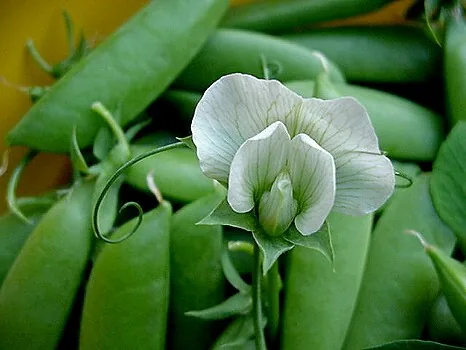
Overview
The snap pea is a cool-season legume (Pisum sativum var. macrocarpon) grown for its rounded, well-filled pods, which are eaten intact. It arose from a cross between the flat-podded snow pea and the round-seeded shelling pea, and that parentage explains its combination of sweetness and crisp texture. As a member of the bean family, it forms a partnership with root bacteria that fix atmospheric nitrogen, which is why the plant supplies much of its own fertility.
Its cool-season physiology drives every scheduling decision. Sowing begins as soon as the soil is workable in early spring because the plant grows and flowers best in mild conditions and shuts down under heat. Habit varies with cultivar: vining types reach 5 to 6 feet and require a trellis, while bush types stay near 2 feet, so support needs follow directly from the type chosen.
Cultural difficulty is low, but the margin for a late start is narrow. Given adequate sun, even moisture, and support, the crop is largely self-sufficient. The limiting factor is temperature at flowering: pods that develop in warm weather turn fibrous, and reproductive growth ceases as heat rises, so timing outweighs almost every other input.
Care
The short version: site the crop in full sun and sow early in spring, provide well-drained soil and roughly an inch of water weekly, restrict nitrogen because the plant fixes its own, and trellis the vining types.
Light
Yield is highest in full sun, since flowering and pod fill are light-driven; partial shade is tolerated and can extend the season where spring warms quickly. Below that threshold, growth goes into thin, elongated stems rather than pods.
Water
Supply about 1 inch of water a week, wetting the soil several inches deep, and keep moisture even through flowering and pod development, the stages most sensitive to water stress. Apply it at the soil line rather than overhead, because dry foliage limits the leaf wetness that fungal disease requires.
Soil
Use well-drained loam at a pH of 6.0 to 7.5, the range that keeps nutrients available to peas. Drainage is the decisive factor, since roots in cold, saturated soil are the ones that succumb to rot.
Temperature
Growth optimizes in cool conditions between 39°F and 75°F (4°C to 24°C). As temperatures reach the mid-80s, flowering falters and the plant enters decline, the physiological basis for sowing as early as the season allows.
Humidity
Ambient outdoor humidity of 40% to 70% is adequate and needs no adjustment outdoors. The variable that matters is air movement, because stagnant humid air around crowded plants favors powdery mildew infection late in the season.
Feeding
Because the crop fixes atmospheric nitrogen through root-nodule bacteria, it requires little to no supplemental feeding. A low-nitrogen formulation such as 5-10-10 is warranted only on genuinely poor soil, and surplus nitrogen shifts growth toward foliage at the expense of pod set.
Pruning
No pruning is horticulturally necessary; pinching the growing tips is optional and simply limits the height of tall vines. After the final harvest, remove and compost the spent vines to clear the bed.
Size & spacing
Mature height ranges from 2 to 6 feet (60 to 180 cm) according to habit, over a narrow spread of 6 to 12 inches (15 to 30 cm). The taller vining forms require trellising for support, and adequate spacing sustains the airflow that suppresses foliar disease.
When to plant
Snap pea scheduling is governed by heat tolerance. Direct-sow into workable soil in early spring, about 4 to 6 weeks before the last frost, so flowering and pod set fall in the cool window; harvest then runs from late spring into early summer, ending as temperatures climb.
Northern hemisphere
Southern hemisphere
Typical months for a temperate climate: start earlier in warm zones, later where spring frosts linger.
- Sow: Not typically started indoors; direct sow
- Plant: Early spring, as soon as the soil is workable and at least 45°F (7°C); about 4-6 weeks before the last frost
- Harvest: Late spring to early summer, roughly 55-70 days after sowing
Hardiness
USDA hardiness zones: 2–11
Temperature: down to -46°C
Troubleshooting
Most snap pea disorders track back to weather and timing rather than cultural neglect, so diagnosis starts with the season. Inspect the foliage and pods for the early signs described below, and intervene before a problem compounds. Read the symptom, confirm the cause, and act while the crop is still viable.
Basal leaves yellowing with overall stunting
Yellowing lower leaves on stunted plants indicate root rot or Fusarium wilt, soil-borne pathogens that establish in cold, waterlogged ground. Rogue out and discard affected plants, as browned, rotted roots cannot recover. Managing it depends on prevention: well-drained soil, crop rotation, and resistant cultivars break the cycle these pathogens rely on.
Fix:
- Remove and discard affected plants
- Improve soil drainage
White powdery growth colonizing the foliage
The powdery white layer is powdery mildew, a fungus that establishes late in the season when warm dry days alternate with cool humid nights, the conditions its spores favor. Remove the most heavily colonized vines, increase air circulation to lower leaf-surface humidity, and apply sulfur or a labeled fungicide if it advances. Because infection peaks with heat, early sowing that matures the crop beforehand is the most reliable control.
Fix:
- Remove severely affected vines
- Improve air circulation
- Apply a labeled fungicide or sulfur if needed
Distorted, sticky foliage carrying small green insects
The soft green insects massed at the shoot tips are pea aphids, which damage tissue by sap-feeding and, more seriously, transmit viruses between plants. Dislodge them with a strong water spray, treat with insecticidal soap, and support the lady beetles that prey on them. Restricting nitrogen matters here, since the succulent growth that excess nitrogen produces is what attracts colonization.
Fix:
- Spray plants with a strong stream of water
- Apply insecticidal soap
- Encourage natural predators such as lady beetles
Flower abscission with no pod set
When flowers drop and no pods form, the cause is heat: above roughly 85°F (29°C), snap peas halt flowering and pod set altogether. No in-season treatment reverses it, so harvest remaining pods and transition the bed to a warm-season crop. The mechanism is why timing is the true control, sowing early enough that flowering occurs under cool conditions.
Fix:
- Harvest any remaining pods promptly
- Replace with a warm-season crop
Pods becoming fibrous and starchy
Pods left past maturity convert their sugars to starch, and the tissue becomes fibrous and tough as the seeds enlarge. There is no remedy for overmature pods beyond discarding them. Harvesting every 1 to 3 days, while pods remain plump but tender, keeps the crop at eating quality.
Fix:
- Harvest promptly when pods are plump but still tender
- Pick every 1-3 days
Toxicity
Snap pea is an edible species with no toxic principle, and all parts are safe to consume, including pods, seeds, shoots, and flowers. It presents no hazard to people or animals. The one caution is taxonomic: do not confuse it with the ornamental sweet pea (Lathyrus), a separate genus that is toxic and not a food plant.
Safe for
People · Cats · Dogs · Horses · Rabbits · Livestock · Birds
Cats None
Snap peas contain no toxin harmful to cats, so a chewed vine or an eaten pod poses no risk. Ingesting a large volume of plant material may cause transient gastrointestinal upset, as any bulk of greens can.
Dogs None
Dogs tolerate snap peas without harm, and a fresh pod is a palatable low-risk snack. The only likely effect is mild digestive disturbance following a sudden increase in vegetable intake.
Horses Safe
Pods, foliage, and vines are all safe forage for horses. Peas add modest dietary protein, though they are better offered occasionally than as a primary feed.
Rabbits Safe
Rabbits digest snap pea leaves, pods, and shoots well, and these make a suitable component of their greens. Any new forage should be introduced gradually to allow the gut flora to adjust.
Livestock Safe
Cattle, goats, and sheep can graze pea vines safely, and the foliage is an established forage. No toxic principle limits intake.
Birds Safe
Poultry and other birds consume peas and tender shoots without risk. The seed is a useful protein source in their diet.
People Safe
Snap peas are cultivated specifically for consumption, eaten pod and all, raw or lightly cooked. They are a safe, sweet vegetable suitable for the whole household, children included.
No special handling needed; this is a safe edible crop.
Varieties
Snap pea cultivars sort chiefly by mature height and by pod character. The following are the reference types worth distinguishing.
Sugar Snap
The original sugar snap cultivar, a vine of 5 to 6 feet bearing plump, rounded pods sweet enough to eat whole directly from the plant.
Sugar Ann
A compact, early-maturing bush type of roughly 2 feet that requires little or no support.
Snow pea (var. saccharatum)
An edible-pod pea grown for flat, tender pods harvested before the seeds enlarge, the trait that distinguishes it from the round-podded snap pea.
Companions
Peas grow well alongside cucumbers and other legumes that share their easygoing habits, and poorly next to onions and their allium kin, which stunt legume growth.
Plant near
cucumbers: Listed as a compatible companion for peas in extension companion-planting guidance.
beans: Other legumes pair well with peas and similarly help build soil nitrogen.
Keep apart
onions: Alliums such as onions can stunt the growth of legumes and should not be interplanted with peas.
How to propagate
Snap pea is propagated by direct-sown seed, the standard and simplest method for establishing the crop.
SeedEasy
Direct sow in early spring as soon as the soil is workable and at least 45°F (7°C) · Germinates in about 7-14 days; pods ready to harvest in roughly 55-70 days
Snap pea is direct-sown rather than raised as transplants. Sow seed 1 to 1.5 inches deep and 1 to 2 inches apart once the soil is workable in early spring, and install a trellis or netting for the vining types at planting. Germination takes about 7 to 14 days and pods reach harvest in roughly 55 to 70 days; inoculating the seed with Rhizobium bacteria at sowing improves nitrogen fixation.
Myths
Peas require heavy nitrogen fertilizer for a good crop.
The premise ignores the crop's biology: peas obtain nitrogen through symbiotic root bacteria and rarely need feeding. Excess nitrogen suppresses pod set, diverting growth into foliage instead of harvest.
All edible-pod peas are the same vegetable.
They separate into distinct types by pod and use. Snap peas bear plump, rounded pods eaten whole, snow peas produce flat pods harvested before seed enlargement, and shelling peas are grown for the seed alone, with the pod discarded.
Ornamental sweet peas and snap peas are interchangeable.
They belong to different genera and are not interchangeable. The ornamental sweet pea is Lathyrus, which is toxic and never a food crop, whereas only Pisum sativum peas such as the snap pea are cultivated for eating.