Vegetable · Fabaceae
Lentil
Lens culinaris
Sown early into cool, well-drained ground, this hardy legume fixes its own nitrogen and repays the grower at harvest.
Full sun
Every 7–14 days
39–81°F · 4–27°C
80–110 days
Overview
Lentil is a cool-season annual legume cultivated for its small, protein-rich seeds, a crop that has sustained human diets for thousands of years across the Middle East, the Mediterranean, and South Asia. Its habit is short and slender, mature height held to 12 to 20 inches (30 to 50 cm), and it completes its cycle from sowing to dry pod within one season. Established stands demand little intervention.
The defining trait separating lentil from most garden vegetables is its symbiosis with soil bacteria. In common with other legumes it develops root nodules in which Rhizobium bacteria reduce atmospheric nitrogen into a form the plant can use, so the crop supplies much of its own nitrogen and leaves residual fertility behind. That property makes lentil a valued rotation crop, interrupting disease cycles and lowering the nitrogen requirement of the crop that follows.
Above all this is a crop governed by planting date and drainage. It withstands light frost, drought, and low fertility, yet it has no tolerance for saturated soil or a crowded, weedy stand. Establish it while the soil remains cool, provide full sun and adequate spacing, and the stand largely carries itself to harvest.
Care
The short version: lentils want full sun, lean well-drained soil, and a cool early-spring sowing. Maintain even moisture through flowering and pod fill while keeping the roots from standing wet, and forgo nitrogen because the plant fixes its own.
Light
Lentils are a full-sun crop and yield best under all-day light, tolerating only a little partial sun. Their short, slender habit makes them weak competitors, so shading from taller plants or weeds directly reduces their performance.
Water
Supply even moisture during germination, flowering, and early pod fill, then reduce it, since established plants tolerate drought. Watering about every 7 to 14 days meets the demand on most soils. Overwatering is the greater hazard, because saturated ground drives the root rot and seedling disease that this crop is prone to.
Soil
Grow lentils in well-drained sandy loam to loam, where drainage governs success more than fertility does. A pH of 6.0 to 7.5 suits both the plant and the Rhizobium bacteria it depends on for nitrogen fixation. Heavy, poorly drained soil is the condition to avoid.
Temperature
As a cool-season crop lentil operates across a broad range, roughly 39°F to 81°F (4°C to 27°C). Seedlings tolerate light frost, but heat and drought during flowering suppress pod set, which is why early sowing to flower ahead of summer heat is the sound strategy.
Humidity
Lentils favor low humidity, around 30% to 50%, consistent with their productivity in open, breezy fields. Damp, still air promotes blight and white mold, so adequate spacing and a canopy that dries quickly reduce disease pressure.
Feeding
Withhold nitrogen, because as a legume the lentil fixes its own via Rhizobium nodules. Inoculate the seed with the correct Rhizobium rather than applying N, and add only a low-nitrogen starter or phosphorus and sulfur when a soil test indicates a deficiency.
Pruning
Lentils require no pruning. Control weeds early, since the short canopy competes poorly, and remove diseased debris at season's end to reduce the inoculum that would otherwise overwinter and reinfect.
Size & spacing
Mature plants remain compact at 12 to 20 inches (30 to 50 cm) tall and 8 to 12 inches (20 to 30 cm) across. Avoid dense stands, because crowding promotes lodging and holds humid, still air at the canopy base where disease develops.
When to plant
Lentil is a cool-season crop sown early and harvested in late summer. Direct-sow in early spring as soon as the soil is workable, near 4°C (40°F), because the seedlings withstand light frost. Harvest follows 80 to 110 days later, once the lower pods turn brown and dry and the plant begins to yellow.
Northern hemisphere
Southern hemisphere
Typical months for a temperate climate: start earlier in warm zones, later where spring frosts linger.
- Plant: Direct-sow in early spring as soon as the soil can be worked and soil temperatures reach about 4°C (40°F); seedlings tolerate light frost.
- Harvest: Harvest when the lower pods turn brown and dry and the plant begins to yellow.
Hardiness
USDA hardiness zones: 3–8
Temperature: down to -40°C
Troubleshooting
Most lentil problems originate in cool, wet weather or in soil that drains poorly. Inspect the leaves, stems, and roots across the season and match the observed symptom to the entries below before an isolated case spreads through the stand.
Wilting, stunted plants dying back from root decay or stem mold
Wet soils favor a root rot complex of Fusarium, Aphanomyces, and Rhizoctonia, which degrades the root system and starves the top of water and nutrients until the plant dies. Under dense, humid canopies the culprit is instead white mold, the Sclerotinia fungus whose fluffy mycelium colonizes stems and leaves behind the hard black sclerotia that survive to reinfect. Neither responds to rescue treatment once established, so rogue and destroy affected plants, correct the drainage that let it start, avoid overwatering, and use long rotations away from susceptible broadleaf and pulse crops.
Fix:
- Improve drainage and avoid overwatering
- Remove and destroy affected plants
- Rotate away from susceptible broadleaf and pulse crops
Dark-bordered tan lesions across leaflets and stem tissue
Dark-margined tan lesions signal ascochyta blight, driven by the fungus Ascochyta lentis, which sporulates and spreads whenever cool, wet weather keeps the foliage wet for long stretches. The pathogen persists on infected seed and on last season's residue, so those carry the inoculum into a new crop. Break that chain with certified disease-free seed, a 3 to 4 year gap between pulses, and destruction of infected debris after harvest.
Fix:
- Use certified disease-free, fungicide-treated seed
- Apply a registered foliar fungicide when conditions favor disease
- Remove and destroy infected residue after harvest
Sticky, distorted growing points colonized by small soft-bodied insects
Colonies of small soft insects on the growing points are pea aphids, which feed on phloem sap and excrete the sticky honeydew that films the leaves and curls them. Their natural enemies, chiefly lady beetles and lacewings, regulate light populations, so conserving those predators is the first line of defense. Reserve a registered insecticide for populations above economic thresholds, and withhold excess nitrogen, since the tender flush it drives is exactly the tissue aphids exploit.
Fix:
- Encourage natural enemies such as lady beetles and lacewings
- Treat with a registered insecticide if populations exceed economic thresholds
Stands collapse and mat together prior to harvest
A collapsed, matted canopy is lodging, the failure of weak stems under the load of a dense stand or lush growth, often triggered by wind and rain. Once the canopy is down, pods lie against damp soil and rot, and the cutter cannot lift them cleanly, so losses mount. Harvest promptly at maturity to cap those losses, and prevent recurrence by cutting the seeding rate, moderating nitrogen, and choosing more upright cultivars.
Fix:
- Harvest promptly once mature to limit losses
- Reduce seeding rate and avoid excess nitrogen in future plantings
Flower abscission and reduced pod set under high heat
A hot, dry spell during bloom imposes heat and moisture stress that aborts flowers before they set pods, which is why pod set falls off in warm, droughty seasons. Because the vulnerable window is flowering itself, the effective levers are timing and moisture. Sow early so flowering finishes ahead of peak summer heat, maintain even moisture through flowering and early pod fill where irrigation allows, and select heat-tolerant cultivars in warm regions.
Fix:
- Provide even moisture through flowering and early pod fill where possible
- Plant early so flowering precedes peak summer heat
Toxicity
For households with pets the assessment is reassuring: the lentil plant is safe across every species considered. It does not appear on the ASPCA's toxic list, and cooked lentils are a wholesome food for people and animals. The one qualification is that dry, raw lentils require cooking before people consume them, a matter of food preparation rather than toxicity.
Safe for
People · Cats · Dogs · Horses · Rabbits · Livestock · Birds
Cats Safe
Because Lens culinaris is absent from the ASPCA's toxic list, a cat that samples the foliage faces no poisoning risk.
Dogs Safe
The foliage carries no canine toxin, and cooked lentils appear as a formulated ingredient in many dog foods.
Horses Safe
The plant holds no compounds toxic to equines, so a horse grazing nearby is at no risk.
Rabbits Safe
Rabbits digest the leaves without harm, though sound feeding keeps the plant as one component of a mixed diet rather than the whole.
Livestock Safe
Ruminants such as cattle, sheep, and goats consume lentil forage and residue without poisoning, and the crop serves as a pulse feed in many systems.
Birds Safe
Poultry and wild birds ingest lentil seed without harm, and the cooked grain is likewise safe.
People Safe
Humans eat lentils as a global dietary staple, provided the dry seeds are cooked first, since raw lentils contain lectins and other antinutrients.
Raw, dry lentils contain lectins and other antinutrients and are cooked before human consumption; this is a food-preparation matter, not a pet-poisoning hazard.
Varieties
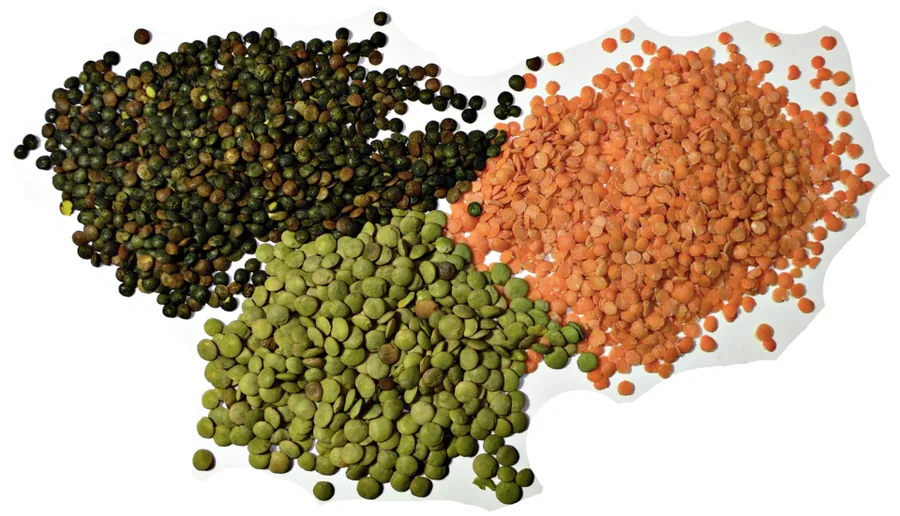
Lentil cultivars differ in seed color and size, and a small set recurs consistently in gardens and kitchens. The following types are the ones worth recognizing.
Laird
Laird is a large green seeded type grown widely because its broad, flat seeds cook up plump.
Eston
Eston is a small green seeded cultivar valued for strong yields paired with early maturity.
Pardina
Pardina, a small Spanish brown lentil, earns its culinary reputation by holding its shape after cooking.
Crimson / red cotyledon types
The crimson or red cotyledon types have a salmon interior, sell largely as split seed, and break down quickly into soups and dals.
Beluga
Beluga is a tiny, glossy black lentil resembling caviar that retains a firm texture through cooking.
How to propagate
Lentil is raised from seed exclusively, which keeps establishment straightforward. Sow directly into the garden and let cool spring soil complete germination.
SeedEasy
Direct-sow in early spring once soil can be worked, about 4°C (40°F) soil temperature. · Seedlings emerge in roughly 7-14 days under cool moist conditions.
Lentil propagates readily from seed sown in place. Direct-sow in early spring as soon as the soil is workable and reaches roughly 4°C (40°F), placing seed 2 to 4 cm (about 1 inch) deep in a firm, well-drained seedbed so the radicle meets consistent moisture. Inoculate the seed with the appropriate Rhizobium beforehand to secure nodulation and nitrogen fixation, after which emergence follows in 7 to 14 days under cool, moist conditions.
Myths
Lentils require generous nitrogen fertilization comparable to typical garden vegetables.
As a legume, lentil fixes atmospheric nitrogen through Rhizobium nodules on its roots, so it seldom benefits from a nitrogen feed. Heavy nitrogen instead drives vegetative growth at the expense of pod set, the same imbalance excess N causes in most crops. Correct Rhizobium inoculation of the seed outperforms applied nitrogen.
Lentils demand frequent irrigation to produce a good yield.
Once established the crop tolerates drought, and it declines in saturated soil, where the root rot pathogens take over. Well-timed moisture at the sensitive stages beats constant irrigation. Supply water through germination, flowering, and early pod fill, then reduce it.