Vegetable · Fabaceae
Chickpea
Cicer arietinum
An ancient legume that feeds itself from the air.
Full sun
Every 7–10 days
50–86°F · 10–30°C
90–120 days
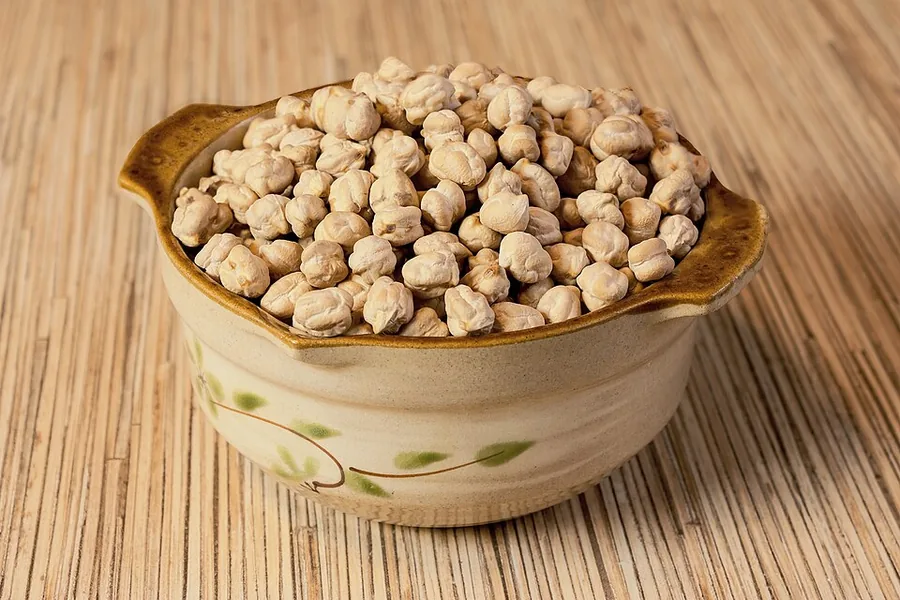
Overview
Chickpea (Cicer arietinum) is an annual vegetable legume in the family Fabaceae and one of the oldest cultivated crops, traced to the Near East thousands of years ago. It also answers to garbanzo bean, Bengal gram, Egyptian pea, and ceci bean.
The plant is a bushy, knee-high annual with small fern-like leaves. A defining trait is the coating of fine glandular hairs over the whole plant, which secrete an acidic exudate, mainly malic and oxalic acid. Seeds form two or three to a short puffy pod.
Rated moderate in difficulty, chickpea rewards growers who respect its cool-season timing and its drainage needs. As a nitrogen-fixing legume it makes most of its own nitrogen, so the management here is less about feeding and more about sun, water, and avoiding disease.
Care
The short version: Chickpea is a cool-season annual that wants full sun, sharp drainage, and very little fuss. Because it partners with Rhizobium bacteria to fix its own nitrogen, you feed it once at planting and let it work. Sow early in spring, water deeply but infrequently, and hold the moisture steady through flowering so the plant sets pods. Pull it after the pods brown.
Light
Give chickpea full sun; it does not tolerate shade. Light is the engine behind pod production, so a shaded plant turns out fewer pods and a weaker frame overall. Site it where nothing taller will shadow it through the season.
Water
Water deeply roughly every 7 to 10 days, and keep moisture even during flowering and pod fill, the two stages most sensitive to drought stress. The plant is drought-tolerant once established, but avoid waterlogged soil: saturated ground starves roots of air and invites root rot. As pods dry toward harvest, reduce water to let them finish.
Soil
Plant in well-drained sandy loam to loam, where drainage counts for more than richness. Aim for a pH of 6.0 to 8.0; the plant tolerates mildly alkaline ground without complaint. Sharp drainage is the priority because standing water at the roots is the main route to root rot.
Temperature
The comfort band runs from 50°F to 86°F (10°C to 30°C). Seedlings shrug off light frost, which is part of why early spring sowing works. The critical limit is heat during flowering: temperatures above the cool-season optimum make flowers drop before they can set pods, so plan the season to keep that stage cool.
Humidity
Chickpea prefers low humidity, 30% to 50%. Dry air around the canopy is protective, while damp, still air encourages leaf diseases by keeping foliage wet long enough for fungal spores to take hold. Good spacing and airflow reinforce the low-humidity advantage.
Feeding
Feed only at planting. As a nitrogen-fixing legume, chickpea makes most of its own nitrogen, so a phosphorus starter plus a Rhizobium inoculant at sowing is usually all it needs. Excess nitrogen is harmful here: it is wasted on a plant that supplies its own and can suppress the nodulation the crop depends on.
Pruning
No pruning is required. This is a bushy annual that grows to maturity, delivers its pods, and is then pulled after harvest. There is no woody structure to shape and no benefit to cutting it back.
Repotting
Not applicable (field/garden annual, not container-grown long term)
Size & spacing
Expect a compact plant 12 to 24 inches (30 to 60 cm) tall with a spread of 8 to 18 inches (20 to 45 cm). That tidy footprint slots neatly into rows or among cool-season crops, and adequate spacing also keeps the canopy open, which works with the plant's preference for dry, moving air.
When to plant
Chickpea runs on a cool-season clock: direct-sow early-to-mid spring once the soil is workable and warmed to about 50°F (10°C), then count on 90 to 120 days to maturity. Timing the spring sowing matters because it places flowering and pod fill ahead of peak summer heat, which is when high temperatures cause flowers to drop. Let pods brown on the plant for dry seed, or harvest green immature seeds earlier for fresh use. Suited to temperate hardiness zones.
Northern hemisphere
Southern hemisphere
Typical months for a temperate climate: start earlier in warm zones, later where spring frosts linger.
- Plant: Direct-sow in early-to-mid spring once soil is workable and has warmed to about 10°C (50°F); chickpea is a cool-season crop that tolerates light frost as a seedling.
- Harvest: Harvest green (immature) seeds earlier for fresh use; for dry seed, harvest when the whole plant and pods have dried and turned brown.
Hardiness
USDA hardiness zones: 4–10
Temperature: down to -34°C
Troubleshooting
Most serious chickpea trouble comes from fungal pathogens that move through cool wet weather or infested soil, plus heat at the wrong moment. Reading the early signs, then splitting a stem or looking closely at lesions, tells you which problem you have and how much can still be saved.
ASCOCHYTA BLIGHT
Brown to tan lesions with dark margins, often in concentric rings, appear on leaves, stems, and pods, with rapid collapse in cool wet weather. This is ascochyta blight (Ascochyta rabiei), the most damaging chickpea disease; it spreads fast in cool rainy conditions and rides in on infected seed and residue. Confirm by finding tiny dark fruiting bodies, the pycnidia, arranged in concentric rings inside the lesions. Use certified disease-free treated seed, apply registered foliar fungicides preventively in high-risk wet seasons, and remove and destroy infected residue. To prevent it, grow resistant varieties, rotate out of chickpea and pulses for several years, avoid overhead watering, and sow clean seed.
Fix:
- Use certified disease-free, treated seed
- Apply registered foliar fungicides preventively in high-risk wet seasons
- Remove and destroy infected crop residue
FUSARIUM WILT
Watch for yellowing, wilting, and stunting, with plants dying in scattered patches. The cause is fusarium wilt (Fusarium oxysporum f. sp. ciceris), a soil fungus that clogs the plant internally; it is worse in warm soils and infested fields, and there is no cure once established. Confirm by splitting the lower stem or taproot to reveal internal vascular discoloration, the browning left where the fungus has blocked the plant's plumbing. Remove and destroy affected plants, improve drainage, and avoid overwatering. Prevent it with resistant cultivars, crop rotation, and by steering clear of fields with a history of the disease.
Fix:
- Remove and destroy affected plants
- Improve drainage and avoid overwatering
HEAT-INDUCED FLOWER DROP
Flowers drop and few or no pods set during hot spells. This is heat stress above the cool-season optimum during flowering, worsened by moisture stress and dry soil at the same stage. Hold even soil moisture through flowering, and time planting so the reproductive stage avoids peak summer heat. The reliable prevention is to sow early in spring so flowering lands in cooler conditions, and to choose adapted varieties.
Fix:
- Maintain even soil moisture during flowering
- Time planting so flowering avoids peak summer heat
Toxicity
Chickpea carries a toxicity rating of none. Cicer arietinum is an edible food legume and is not listed by the ASPCA as toxic to cats or dogs. The one practical caution is mechanical, not chemical: the foliage and pods wear glandular hairs that secrete an acidic exudate of malic and oxalic acid, so prolonged skin contact at harvest can irritate.
Safe for
People · Cats · Dogs · Horses · Rabbits · Livestock · Birds
Cats None
Cooked chickpeas are harmless to cats and even appear in some pet foods, so a nibble of the plant is no worry.
Dogs None
Dogs can eat plain cooked chickpeas without trouble, and the growing plant poses no poisoning risk if bitten.
Horses Safe
There is nothing toxic in chickpea for a grazing horse.
Rabbits Safe
A rabbit can sample the leaves safely, though the sticky acidic hairs may make them less appealing than fresh greens.
Livestock Safe
Cattle, sheep, and goats can graze chickpea without harm, and the residue is sometimes fed as fodder.
Birds Safe
Backyard hens and other birds can eat cooked chickpeas, and the seed is common in feed mixes.
People Safe
Cooked chickpeas are a staple food worldwide; cook the raw seed first, and wear gloves at harvest since the acidic hairs can irritate skin.
The foliage and pods are covered in glandular hairs that secrete an acidic exudate (chiefly malic and oxalic acid). Prolonged skin contact during harvest can cause irritation, so wear gloves and long sleeves when handling plants by hand. Raw seeds are cooked before eating.
Varieties
Commercial chickpea splits into two broad market classes, Kabuli and Desi, separated by seed size, color, and how the seed is used in the kitchen.
Kabuli
Kabuli is the large, pale cream garbanzo with smooth round seeds and a thin coat, the type you find sold dried or canned for cooking.
Desi
Desi is the smaller, darker chickpea with angular seeds and a thicker, often colored coat, common across South Asia and frequently split into chana dal, also called dal.
How to propagate
Propagation is by seed only, and the difficulty is easy. The single technical step that pays off is matching the seed with the right soil partner so the plant can supply its own nitrogen from the start.
SeedEasy
Direct-sow in early-to-mid spring once soil is workable and around 10°C (50°F). · Seedlings typically emerge in about 1-2 weeks under suitable conditions.
Direct-sow early-to-mid spring once the soil is workable and around 50°F (10°C), with seedlings emerging in about 1 to 2 weeks. If chickpeas have not grown in that ground before, coat the seed with the right Rhizobium inoculant at planting so the roots can fix their own nitrogen.
Myths
Chickpeas need heavy nitrogen fertilizer to grow well.
As a legume, chickpea partners with Rhizobium bacteria and fixes much of its own nitrogen from the air. Extra nitrogen fertilizer is simply wasted, and too much can actually reduce the nodulation the plant relies on, working against the very mechanism that feeds it.