Vegetable · Fabaceae
Runner Bean
Phaseolus coccineus
Full sun, a tall support, and consistent moisture let this nitrogen-fixing climber flower and fruit from summer to frost.
Full sun
Every 3–7 days
50–77°F · 10–25°C
65–75 days
Overview
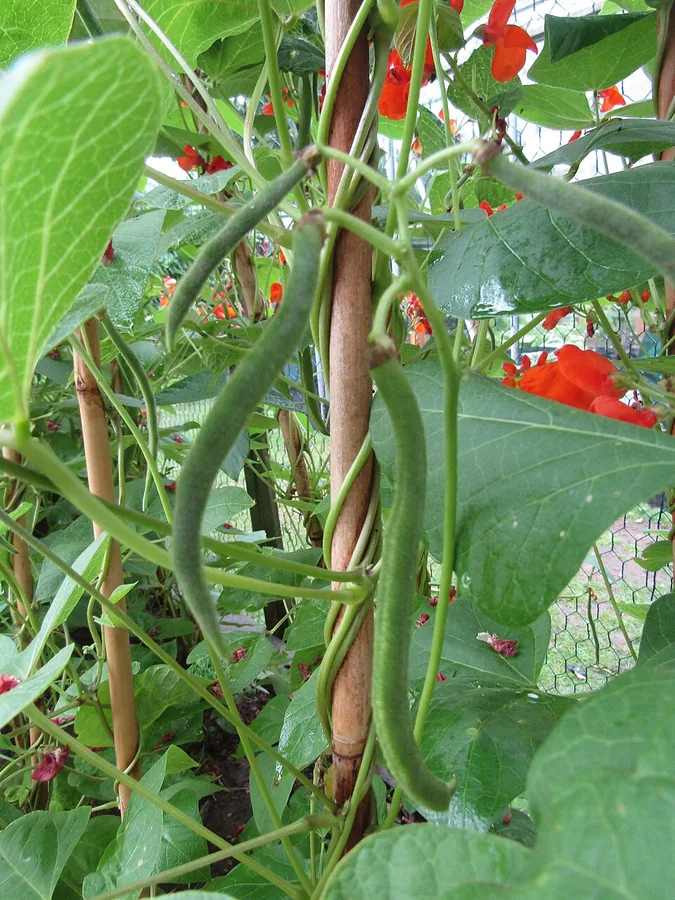
Phaseolus coccineus is a vigorous twining climber in the legume family Fabaceae, cultivated both for ornamental bloom and for its long edible pods. Because its fleshy tuberous roots overwinter, it behaves as a true perennial in zones 7 to 11, yet most growers treat it as a warm-season annual. Trained onto a tall support, a single season of growth reaches 6 to 10 feet.
Bloom runs from early summer to the first frost, in scarlet, white, or the pink-and-white bicolor that distinguishes certain cultivars. The flowers are attractive to bees and hummingbirds, and each pollinated bloom develops into a green pod. Pods eaten young stay tender, while those left to mature deposit fiber and become fit only for shelling as fresh or dried seed.
As a legume, the crop fixes atmospheric nitrogen through root-borne Rhizobium bacteria, which explains its modest fertilizer demand and its tolerance of an inexperienced hand. Its climbing habit is self-directing once a support is provided. The two limiting factors are heat and inconsistent moisture, since sustained heat aborts the flowers before they set and dry soil during bloom compounds the loss.
Care
The short version: site runner beans in full sun with a tall support, maintain fertile, well-drained soil at even moisture near 1 inch of water a week, and fertilize sparingly because root-borne bacteria supply most of the plant's nitrogen.
Light
Runner beans require full sun and tolerate no shade, a reflection of the high light demand behind their rapid climbing growth and continuous flowering. Reduced light slows both, so position them where direct sun is unobstructed.
Water
Supply roughly 1 inch of water a week and hold the root zone evenly moist, most critically during flowering and pod set when water stress aborts flowers. Sandy soils drain faster and call for more frequent irrigation. Consistent moisture is the practical defense against flower drop in warm weather.
Soil
The species performs best in fertile, well-drained loam at pH 6.0 to 7.0, where drainage prevents root stress and the near-neutral reaction keeps nutrients available. Incorporating compost before sowing improves both structure and fertility for the deep root system.
Temperature
The productive range falls between 50°F and 77°F (10°C to 25°C), and cool summers favor sustained pod set. Above that range, pollen viability declines and flowers abort, which is why heat, not cold, usually caps the crop.
Humidity
Ambient outdoor humidity of 40% to 70% meets the plant's needs, so no supplementation is warranted. Adequate spacing that allows air movement through the canopy is the more useful measure, since it limits conditions that favor foliar problems.
Feeding
Feed sparingly, because Rhizobium bacteria in the roots fix most of the nitrogen the plant needs. A single 5-10-10 application at planting suffices, and surplus nitrogen shifts growth toward foliage at the expense of pods.
Pruning
Routine pruning is unnecessary. Pinching the growing tip once the vine reaches the top of its support redirects energy into lateral branching and pod set, and removing spent pods sustains cropping by preventing the plant from shifting to seed maturation.
Repotting
Container culture is not standard for this crop. Direct sowing at the foot of a tall support suits its deep rooting and vigorous climbing habit far better than a pot.
Size & spacing
Mature vines climb 6 to 10 feet (1.8 to 3 m) while occupying a narrow footprint, spreading only 12 to 24 inches (30 to 60 cm) at the base. Provide a substantial vertical support and spacing sufficient for airflow through the foliage.
When to plant
Sowing is governed by soil temperature rather than the calendar. Wait until the last spring frost has passed and the soil holds at 50°F to 60°F (10°C to 16°C), sow direct, and expect the first young pods roughly two months later, with picking continuing until frost.
Northern hemisphere
Southern hemisphere
Typical months for a temperate climate: start earlier in warm zones, later where spring frosts linger.
- Sow: Optional: 2-3 weeks before the last spring frost in biodegradable pots to avoid root disturbance.
- Plant: After the last spring frost, once soil is at least 50-60°F (10-16°C).
- Harvest: Flowers from early-to-mid summer until frost; harvest young pods (10-15 cm / 4-6 in) about 65-75 days after sowing.
Hardiness
USDA hardiness zones: 7–11
Temperature: down to -18°C
Troubleshooting
Disorders in runner beans concentrate at three sites: the flowers, the developing pods, and the foliage. Each presents a distinct signal that points to its cause, so accurate reading of the symptom shortens the path to a remedy. The entries below pair each sign with the mechanism behind it.
Flowers abort in heat without setting pods
The pattern is blossom drop, a physiological response to heat. When daytime temperatures exceed 80°F to 90°F (27°C to 32°C), pollen viability falls and flowers abscise before fertilization completes. Cooling and evenly watering the root zone, plus light afternoon shade during heat waves, limits the loss until temperatures fall and pod set resumes.
Fix:
- Keep soil evenly moist and mulch to moderate root-zone temperature
- Provide light afternoon shade during heat waves
- Wait for cooler weather, when pod set typically resumes
Foliage is skeletonized or curled and distorted
Lacy, skeletonized leaves with yellow larvae on the undersides indicate the Mexican bean beetle, whereas curled new growth colonized by soft-bodied insects indicates aphids. Hand removal of beetles, larvae, and orange egg masses addresses the first, while a forceful water spray dislodges aphids, with insecticidal soap reserved for heavy infestations. Regular scouting, floating row covers on young plants, and support for predatory lady beetles hold both in check.
Fix:
- Hand-pick beetles, larvae and egg masses
- Dislodge aphids with a strong spray of water
- Apply insecticidal soap to heavy infestations
Pods develop fiber and lose tenderness
Pods that remain on the vine past the tender stage turn over-mature, laying down the fibers and strings that replace crisp texture with toughness. Harvesting at 4 to 6 inches (10 to 15 cm) and inspecting every 2 to 3 days keeps pods within their tender window. Pods that pass it retain value as shelled fresh or dried beans.
Fix:
- Harvest pods young, at 10-15 cm (4-6 in)
- Pick every 2-3 days to catch pods at peak tenderness
Toxicity
The cooked pods and seeds are edible, and the growing plant is not listed as toxic to pets or livestock. The single hazard is the raw mature seed, which contains the lectin phytohaemagglutinin and provokes gastrointestinal upset when eaten in quantity. Thorough cooking denatures the lectin, so dried seed should always be cooked and kept from animals that might ingest it raw.
Toxic to
Cats · Dogs
Safe for
People · Horses · Rabbits · Livestock · Birds
Cats Caution
Runner beans are not classed as toxic to cats, and most cats show no interest in the plant. The relevant risk is the raw mature bean, whose lectin can produce vomiting or diarrhea if a cat consumes several, so dried seed is best stored out of reach.
Dogs Caution
No toxicity to dogs is recorded, though a dog that swallows raw dried beans may develop gastric upset from the same lectin. Cooked pods and beans present no concern; only the raw mature seed warrants control.
Horses Safe
A grazing horse is not threatened by the growing plant. In keeping with legumes generally, quantities of raw dried beans are inadvisable, but the foliage and pods themselves carry no toxicity.
Rabbits Safe
Rabbits may browse the foliage without harm. The exception is the raw mature seed, which holds the same lectin noted for other species, so browsing is best confined to leaves and young pods.
Livestock Safe
Cattle, goats, and sheep face no toxicity from the living plant. The only qualification is the feeding of raw dried beans in quantity, which should be cooked rather than offered uncooked.
Birds Safe
Poultry and backyard birds are unaffected by runner beans in the garden. Bulk raw dried beans are the exception, since the uncooked seed is hard on the digestive tract, while pods and foliage are innocuous.
People Safe
For people, cooked pods and beans are a common and safe food. The raw mature bean is the exception because of its phytohaemagglutinin content, so dried seed must be cooked thoroughly before consumption.
Raw or undercooked mature (dry) seeds contain phytohaemagglutinin, a lectin that can cause nausea, vomiting and diarrhea if eaten in quantity; cook seeds thoroughly. Young pods, cooked, are safe.
Helpline numbers

United States
ASPCA Animal Poison Control: (888) 426-4435 (fee applies)

United Kingdom
Animal PoisonLine: 01202 509000 (fee applies)

Australia
Animal Poisons Helpline: 1300 869 738
Varieties
The cultivated runner beans divide chiefly by flower color and by intended use, whether for the table, for ornament, or for both. A few named cultivars account for most of what a grower will encounter.
Scarlet Emperor
A long-standing scarlet-flowered heirloom that reaches maturity in about 75 days and bears long green pods in successive heavy flushes.
Painted Lady
An ornamental selection prized for its bicolored red-and-white flowers as much as for its pods.
White-flowered (e.g. 'Czar' / 'Albus')
A dual-purpose cultivar bearing white flowers and large white seeds, valued as both a fresh pod and a shelled bean.
Companions
Runner beans shine in the Three Sisters planting, climbing the corn for support and feeding nitrogen back to it and the squash sprawling below.
Plant near
corn: In the Three Sisters planting, corn stalks give the climbing beans a natural support while the beans fix nitrogen for the corn.
squash: Part of the Three Sisters; sprawling squash shades the soil and deters pests while the beans climb the corn and fix nitrogen.
How to propagate
Propagation is by seed, and the species germinates readily with no pretreatment such as soaking or chilling. Direct sowing into warm soil is the standard and most reliable method.
SeedEasy
Direct-sow outdoors after the last spring frost once soil reaches at least 50-60°F (10-16°C). · Germinates in 7-14 days; begins flowering about two months after sowing.
Sow seed 1 to 1.5 inches (2.5 to 4 cm) deep at the base of a tall support once frost has passed and the soil has reached 50°F to 60°F (10°C to 16°C), the temperature at which germination proceeds reliably. Emergence follows in 7 to 14 days, with flowering about two months after sowing, so an indoor start of 2 to 3 weeks offers only a marginal advantage. In zones where the roots survive winter, the tuberous roots can be lifted in fall and stored to produce an earlier crop the following year.
Myths
Runner beans are poisonous and should not be eaten.
Cooked young pods are a routine vegetable consumed worldwide without incident. The hazard is confined to raw or undercooked mature dry seed, which contains phytohaemagglutinin and can cause gastric upset. Cooking denatures the lectin, rendering the dried beans safe.
Runner beans require heavy nitrogen to crop well.
As legumes, they obtain nitrogen from the atmosphere through Rhizobium bacteria in their root nodules, so their external requirement is minimal. Excess nitrogen favors vegetative growth over flowering, reducing rather than improving the pod yield.