Vegetable · Fabaceae
Fava Bean
Vicia faba
Sow them into cold spring soil, supply sun and steady moisture, and these hardy broad beans crop early while temperatures stay cool.
Full sun
Every 5–7 days
75–90 days
USDA 3–8
Overview
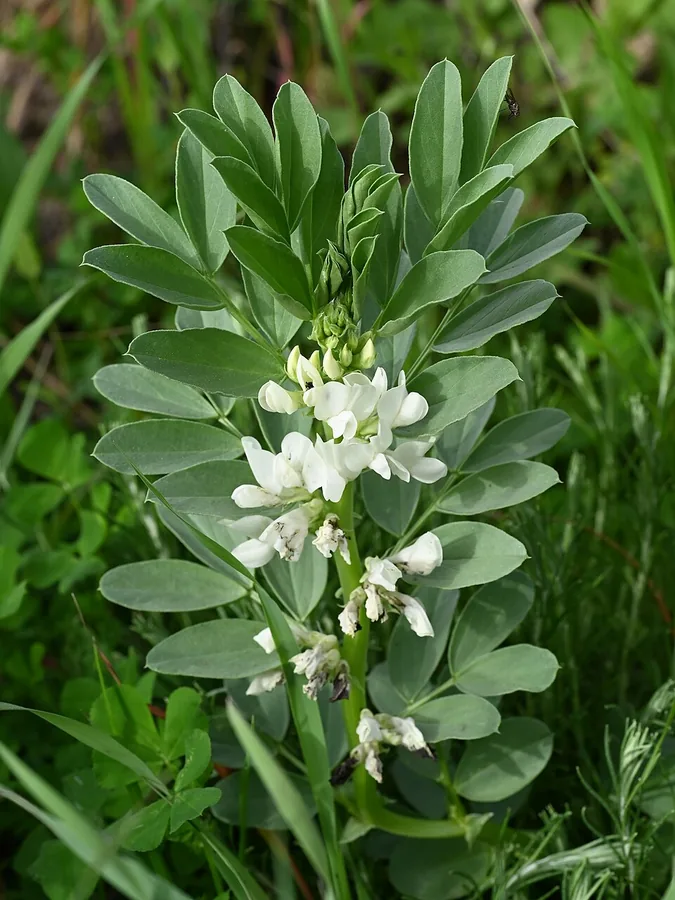
Vicia faba is among the most anciently cultivated of food crops, a cool-season legume with a cold tolerance unmatched by most garden vegetables. The plant grows tall and erect on a characteristically squared, self-supporting stem that carries the flowers and the heavy pods close to the axis. The alternate common name broad bean records the wide, flattened seeds held within each pod, whose inner wall is lined with a soft, spongy tissue.
Cold adaptation is the defining agronomic trait. Sowing precedes that of most beans by weeks, going in during early spring as soon as the ground is workable, or in autumn where winters remain mild. As a nitrogen-fixing legume, the crop satisfies much of its own nitrogen demand through root-nodule symbiosis and improves the residual fertility available to a following crop.
Cultural requirements are modest and the harvest is early. Established in suitable ground and held at even soil moisture through bloom and pod fill, with the apical growth monitored for black aphids, the plant performs reliably. Where sowing is timed so anthesis falls in cool weather, tender pods and seeds follow from late spring into early summer.
Care
The short version: full sun and cool temperatures, a deep well-drained loam high in organic matter, and consistent moisture through flowering and pod fill, with minimal feeding required because root-nodule symbiosis supplies much of the plant's nitrogen.
Light
Yield is highest in full sun, though the plant accepts light partial shade and will still set pods under it. High light maintains stem rigidity in the tall canopy and supports heavier flowering.
Water
Hold the soil evenly moist through germination, flowering, and pod fill, which in practice means a thorough irrigation every 5 to 7 days. Avoid the swing from drought to saturation, and reduce water in cold, wet soils, where waterlogging asphyxiates and rots the seed.
Soil
A deep, well-drained loam enriched with organic matter is the ideal medium. The crop performs across a pH of 6.0 to 7.5, and the depth and free drainage accommodate the vigorous taproot that anchors the tall shoot.
Temperature
This is a genuine cool-season crop, cold-hardy to roughly 14°F (-10°C) and most productive below 77°F (25°C). The critical risk is heat at anthesis, which induces flower abortion before pods can set.
Humidity
Ambient outdoor humidity in the 40% to 60% range is adequate and needs no management. Air movement is the controlling variable, since a still, damp canopy favors the establishment of chocolate spot.
Feeding
As a nitrogen-fixing legume, the fava meets most of its nitrogen needs through nodulation and seldom requires supplemental N. On low-fertility ground, incorporate a modest phosphorus and potassium amendment at planting and apply nothing further.
Pruning
When the lowest pods begin to set, pinch out the soft growing tips. The cut removes the succulent shoots that black bean aphids preferentially colonize and redirects assimilates into pod fill.
Size & spacing
Mature plants reach 3 to 5 feet (90 to 150 cm) in height with a narrow footprint of 12 to 18 inches (30 to 45 cm). Allot that spacing so the canopy dries quickly and chocolate spot finds fewer favorable conditions.
When to plant
The cold that limits most beans is what this crop is built for. Direct-sow in early spring once the soil is workable, or in autumn where winters stay mild, and the harvest of tender pods runs from late spring into early summer, before rising heat curtails further set.
Northern hemisphere
Southern hemisphere
Typical months for a temperate climate: start earlier in warm zones, later where spring frosts linger.
- Plant: Direct-sow in early spring as soon as soil is workable, or sow in fall in mild-winter (zone 7+) climates for overwintering.
- Harvest: Harvest tender pods/seeds in late spring to early summer.
Hardiness
USDA hardiness zones: 3–8
Temperature: down to -40°C
Troubleshooting
Most disorders of the fava concentrate on the apical growth or, in humid weather, on the lower canopy. Early recognition keeps a minor problem contained, because the controls are most effective before populations or lesions build. Match the observed sign below, then intervene while the response still alters the outcome.
Reddish-brown lesions blackening foliage in wet seasons
Discrete reddish-brown lesions that merge and darken the canopy in wet weather indicate chocolate spot, a Botrytis disease favored by cool, humid air and prolonged leaf wetness in dense stands. Wider spacing speeds drying because better air movement shortens the window the fungus needs to establish, and removing the worst foliage cuts the inoculum on hand. Keeping water off the leaves and holding nitrogen in check, which limits the soft growth the pathogen exploits, both slow its spread.
Fix:
- Improve air circulation by wider spacing
- Remove and destroy badly affected foliage
- Avoid overhead watering
Black aphid colonies massing on the apical growth
Dark colonies crowding the shoot tips point to black bean aphids, which concentrate on the apical growth because the soft, sap-rich new tissue feeds them best. Their excreted honeydew draws tending ants and supports a sooty mold film. Removing the most heavily colonized tips eliminates the prime feeding sites, a forceful water spray strips the rest, and insecticidal soap remains in reserve for colonies that persist.
Fix:
- Pinch off and destroy heavily infested growing tips
- Dislodge colonies with a strong water spray
- Use insecticidal soap on persistent infestations
Flower abscission and failed pod set under heat
Vigorous foliage paired with dropped blossoms and poor pod set typically reflects heat during flowering, since this cool-season crop aborts flowers once temperatures push past its optimum at anthesis. Even soil moisture through bloom reduces the added stress that compounds the abortion, and prompt harvest of any pods that do form keeps assimilates moving toward set rather than maturation. The durable correction is timing: schedule sowing so flowering falls in cool weather, spring-sowing early or fall-sowing in mild climates.
Fix:
- Maintain even soil moisture during bloom
- Harvest existing pods promptly to encourage continued set
Toxicity
As an edible crop, Vicia faba presents no toxic hazard to cats, dogs, horses, rabbits, livestock, or poultry. The cooked beans are nutritious for the general population, with one defined exception: individuals carrying the inherited G6PD enzyme deficiency can develop the acute hemolytic reaction termed favism from ingesting the beans or inhaling the pollen, and they should avoid the plant entirely.
Safe for
People · Cats · Dogs · Horses · Rabbits · Livestock · Birds
Cats None
The species carries no recognized toxic principle for cats, so an incidental bite of leaf or pod warrants no concern.
Dogs None
Vicia faba is absent from the ASPCA toxic-plant listing, so dogs may share the planting safely. A large volume of raw beans tends to produce only mild gas or loose stool as it passes.
Horses Safe
Horses metabolize fava foliage without ill effect, a tolerance long enough recognized that the common name horse bean derives from it.
Rabbits Safe
Rabbits browse the leaves and immature pods without harm; introduce any new green gradually, as standard practice with all fresh forage.
Livestock Safe
Cattle, goats, and sheep consume Vicia faba as an established feed and fodder crop, so field exposure presents no meaningful hazard.
Birds Safe
Poultry forage on the seeds and greens without risk, and the crop is cultivated as a bird feed in some regions.
People Safe
Cooked fava beans are a nutritious food for the general population. The defined exception is individuals with the inherited G6PD enzyme deficiency, in whom ingestion of the beans or inhalation of the pollen can precipitate the acute hemolytic reaction termed favism, so such individuals must avoid the plant entirely.
Human food-safety note: people with the inherited enzyme deficiency G6PD (favism) can develop acute hemolytic anemia from eating fava beans or even inhaling the pollen. This is a human genetic-condition concern, not a pet toxicity or general toxicity issue.
Varieties
Many cultivars of Vicia faba are in commerce, but a small group recurs in home cultivation. The following are the ones worth identifying by name.
Aquadulce
A long-pod cultivar whose marked cold tolerance makes it the standard selection for autumn sowing and overwintering in mild climates.
Windsor
The traditional broad, flat-seeded type borne in short pods, selected primarily for the depth of its eating quality.
The Sutton
A dwarf cultivar reaching about 12 inches (30 cm), a height that suits confined beds and exposed, windy positions.
Companions
Fava beans pair well with hungry crops that draw on the nitrogen they leave behind, and sit poorly next to onions and garlic, which many gardeners find hold legumes back.
Plant near
brassicas: As a nitrogen-fixing legume, fava beans can precede or accompany heavy-feeding brassicas that benefit from improved soil nitrogen.
Keep apart
onions and garlic (alliums): Alliums are commonly cited as poor companions for beans and other legumes.
How to propagate
Propagation is by seed and is straightforward, with the seed placed directly in its cropping position, where the plant completes its short annual cycle.
SeedEasy
Direct-sow in early spring as soon as soil is workable, or in fall in mild-winter climates. · 1 to 2 weeks to germinate in cool soil
Direct seeding is the rule with favas, because rapid establishment and a sensitive taproot make transplanting counterproductive. Set the seed about 2 inches (5 cm) deep into cool, workable soil in early spring, or sow in fall where winters remain mild. Emergence follows in 1 to 2 weeks even at low soil temperatures, since the species germinates readily in the cold.
Myths
Fava beans are toxic to everyone and unsafe to eat.
Cooked fava beans are a nutritious staple for the general population. The genuine exception is anyone with the inherited G6PD enzyme deficiency, in whom ingestion of the beans or inhalation of the pollen can trigger the acute hemolytic reaction known as favism. The hazard lies in an inherited enzyme defect in the consumer, not in any toxin within the plant.