Herb · Amaryllidaceae
Garlic Chives
Allium tuberosum
Harvest it repeatedly through the season and garlic chives regenerate from the crown with flat, garlic-scented leaves.
Full sun
Every 5–10 days
80–90 days
USDA 4–9
Overview
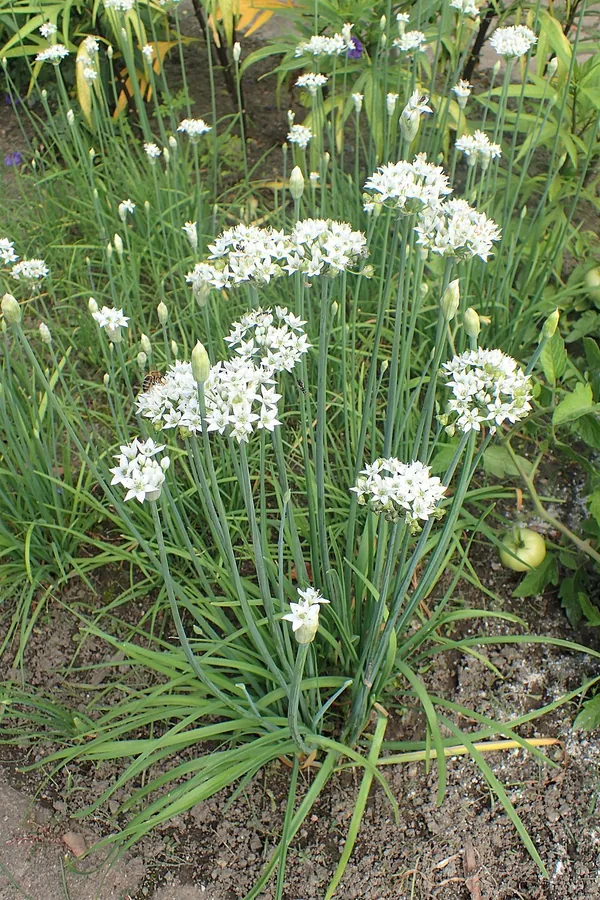
Garlic chives are a hardy, clump-forming perennial in the onion family, cultivated for flat leaf blades that carry a mild garlic flavor rather than the onion pungency of common chives. Native to eastern Asia, the species has served as a culinary crop there for centuries and circulates under names such as Chinese chives, Chinese leek, and nira. In late summer it throws up white, star-shaped flowers whose sweet scent draws pollinators.
Among herbs, few are less demanding. The crown withstands cold to -22°F (-30°C), endures summer heat, and requires little intervention once the clump is established. Cut leaves as needed and the plant recruits fresh growth from the crown to replace the harvested foliage.
The trait that warrants management is its reproductive vigor. Allowed to flower and ripen seed, garlic chives self-sow freely and can colonize ground well outside the intended planting. Cut the flower heads before the seed matures and the plant stays confined to its site.
Care
The short version: full sun and fertile, well-drained soil held evenly moist yield the most tender leaves. Shear the clump to renew growth, divide it every few years, and deadhead the flowers to prevent runaway self-seeding.
Light
Site garlic chives in full sun, where the leaves stay stout and develop their fullest flavor. The plant also performs in partial shade, though reduced light yields thinner, softer blades.
Water
Hold the soil evenly moist for the most tender leaves, which in practice means irrigating about every 5 to 10 days according to weather and soil. An established clump can bridge a brief dry interval, but sustained drought degrades both flavor and leaf texture.
Soil
Grow the plant in fertile, well-drained loam amended with ample organic matter. A soil pH of 6.0 to 7.0 suits it, placing it close to neutral.
Temperature
Cold hardiness sets this herb apart. Garlic chives survive winter lows of -22°F (-30°C) and tolerate heat to roughly 95°F (35°C), the physiological breadth that lets the crown return each season.
Humidity
Ambient humidity of about 40% to 60% meets its needs, and outdoors the figure rarely warrants attention. Airflow does more to suppress rust than any target humidity, since it dries the leaf surface.
Feeding
Fertilize across spring and summer with a balanced or nitrogen-forward product to drive leaf production. A single seasonal application generally suffices for a clump in reasonably fertile ground.
Pruning
Cut leaves to about 2 to 3 cm above the crown as required, and shearing the entire clump stimulates fresh, tender regrowth from the base. Remove the spent flower heads without delay, or the plant will disperse seed across the bed.
Repotting
The relevant operation here is division, not repotting. Every 2 to 3 years, lift and split a congested clump once the center packs tight, leaf vigor declines, and production falls off.
Size & spacing
A mature clump attains 12 to 20 inches (30 to 50 cm) in height and occupies 8 to 12 inches (20 to 30 cm) in spread. Allow that spacing so air circulates through the canopy and rust finds less purchase.
When to plant
Garlic chives tolerate a wide sowing window. Start seed indoors 6 to 8 weeks before the last frost, or direct-sow in spring, and transplant out once hard frost has passed. Harvest leaves throughout the growing season, and remove the white flowers that open in late summer before they set seed.
Northern hemisphere
Southern hemisphere
Typical months for a temperate climate: start earlier in warm zones, later where spring frosts linger.
- Sow: 6-8 weeks before the last spring frost
- Plant: Spring, after danger of hard frost has passed
- Harvest: Snip leaves through the growing season; fragrant white star-shaped flowers appear in late summer (deadhead before seed set to prevent aggressive self-seeding)
Hardiness
USDA hardiness zones: 4–9
Temperature: down to -34°C
Troubleshooting
Garlic chives remain trouble-free through most seasons, and the few disorders that appear are readily diagnosed. Nearly all present on the foliage or in an aging clump. Match the symptom below and intervene early, before the problem spreads.
Silvered stippling and bleached flecks on the foliage
Stippled, silvered, and deformed foliage points to onion thrips, whose rasping mouthparts abrade the leaf surface and drain the cell contents, leaving the tell-tale streaks. Populations climb quickly under the hot, dry conditions that favor them. Dislodge them with a forceful jet of water, treat the clump with insecticidal soap, and cut away foliage too damaged to recover.
Fix:
- Spray foliage with a strong jet of water to dislodge thrips
- Apply insecticidal soap or horticultural oil to affected plants
- Remove heavily infested leaves
Raised orange pustules erupting along the leaf surface
Raised orange pustules that shed spores onto the fingers are allium rust, a foliar fungus that establishes where dense clumps hold humidity and the leaf surface stays wet long enough for infection. Excise and destroy the affected leaves to remove inoculum. Thin or divide the clump to raise airflow and drop leaf-surface moisture, and irrigate at the base rather than overhead.
Fix:
- Remove and destroy infected leaves
- Improve air circulation by thinning and dividing clumps
- Avoid overhead watering
Volunteer seedlings colonizing the bed and beyond
Once the umbels ripen and shatter, garlic chives self-seed prodigiously, dispersing viable seed that germinates well beyond the parent clump. The mechanism is simple: mature seed left on the plant falls and colonizes open ground. Remove the flower heads before seed matures to cut off the source, and hoe or hand-pull the young volunteers before they root deeply.
Fix:
- Pull or hoe unwanted seedlings while young
- Remove flower heads before seed matures and disperses
Dead, unproductive center forming in a mature clump
A congested clump loses vigor as its densely packed bulblets compete for the same water and nutrients, and the oldest tissue at the center starves and dies out first. Lift the entire clump during the low-demand window of spring or early fall, separate it into healthy divisions, and reset them at proper spacing so each division has resources to draw on.
Fix:
- Lift and divide the clump in spring or early fall
- Replant healthy divisions with adequate spacing
Toxicity
The verdict splits by audience. Garlic chives are a safe, palatable herb for people, yet as an Allium they are toxic to cats, dogs, horses, and other animals. The organosulfur compounds present in every part oxidize red blood cells and can precipitate hemolytic anemia, with cats the most sensitive of all. Keep plants, trimmings, and harvested leaves well beyond the reach of pets and livestock.
Toxic to
Cats · Dogs · Horses · Rabbits · Livestock · Birds
Safe for
People
Cats Severe
Cats show the greatest sensitivity of any species, so even a small ingestion can be clinically significant. The early picture of vomiting, weakness, and pale gums gives way to red or brown urine, rapid breathing, and collapse as hemolysis destroys the red blood cells.
Dogs Moderate
A dog that consumes the foliage typically presents with vomiting and diarrhea in the acute phase. Over the following day or two, the oxidative blood damage emerges as lethargy, pale mucous membranes, and rust-colored urine.
Horses Toxic
Horses are markedly sensitive to alliums, and the same organosulfur compounds oxidize their red blood cells. Sustained grazing produces weakness, a lackluster coat, dark urine, and the pallor of anemia.
Rabbits Toxic
Exclude this plant from a rabbit's diet without exception. The thiosulfates that injure other species damage the rabbit erythrocyte in the same manner, so it warrants no place as a green or a treat.
Livestock Toxic
Cattle, sheep, and goats are all susceptible where alliums grow within grazing reach. Cumulative intake yields anemia, weakness, reluctance to move, and discolored urine.
Birds Toxic
Birds are equally exposed to allium toxicosis, their erythrocytes sustaining the same oxidative injury. Even a modest dose can bring on weakness, respiratory distress, and reduced appetite, so exclude clippings from poultry and pet birds alike.
People Edible
For healthy people the leaves are a culinary staple, eaten raw or cooked without concern. The flat leaves, buds, and flowers all serve in stir-fries and dumplings.
Keep plants, trimmings, and harvested leaves out of reach of pets; do not feed any part to animals and dispose of clippings securely.
Helpline numbers

United States
ASPCA Animal Poison Control: (888) 426-4435 (fee applies)

United Kingdom
Animal PoisonLine: 01202 509000 (fee applies)

Australia
Animal Poisons Helpline: 1300 869 738
Varieties
The plain species accounts for most garlic chives in trade, though a few selections are worth knowing for the kitchen gardener.
'Geisha'
This selection is bred for broader, tender leaves and a fuller garlic flavor that recommends it for culinary use.
Broad-leaf types (mauershan / da ye)
These forms bear wider, flatter leaves valued in Asian cuisine and particularly suited to stir-fries.
Companions
Garlic chives sit awkwardly next to legumes, since alliums tend to hold back their growth.
Keep apart
Beans: Alliums can inhibit the growth of beans
Peas: Alliums can inhibit the growth of peas
How to propagate
Two reliable methods increase garlic chives, both well within a beginner's reach. Division delivers a usable plant sooner, while seed is inexpensive and easy provided you accept a longer timeline.
DivisionEasy
Spring or early fall · 4-6 weeks
Division is the most direct route to new plants, best carried out in spring or early fall when demand on the roots is low. Lift the clump, separate it into sections carrying several bulblets apiece, and reset them promptly with room to develop. Each division roots and reestablishes in roughly 4 to 6 weeks.
SeedEasy
Start indoors 6-8 weeks before last frost or sow outdoors in spring · 2-3 weeks to germinate; one to two seasons to a harvestable clump
Seed propagation is straightforward but slower to yield a usable plant. Sow indoors 6 to 8 weeks before the last frost, or direct-sow in spring, with germination in 2 to 3 weeks. Building a full, cutting-sized clump takes one to two seasons, and because the species self-sows readily, deadhead the umbels to keep volunteers in check.
Myths
A culinary herb this mild cannot poison a cat or dog.
Culinary mildness for people says nothing about tolerance in animals. As a member of Allium, garlic chives are toxic to cats and dogs, and even small or repeated exposures injure red blood cells. The same herb that seasons a meal can induce hemolytic anemia in a pet.
Garlic chives are merely a variety of ordinary chives.
They are distinct species that merely resemble one another. Garlic chives (Allium tuberosum) bear flat, garlic-flavored leaves and white flowers, whereas common chives (Allium schoenoprasum) produce hollow, onion-flavored leaves and purple inflorescences.