Vegetable · Amaryllidaceae
Shallot
Allium cepa Aggregatum Group
Set one bulb and lift a cluster: the shallot divides rather than swells, season on season.
Full sun
Every 3–7 days
90–120 days
USDA 4–10
Overview
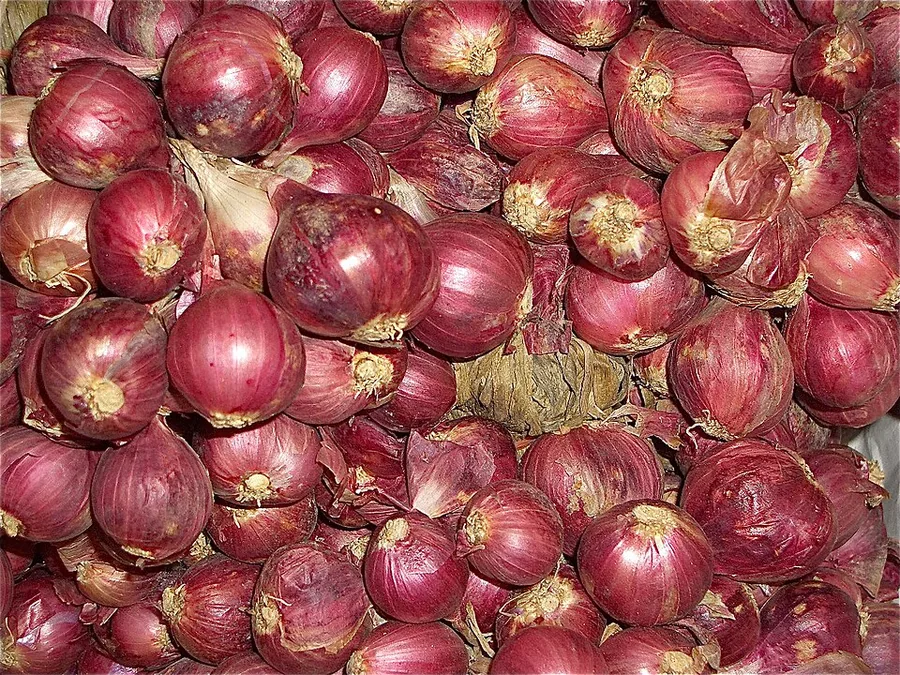
The shallot is a milder, sweeter member of the onion clan, valued in the kitchen for the gentle garlicky depth it lends sauces and dressings. Botanically it sits in the Aggregatum Group of Allium cepa, sharing the species with the bulb onion but diverging in habit: rather than enlarging into one bulb, a planted set divides at the base into a cluster, so a single bulb yields several at lifting.
Culturally shallots are undemanding. They call for full sun, an open fertile soil, and consistent moisture through the vegetative phase, after which a drying period lets the bulbs mature. Most growing stock is vegetative, with the best bulbs held back and replanted each year, though several modern cultivars are true-breeding from seed. That vegetative habit is precisely why saved sets can carry disease from one season to the next.
The production cycle is long and even-paced. Sets go in during early spring or fall, bulk through the warm season, and are lifted in summer once the foliage yellows and lodges, the plant's own signal that bulbing is complete. Properly cured and stored, the bulbs hold for months, a storage life that underpins the shallot's long standing as a kitchen staple.
Care
The short version: shallots perform in full sun and open, fertile soil, take roughly an inch of water a week during leaf growth, and finish best when irrigation is withdrawn as the tops yellow, allowing the bulbs to cure.
Light
Shallots are a full-sun crop, wanting six or more hours of direct light daily to build full-sized bulbs. They tolerate partial sun, but under lower light the bulbs finish smaller and the plants are slower to bulk.
Water
The root system is shallow and dries rapidly, so keep the soil evenly moist during leaf growth at roughly an inch of water a week. As the tops yellow and lodge, withdraw water; this drying phase is what allows the bulbs to cure and firm for storage.
Soil
Grow shallots in loose, fertile, well-drained loam amended with organic matter, holding pH between 6.0 and 6.8. On heavy ground, raised beds are the practical fix, keeping the shallow roots clear of the waterlogging that drives basal rot.
Temperature
The crop is hardy across a wide band, roughly 32°F to 86°F (0°C to 30°C). Cold exposure early on can induce bolting, whereas summer heat signals the bulbs to complete and cure.
Humidity
Ambient humidity is not a limiting factor outdoors, so there is no target figure. The relevant variable is air movement, since foliage that stays wet in crowded stands is what allows downy mildew to establish.
Feeding
Feed monthly with a balanced or nitrogen-forward fertilizer side-dressed during active leaf growth, when demand is highest. Discontinue nitrogen once bulbing starts, because continued nitrogen favors foliage at the expense of bulb development.
Pruning
No structural pruning applies. The one task is to remove flower scapes as they emerge, redirecting the plant's resources from seed production into the bulbs.
Repotting
Not applicable; grown as a bed or container crop replanted each season from saved sets
Size & spacing
Mature plants are narrow and upright, standing about 12 to 24 inches (30 to 60 cm) tall. Each occupies only 4 to 6 inches (10 to 15 cm) of spread, so set clusters at that spacing to allow the bulbs room to expand.
When to plant
Shallots follow a long, temperate-season cycle. Put sets in during early spring once the ground works, or in autumn where winters stay mild, then allow the crop the full warm season to bulk before lifting in summer as the tops yellow and lodge.
Northern hemisphere
Southern hemisphere
Typical months for a temperate climate: start earlier in warm zones, later where spring frosts linger.
- Sow: late winter, 8-10 weeks before last frost (seed-grown shallots only)
- Plant: early spring as soon as soil is workable, or fall in mild-winter regions
- Harvest: summer, when tops yellow and fall over
Hardiness
USDA hardiness zones: 4–10
Temperature: down to -34°C
Troubleshooting
Most shallot disorders register first in the foliage or the bulbs, and the majority trace to weather, irrigation practice, or plant spacing. Reading the early signs correctly lets you intervene before losses spread down the row. Match the symptom below to its cause, then treat while intervention still changes the outcome.
Basal softening and collapse of the bulb
Bulbs that turn soft and rot from the base signal basal rot and bacterial soft rot, favored by wet, poorly drained soil and entering through the basal plate. Infected bulbs will not recover, so lift and dispose of them rather than composting. Correcting drainage, using raised beds, and curing the harvest in warm, airy conditions removes the moisture these organisms need.
Fix:
- Remove and discard affected bulbs (do not compost)
- Improve drainage or move to raised beds
- Cure harvested bulbs in a warm, dry, airy spot before storage
Silvery streaking and pale flecking on the leaves
The silvery streaking is diagnostic of onion thrips, which rasp the leaf surface and feed within the sheltered folds. Populations escalate under hot, dry conditions, so dislodge them with forceful water sprays and treat the leaf bases with insecticidal soap or spinosad. Maintaining even soil moisture keeps the plants unstressed and less favorable to a thrips buildup.
Fix:
- Knock thrips back with strong sprays of water
- Apply insecticidal soap or spinosad per label, targeting leaf bases
- Keep plants well watered to reduce stress
Yellowing patches under a violet-gray sporulation
Yellowing patches carrying a violet-gray bloom indicate downy mildew, caused by Peronospora destructor under cool, humid conditions. Remove and destroy affected tissue, shift to early-day base watering, and widen spacing so foliage dries before the pathogen sporulates. Where pressure is sustained, a labeled fungicide applied preventively will limit its spread.
Fix:
- Remove and destroy infected leaves and badly affected plants
- Switch to drip irrigation or water early in the day
- Apply a labeled fungicide preventively if disease pressure is high
Premature scape emergence with undersized bulbs
A scape appearing ahead of schedule is bolting, generally induced by cold exposure or temperature swings soon after planting, and made worse by oversized sets. Remove the scapes promptly to conserve what bulb development remains. Since bolted bulbs store poorly, use them fresh.
Fix:
- Snap off flower stalks as soon as they appear
- Use bolted plants fresh promptly, as their bulbs store poorly
Toxicity
Shallots are a culinary staple and entirely safe for people, yet they are hazardous to animals. As an Allium, every part contains organosulfur compounds, including thiosulfates and N-propyl disulfide, that oxidize red blood cells and can produce Heinz-body hemolytic anemia in cats, dogs, horses, and livestock, with cats the most susceptible. Because heat and drying do not degrade these compounds, bulbs, tops, and cooked scraps must be kept from pets.
Toxic to
Cats · Dogs · Horses · Rabbits · Livestock · Birds
Safe for
People
Cats Severe
Cats are the most susceptible species and may be affected by a small quantity. Expect vomiting, weakness, pale gums, rapid breathing, and red-to-brown urine as red blood cells are destroyed.
Dogs Moderate
A dog that ingests bulbs, tops, or kitchen scraps may drool, vomit, and lose appetite, with abdominal pain and weakness following. Larger or repeated doses can progress to significant hemolytic anemia.
Horses Toxic
Horses respond to the same organosulfur compounds, and shallot that is grazed or fed damages their red blood cells. Anticipate dullness, weakness, and dark urine as anemia develops.
Rabbits Toxic
Shallot should never be offered to rabbits in any form. Bulbs and green tops carry the same blood toxins and can cause weakness, reduced appetite, and anemia.
Livestock Toxic
Cattle, sheep, and goats are all at risk from consuming shallot tops, bulbs, or cull piles. The result is oxidative blood damage presenting as weakness, pale mucous membranes, and discolored urine.
Birds Toxic
Poultry and pet birds should be kept well away from shallot. Their red blood cells are vulnerable to the same compounds, and even modest quantities can prove harmful.
People Safe
For people, shallots are a safe kitchen staple eaten raw or cooked. The toxicity is confined to animals, so the practical risk lies only in sharing scraps or trimmings with a pet.
Plants pose no contact hazard to people; risk is from pets ingesting bulbs, tops, scraps, or cooked dishes containing shallot. Store harvested and curing bulbs out of reach of pets.
Helpline numbers

United States
ASPCA Animal Poison Control: (888) 426-4435 (fee applies)

United Kingdom
Animal PoisonLine: 01202 509000 (fee applies)

Australia
Animal Poisons Helpline: 1300 869 738
Varieties
Several shallot types are worth distinguishing, ranging from gray-skinned French selections to round, seed-raised hybrids. The following are the cultivars most often named.
French Gray (Griselle)
French Gray, or Griselle, is a gray-skinned traditional French shallot noted for a concentrated, refined flavor, and is at times classified separately from the common shallots.
Dutch Yellow
Dutch Yellow is a dependable yellow-skinned multiplier that produces abundant clusters and holds well through the off-season in storage.
Zebrune
Zebrune is an elongated seed-grown 'banana' shallot, distinguished by copper-pink skin and a single torpedo-shaped bulb.
Ambition
Ambition is a seed-raised hybrid forming round, reddish-bronze bulbs with a notably long storage life.
Companions
Shallots get along with most beds, helping to throw pests off the scent near carrots and brassicas, but they hold back the legumes, so keep beans and peas in their own ground.
Plant near
carrots: Alliums interplanted with carrots are traditionally used to help confuse carrot pests, and the crops share bed conditions without competing heavily.
brassicas: Cabbage-family crops pair well with alliums, whose scent may help deter some brassica pests.
lettuce: Shallow-rooted, quick lettuce fits between upright shallot rows without competing for space or light.
Keep apart
beans and peas: Legume growth is reported to be inhibited when planted near alliums, so beds are kept separate.
How to propagate
Two propagation routes exist. The standard is vegetative division from saved sets, while seed offers a cleaner crop that forms a single larger bulb.
Bulbs & cormsEasy
Early spring or fall planting of individual sets/cloves, pointed end up, just below the soil surface · Sprouts in 1-2 weeks; each set multiplies into a cluster of 4-12 bulbs in roughly 90-120 days
Vegetative propagation from sets is the standard method. Insert each set pointed end up just beneath the soil surface in early spring or fall; it emerges within a week or two and then divides into a cluster of 4 to 12 bulbs over the following 90 to 120 days. Retaining the firmest, healthiest bulbs at harvest provides the next season's planting stock.
SeedModerate
Sow indoors in late winter 8-10 weeks before last frost, or direct-sow in early spring · Transplant-ready in about 8-10 weeks; bulbs mature in one long season (100-120+ days)
Seed propagation demands more time but avoids the pathogens carried on saved sets. Sow indoors in late winter, about 8 to 10 weeks before the last frost, transplanting once seedlings reach 8 to 10 weeks of age. Seed-grown plants typically form a single larger bulb over one extended season of 100 to 120 days or more, and cultivars such as Zebrune and Ambition are bred for this route.
Myths
Shallots are simply small onions that grow and behave like standard bulb onions.
Placed in the Aggregatum Group of Allium cepa, a shallot bulb divides into a cluster of offsets rather than enlarging into one onion. That single distinction governs spacing, harvest method, and the practice of saving your own planting stock.
Cooking or drying shallots makes them safe for cats and dogs.
Neither heat nor drying degrades the organosulfur toxins, which remain active in cooked, dried, and powdered shallot. In every form, shallot, onion, and garlic can induce Heinz-body hemolytic anemia in pets.