Herb · Lamiaceae
Garden Sage
Salvia officinalis
A drought-adapted Mediterranean subshrub that rewards full sun and free drainage with years of aromatic, oil-rich leaves.
Full sun
Every 7–14 days
75 days
USDA 4–8
Overview
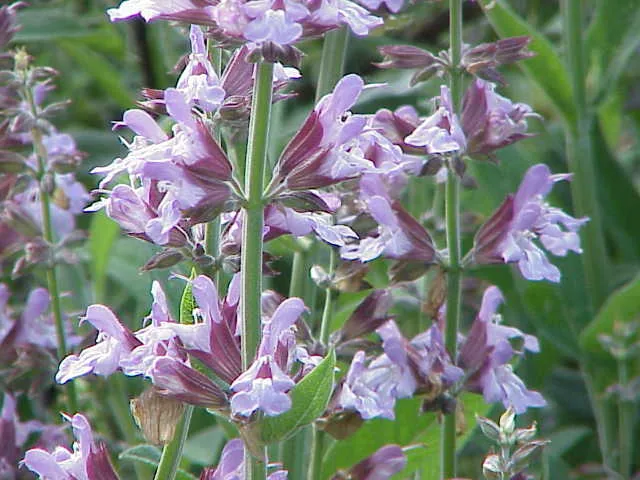
Garden sage is a woody Mediterranean perennial in the family Lamiaceae, valued for the aromatic oils held in its gray-green foliage. Those same volatile oils, concentrated by strong light, give the leaves their savory scent and culinary value. In early summer the plant lifts spikes of bluish-lavender flowers that draw pollinating bees. Once its root system is established, its demands drop sharply.
The plant's Mediterranean origin explains its two firm requirements: sun and free-draining soil. Adapted to heat and periodic drought, sage instead suffers in heavy, saturated ground, where persistent moisture brings on root rot. Soil structure therefore outweighs almost every other growing factor. Cold-hardy to zone 4, an established crown resprouts each spring and slows only with age.
Harvest leaves across spring and summer, and take them before flowering, when the concentration of aromatic oil in the foliage peaks. A light spring pruning redirects growth into fresh, bushy shoots, yet the stems lignify with age regardless. Because old plants turn woody, propagation from cuttings is the practical way to keep a productive plant on hand.
Care
The short version: site sage in full sun with fast-draining soil, water only after the top half dries, feed lightly if at all, and prune each spring to force bushy growth.
Light
Sage requires full sun, a minimum of six hours daily, because strong light drives the synthesis of the essential oils that give the leaves their flavor. It tolerates light afternoon shade, but under deeper shade the stems weaken and grow lax and the foliage loses potency.
Water
Allow the top half of the soil to dry between waterings; sage is drought-adapted once established and far more tolerant of dryness than of saturation. A cycle of roughly every 7 to 14 days suits most plants, with containers drying faster and needing water sooner. Sustained wet soil is the principal cause of decline.
Soil
Grow sage in well-drained sandy or loamy soil that admits water freely. A pH of 6.0 to 7.5 is suitable, but drainage governs success more than reaction, since standing water at the roots leads directly to rot.
Temperature
Sage is exceptionally cold-hardy, enduring temperatures from -20°F (-29°C) at the low end to about 95°F (35°C) at the high. That breadth of tolerance is why established plants persist in the open ground through winter across much of the temperate range.
Humidity
Low humidity, on the order of 30% to 50%, suits sage and reflects its dry native climate. Damp, still air favors the spores of powdery mildew, so free air movement protects the plant far more effectively than any added moisture.
Feeding
Feed sparingly, because sage is a light feeder and overfeeding reduces the flavor of the leaves. A single light application of balanced fertilizer or compost in spring is sufficient, and fertile soil often makes feeding unnecessary.
Pruning
Prune lightly in spring as growth resumes to remove old wood and encourage dense, bushy branching, and harvest through the season. Even so, the woody base of the plant lignifies with age, so plan to replace declining specimens every 3 to 5 years.
Repotting
Repot container plants every 1 to 2 years, or when roots circle the pot and water runs straight through without wetting the medium. Increase pot size by a single increment only, since an oversized volume of mix retains the excess moisture that sage cannot tolerate.
Size & spacing
A mature plant reaches 16 to 30 inches (40 to 75 cm) in height with a spread of 18 to 35 inches (45 to 90 cm). Spacing plants to that width maintains the air movement that suppresses powdery mildew.
When to plant
As a cold-hardy perennial, sage is grown on a multi-year footing rather than replanted each season. Sow indoors in late winter or transplant in spring once frost has cleared, then harvest through spring and summer. Cut just before the early-summer bloom, when leaf oil content is highest.
Northern hemisphere
Southern hemisphere
Typical months for a temperate climate: start earlier in warm zones, later where spring frosts linger.
- Sow: 6-8 weeks before the last spring frost
- Plant: spring after danger of frost has passed
- Harvest: Spikes of bluish-lavender to pinkish-lavender flowers appear in early summer; harvest leaves anytime during spring and summer, best before flowering for peak flavor.
Hardiness
USDA hardiness zones: 4–8
Temperature: down to -34°C
Troubleshooting
Most disorders in sage stem from a single cause: excess moisture, whether at the roots or as humid, stagnant air around the canopy. Read the leaves, roots, and older stems as diagnostic surfaces and intervene early. Identify the pattern below before treating.
Wilting and root death under waterlogged conditions
Prolonged saturation drives root rot, which leaves the roots soft, brown, and mushy and eventually collapses the plant. A collapsed specimen cannot be recovered, so remove it and let the soil dry. The durable remedy is drainage, achieved through a raised bed, a container with functioning holes, or a reduced watering regime.
Fix:
- Reduce watering and allow soil to dry
- Improve drainage or move to a raised bed or container with drainage holes
- Remove severely affected plants
Bare, lignified lower stems with growth confined to the tips
This reflects natural aging rather than any disorder. Over several seasons the lower stems harden and shed their leaves while active growth withdraws to the tips. Light annual pruning prolongs a bushy habit, but woodiness is inevitable, so rotate in replacements every 3 to 5 years.
Fix:
- Prune lightly in spring to encourage bushy growth
- Replace plants every 3-5 years as they become woody
White powdery colonies on the upper leaf surface
The white film is powdery mildew, a fungal disease that establishes in humid, poorly ventilated air among crowded plants. Thin and space the planting to restore air movement, direct water to the soil rather than the foliage, and remove the most affected leaves. Full sun and dry leaf surfaces deny the fungus the conditions it needs.
Fix:
- Improve air circulation by thinning and spacing plants
- Avoid overhead watering and water at the base
- Remove and discard affected foliage
Toxicity
For animal-keeping households the verdict is straightforward: garden sage is safe. The ASPCA classifies Salvia officinalis as non-toxic to cats and dogs, and the culinary foliage poses no hazard to people or other animals. The one exception is concentrated sage essential oil, which is high in the compound thujone and must not be equated with the herb.
Safe for
People · Cats · Dogs · Horses · Rabbits · Livestock · Birds
Cats None
Sage is non-toxic to cats per the ASPCA listing, so a nibble carries no risk. Large quantities of any leafy plant may provoke transient gastrointestinal upset, but the herb itself contains no feline toxin.
Dogs None
Dogs face no toxic risk from sage, as the culinary leaves are non-toxic. An opportunistic mouthful from the herb bed requires no intervention.
Horses Safe
Sage presents no toxic hazard to horses; the aromatic foliage holds no harmful compound, and its strong scent generally discourages grazing in any case.
Rabbits Safe
Rabbits may take sage in small amounts without risk. It suits an occasional herb rather than a staple green, and it carries no toxin of concern.
Livestock Safe
Ruminants such as goats, sheep, and cattle can browse sage safely, since the plant contains nothing toxic to them.
Birds Safe
Sage poses no risk to birds or poultry and is safe to cultivate where they forage.
People Safe
For people the leaves are a safe culinary ingredient. Only the concentrated essential oil, rich in thujone, warrants moderation.
Concentrated sage essential oil is high in thujone and should be kept away from pets and not confused with the edible herb; the plant and culinary leaves themselves are non-toxic. As with any plant, ingestion of large amounts of foliage may cause mild gastrointestinal upset.
Varieties
Beyond the plain green species, several selections combine ornamental foliage with full culinary use. Each is distinguished mainly by leaf form and color.
'Berggarten'
A compact selection bearing large, rounded gray-green leaves that flowers only rarely, directing its resources into dense foliage.
'Icterina'
A golden-leaved form margined in green and yellow, useful as low, bright edging near the front of a planting.
'Purpurascens'
A purple-leaved sage whose emerging growth is a soft reddish-purple that greens as it matures.
'Tricolor'
A variegated selection patterned with green, white, and purple-pink across each leaf.
How to propagate
Sage propagates readily by three routes, and the right choice depends on the season, the state of the parent plant, and how quickly a rooted plant is needed.
Stem cuttingsEasy
Late spring to summer from softwood cuttings · 3 to 6 weeks to root
Softwood cuttings give the fastest true-to-type increase. Take a cutting from a non-flowering shoot in late spring or summer, insert it in a moist, well-drained medium, and it typically roots within 3 to 6 weeks as a clone of the parent.
SeedModerate
Start indoors 6-8 weeks before last frost or sow outdoors after frost · Germinates in about 2-3 weeks; plants reach maturity around 75 days
Seed is slower and less uniform, since germination is uneven. Sow indoors 6 to 8 weeks before the last frost or outdoors once frost has passed, expect emergence in about 2 to 3 weeks, and allow roughly 75 days to reach a usable size.
LayeringEasy
Spring to summer · Several weeks to a few months to root
Layering roots a stem while it remains attached to and supplied by the parent. Pin a low, flexible shoot to the soil in spring or summer, allow several weeks to a few months for roots to form, then sever the rooted plant.
Myths
Garden sage is toxic to cats and dogs.
The record does not support this. The ASPCA classifies Salvia officinalis as non-toxic to both cats and dogs, making the garden herb safe around companion animals. The genuine caution concerns the concentrated essential oil, which is high in thujone, a product distinct from the culinary leaves.