Herb · Lamiaceae
Holy Basil
Ocimum tenuiflorum
Site it in full sun and warm soil, pinch the growing tips, and tulsi yields fragrant leaves across the season.
Full sun
Every 2–4 days
50–95°F · 10–35°C
60–90 days
Overview
Holy basil, known in India as tulsi, is an aromatic species in the mint family whose clove-like, peppery volatiles release the moment the foliage is disturbed. Cultivated for centuries as both a culinary herb and a sacred plant, it bears the accepted botanical name Ocimum tenuiflorum. It is perennial in consistently warm climates, though growers in cooler temperate regions raise it as a single-season annual.
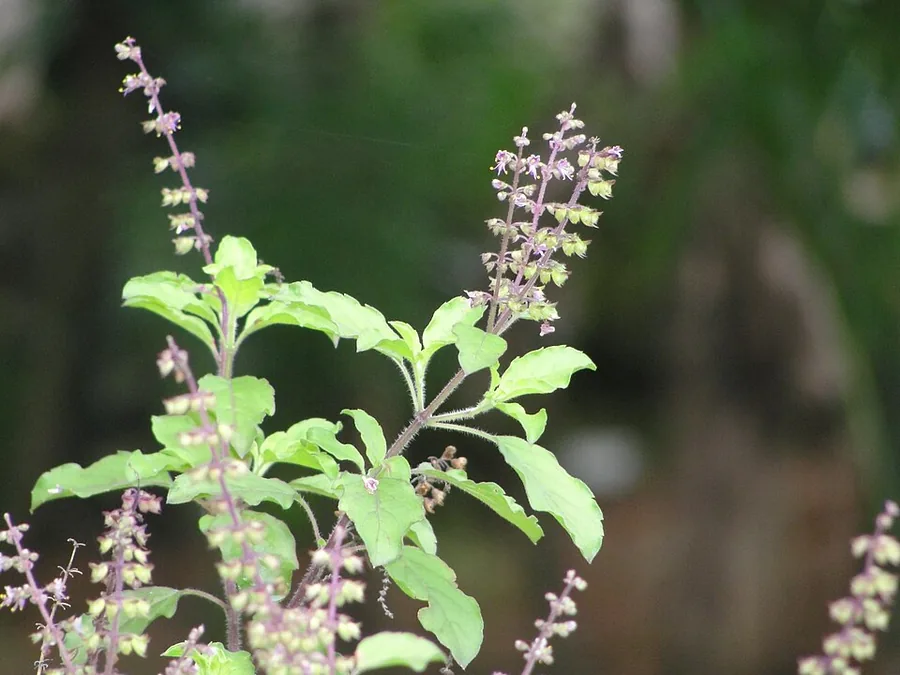
The plant makes modest demands. It requires sun, warmth, and steady soil moisture, and once conditions warm it grows fast, attaining 12 to 24 inches (30 to 60 cm) in a season. Leaf color runs from green to purple-tinged according to the type, and the small white-to-lavender flowers are themselves strongly aromatic.
The single behavior to anticipate is the reproductive shift to flowering. As soon as a tulsi plant initiates flower spikes, leaf size and flavor decline because resources move toward seed. Consistent pinching of the tips and spikes exchanges a brief bloom for months of tender, flavorful foliage.
Care
The short version: full sun and warm, well-drained soil held evenly moist but never saturated. Feed monthly through the growing season and pinch the tips and flower spikes regularly to maintain a bushy habit and sustained leaf production.
Light
Holy basil requires full sun, ideally 6 or more hours daily. It tolerates a degree of partial sun and will still grow, but a bright, open exposure produces fuller and more aromatic foliage.
Water
Maintain the soil evenly moist but well drained, permitting the surface to dry slightly between waterings. It performs poorly in waterlogged ground, so drainage is as important as the watering schedule itself. During summer heat, expect to irrigate every 2 to 4 days.
Soil
Grow it in fertile, well-drained soil rich in organic matter, whether a loam or a sandier medium. A pH between 6.0 and 7.5 suits it, a range that most garden soils and potting mixes fall within.
Temperature
A warmth-adapted species, it performs best between 50°F and 95°F (10°C to 35°C). It has no frost tolerance whatever, so defer planting out until the weather has settled and warmed.
Humidity
Average relative humidity of 40% to 60% is sufficient, a level typical of most homes and gardens. Misting and other atmospheric adjustments are unnecessary.
Feeding
Apply a balanced all-purpose fertilizer or a diluted liquid feed monthly across the spring and summer growing season. Light, regular feeding sustains fresh leaf production while avoiding the soft, pest-susceptible growth that heavy nitrogen encourages.
Pruning
Pinch the growing tips frequently to promote a bushy rather than leggy habit, and remove flower spikes the instant they form. Diligent spike removal delays bolting and prolongs the production of tender leaves markedly.
Repotting
Cultivated as an annual, holy basil rarely requires repotting within a season, though a vigorous specimen may benefit from a larger pot once a year. Roots at the drainage holes, slowed growth, and rapid drying of the soil indicate that it is ready to move up.
Size & spacing
Mature plants stand about 12 to 24 inches (30 to 60 cm) tall with a spread of 12 to 18 inches (30 to 45 cm). Allocate that much space per plant so air circulates and the foliage stays dry and healthy.
When to plant
Holy basil is entirely frost-intolerant. Sow indoors in early spring, transplant only once frost has passed and the soil has warmed, and harvest foliage from early summer through to the close of the season.
Northern hemisphere
Southern hemisphere
Typical months for a temperate climate: start earlier in warm zones, later where spring frosts linger.
- Sow: 6-8 weeks before the last expected frost
- Plant: After all danger of frost has passed and soil is warm (above ~15°C/60°F)
- Harvest: Harvest leaves from early summer onward; pinch flower spikes as they appear to prolong leaf harvest
Hardiness
USDA hardiness zones: 10–11
Temperature: down to -1°C
Troubleshooting
The foliage is where most holy basil disorders declare themselves, whether the cause is a pest, excess moisture, or the onset of flowering. Early diagnosis makes a measured response effective. Identify the symptom below, then intervene while the intervention still counts.
Collapse accompanied by soft, darkened root tissue
Saturated soil has deprived the roots of oxygen and brought on root rot, a condition from which a badly affected plant seldom recovers. On inspection the roots are brown and mushy rather than the firm white of healthy tissue, and the surrounding medium remains waterlogged. Correcting drainage, allowing the surface to dry between irrigations, and never leaving roots in standing water addresses the underlying cause.
Fix:
- Improve drainage and allow soil to dry between waterings
- Remove badly affected plants and avoid replanting in soggy soil
Curled, sticky foliage with small insects on the undersides
Sap-feeding aphids or whiteflies have colonized the soft new growth, and their feeding both distorts the leaves and coats them in honeydew. A forceful jet of water displaces the colonies, after which insecticidal soap or neem oil on the undersides clears the survivors. Because these insects favor lush, succulent tissue, moderating nitrogen removes the very growth that sustains them.
Fix:
- Spray foliage with a strong jet of water to dislodge insects
- Apply insecticidal soap or neem oil to affected foliage
- Encourage natural predators such as ladybugs and lacewings
Foliage grazed into a lace-like skeleton
The Japanese beetle, a metallic green-bronze pest, consumes the leaf tissue between the veins and leaves the vascular framework as lacework. Handpicking into soapy water during the cool morning hours is effective, and it matters because aggregating beetles release cues that attract still more feeders. Where pressure peaks in midsummer, a floating row cover physically excludes them from the crop.
Fix:
- Handpick beetles and drop them into soapy water
- Cover plants with floating row cover during peak beetle activity
Flower spikes emerging as leaves diminish in size and flavor
This is bolting, the reproductive transition triggered as the plant matures or is stressed by heat. Once flowering begins, resources are diverted into seed production, so vegetative leaves become smaller and less flavorful. Removing the spikes as they emerge, together with routine tip pinching, redirects that energy back into foliage and extends the harvest window considerably.
Fix:
- Pinch off flower spikes as they form to redirect energy into leaf production
Toxicity
The verdict is reassuring: holy basil is safe for every household member. The ASPCA classifies basil as non-toxic to cats and dogs, and people worldwide consume the foliage and brew it as tea. A pet that grazes a large quantity may experience brief, mild gastrointestinal upset, but nothing in the plant is capable of real harm.
Safe for
People · Cats · Dogs · Horses · Rabbits · Livestock · Birds
Cats None
The ASPCA classifies basil as non-toxic to cats, so an exploratory nibble carries no consequence. Only ingestion of an entire plant is likely to produce transient, mild gastrointestinal upset.
Dogs None
Dogs face no toxic risk from holy basil. The most that a substantial mouthful would provoke is a self-limiting bout of digestive upset.
Horses Safe
Holy basil is safe for horses, as the plant contains no compound capable of harming one that grazes on it.
Rabbits Safe
Rabbits may consume the leaves within a varied diet, since the plant itself presents no hazard. Introducing any unfamiliar green gradually allows the digestive system to adjust.
Livestock Safe
Cattle, goats, and sheep can browse holy basil without adverse effect, because it lacks the compounds that render some garden species problematic to grazing stock.
Birds Safe
The plant is safe for birds. Both backyard poultry and companion birds may peck at the foliage without concern.
People Safe
Holy basil is a culinary and tea herb consumed worldwide. The foliage is suitable used fresh, dried, or steeped, and the entire plant is safe to handle.
Generally safe around pets; concentrated basil essential oils and large quantities of foliage may cause mild, transient stomach upset if ingested.
Varieties
Several types of tulsi circulate in gardens and seed catalogs, each with a distinct flavor and coloration. The following are the ones worth identifying by name.
Rama Tulsi (Sri Tulsi)
A green-leaved cultivar with milder clove notes and lightly purple-tinged flowers, it is the most subtle of the three in culinary use.
Krishna Tulsi
Distinguished by purple-tinged leaves and stems, this type delivers a more pronounced, peppery clove character than the green forms.
Kapoor Tulsi
A fast-flowering, heavy-seeding type valued in cooler temperate regions for its rapid maturation within a short growing season.
How to propagate
Holy basil propagates readily, whether raised from a fresh seed packet or increased vegetatively from an existing plant.
SeedEasy
Start indoors 6-8 weeks before last frost, or direct sow after frost when soil is warm · 2-3 weeks to germinate; about 6-8 weeks to transplant size
Seed is the standard means of increase: sow indoors 6 to 8 weeks before the last frost or direct sow once the soil has warmed. Surface-sow or barely cover the fine seed, since germination depends on both light and warmth in the range of 70°F to 84°F (21°C to 29°C). Emergence follows over 2 to 3 weeks, with seedlings reaching transplant size in roughly 6 to 8 weeks, after which established plants self-seed readily.
Stem cuttingsEasy
During active growth in spring and summer · 2-4 weeks to root
Vegetative cuttings offer the quickest increase during the active spring and summer growth. Select a non-flowering shoot about 4 to 6 inches (10 to 15 cm) long, remove the lower leaves, and set it in water or moist potting medium. Roots initiate over 2 to 4 weeks, yielding a genetic clone of the parent ready for potting on.
Myths
Holy basil and sweet basil are the same plant.
They are in fact two distinct species united only by a shared common name. Holy basil, Ocimum tenuiflorum, carries a clove-like, peppery flavor and is generally cooked or brewed as tea. Sweet basil is the milder species used raw in salads or on pizza.
Holy basil is toxic to cats and dogs.
This is unfounded. The ASPCA classifies basil as non-toxic to both cats and dogs, so a curious animal is at no risk from a few leaves. The sole caveat is that a large quantity may cause mild, short-lived gastrointestinal upset.