Herb · Lamiaceae
Bee Balm
Monarda didyma
Full sun, consistent soil moisture, and open spacing are what drive heavy bloom and low mildew pressure in Monarda didyma, and pollinators work the flowers all season.
Full sun
Every 3–7 days
USDA 4–9
2–4 ft · 0.6–1.2 m
Overview
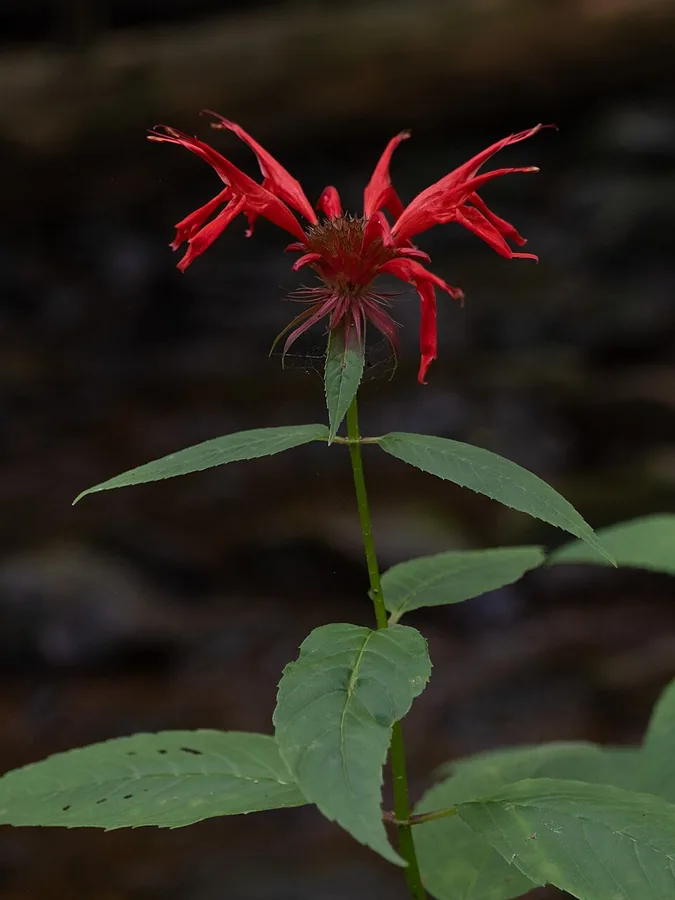
Monarda didyma belongs to the mint family and ranks among North America's native perennials. Ragged whorls of red, pink, or wine flowers crown the characteristic square stems, held above foliage that yields a citrus note when bruised, which accounts for the bergamot epithet. Those blooms sustain bees, butterflies, and hummingbirds across a long flowering window.
Spread is rhizomatous: underground stems push outward until one plant occupies a broad clump within a few seasons. That expansion suits a naturalized meadow but demands periodic division in a formal bed, where the crown otherwise overruns its neighbors. Use of the leaves as a beverage by the Oswego people is the origin of the Oswego tea name.
Requirements are modest, reducing essentially to three factors: direct light, uniform soil moisture, and unobstructed air around the canopy. Supply them and the plant flowers for months. Restrict airflow and powdery mildew, the one persistent liability of the species, takes hold.
Care
The short version: full sun, a fertile medium held uniformly moist, and free air movement through the stand. Lifting and dividing the crown every 3 to 4 years restores vigor, while removing spent inflorescences redirects resources into a repeat flush.
Light
Floral initiation is light-dependent, so full sun produces the heaviest bloom; the plant merely tolerates partial shade. Reduced illumination is the principal cause of sparse flowering and the condition under which powdery mildew establishes most readily.
Water
Reproduce the streambank and wet-meadow conditions of its origin by holding the root zone uniformly moist. Irrigation at intervals of every 3 to 7 days generally suffices; apply it to the soil, never the canopy, because free moisture on foliage promotes powdery mildew.
Soil
A humus-rich, moisture-retentive medium matches the riparian soils in which the species evolved, and dense clay presents no obstacle. Maintain a reaction of 6.0 to 7.0, since mildly acidic through neutral conditions favor root function.
Temperature
Cold hardiness is considerable: the crown survives winter minima of -29°F (-34°C) and tolerates summer maxima of 90°F (32°C). That breadth of adaptation underlies its wide cultivation.
Humidity
Ambient humidity in the ordinary 40% to 60% band is immaterial to performance. What governs disease is air exchange, because static, saturated air within a congested canopy is the precondition powdery mildew requires.
Feeding
Nutrient demand is low. A single spring application of a balanced fertilizer, or an incorporation of compost, satisfies the season's requirement for a native adapted to unimproved ground.
Pruning
Removing spent inflorescences through the season prompts a secondary flush; once flowering concludes, reduce the plant to its basal rosette. Thinning congested stems improves air exchange, and retaining a portion of the hollow stems through winter provides nesting cavities for native bees.
Repotting
This is a border perennial rather than a container subject, so the operative task is crown division at intervals of 3 to 4 years. Undertake it when the center senesces or flowering output declines.
Size & spacing
Mature height falls between 2 to 4 feet (60 to 120 cm), with a lateral spread of 16 to 35 inches (40 to 90 cm). Allocate the full spread at planting so air circulates through the stand and mildew pressure stays low.
When to plant
Culturally the plant follows a cold-climate perennial cycle. Sow under cover in late winter, transplant after the last spring frost, and expect the display from midsummer into early fall. For culinary use, cut the foliage as flower buds form, since aromatic oils peak just ahead of bloom.
Northern hemisphere
Southern hemisphere
Typical months for a temperate climate: start earlier in warm zones, later where spring frosts linger.
- Sow: Late winter, 6-8 weeks before last frost
- Plant: Spring after last frost
- Harvest: Showy flowers mid-to-late summer (July-September); harvest aromatic leaves before flowering for best tea flavor
Hardiness
USDA hardiness zones: 4–9
Temperature: down to -34°C
Troubleshooting
Most disorders in this species reduce to two conditions: insufficient light or stagnant, congested air. Diagnosis is largely a matter of reading foliage condition and crown architecture. Locate the matching entry below and intervene before the problem advances.
A Hollow Crown Ringed by Outward-Racing Growth
A vacant center encircled by expanding margins is characteristic of a rhizomatous perennial: the founding crowns exhaust themselves while peripheral growth advances. No pathogen is implicated. Divide on a 3 to 4 year cycle, retain the vigorous outer divisions for replanting, and excise rhizomes that stray beyond the intended footprint.
Fix:
- Divide clumps every 3-4 years, replanting vigorous outer sections
- Remove unwanted rhizomes to control spread
A Pale Powdery Coating Advancing Over the Foliage
The coating is powdery mildew, the definitive complaint of the genus, and it proliferates where crowding and still air coincide. Overhead irrigation and warm, saturated, motionless air accelerate it, since the fungus colonizes undisturbed damp surfaces. Open the stand by thinning and dividing, irrigate at soil level, remove the most affected foliage, and replant with resistant selections.
Fix:
- Improve air circulation by thinning and dividing crowded clumps
- Avoid overhead watering; water at the base
- Remove and dispose of affected foliage
- Choose mildew-resistant cultivars
Orange-Brown Pustules Studding the Leaf Undersides
Rust-colored raised pustules confined to the lower leaf surface indicate a rust infection. Excise and destroy the affected foliage, increase spacing so air moves through the planting, and keep the leaves dry, denying the spores the film of moisture they need to germinate.
Fix:
- Remove and destroy infected leaves
- Improve air circulation
- Avoid wetting foliage
Vigorous Foliage Yet Almost No Blooms
Two factors suppress flowering: inadequate light and a congested crown with no room left to perform. Increase exposure by relocating the plant or removing what shades it, rejuvenate a packed crown through division, and deadhead to elicit a second round of bloom.
Fix:
- Relocate to or thin for full sun
- Divide overcrowded clumps
- Deadhead to encourage rebloom
Toxicity
From a safety standpoint the record is unambiguous: no toxicity is documented. The foliage is culinary, historically infused as Oswego tea, and no extension authority classes the species as hazardous to humans or animals. Incidental grazing by a pet carries no consequence.
Safe for
People · Cats · Dogs · Horses · Rabbits · Livestock · Birds
Cats None
No toxic principle is recorded in the species, so a cat that samples the foliage is in no danger. Consuming a large quantity of any pungent herb may cause transient gastric upset, which resolves without treatment.
Dogs None
No canine toxicity is documented for this species. A dog that eats an unusually large amount of foliage may pass loose stool briefly, an effect of bulk rather than of any poisonous compound.
Horses Safe
Equines browse the plant without adverse effect; indeed the vernacular name horsemint records that grazing history. No toxic constituent is present.
Rabbits Safe
The foliage poses no hazard to rabbits. In practice its strong mint-family aroma tends to deter serious browsing before it starts.
Livestock Safe
Goats, sheep, and cattle all browse the foliage without adverse effect. No constituent of the plant presents a risk to grazing stock.
Birds Safe
The species is innocuous to birds; its nectar-laden flowers are in fact a sustained draw for hummingbirds through summer, and poultry may peck the foliage without hazard.
People Safe
Human use is well established: the foliage is edible and historically steeped as Oswego tea. Leaf flavor peaks before bloom, and the flowers themselves are edible, often used as a garnish.
Generally safe to handle; the aromatic foliage is edible. As with any plant, discourage pets from grazing large quantities.
Varieties
Selection within the genus has centered on two traits, flower color and resistance to mildew. The cultivars catalogued here are the ones most frequently encountered in the trade.
'Jacob Cline'
Bears large red flowers and shows markedly stronger mildew tolerance than typical seedlings, the reason for its enduring popularity.
'Marshall's Delight'
Selected specifically for strong resistance to mildew, this cultivar carries clean pink flower heads.
'Raspberry Wine'
Produces deep wine-colored flowers on sturdy, upright growth tall enough to anchor the back of a planting.
'Petite Delight'
A dwarf selection whose lavender-pink bloom suits tight beds and container culture where a full-sized Monarda would sprawl.
How to propagate
Because increase and maintenance coincide in this rhizomatous perennial, routine division supplies most new plants. Where larger numbers are wanted, cuttings and seed provide two supplementary methods.
DivisionEasy
Spring or fall, every 3-4 years · One growing season
Division doubles as propagation and upkeep, making it the default method of increase. Lift the expanding crown in either spring or autumn, separate it, and reset the vigorous perimeter growth while discarding the depleted woody core. Establishment of the divisions takes a single season.
Stem cuttingsModerate
Late spring to early summer from softwood growth · Several weeks to root, established by next season
Softwood material struck from non-flowering shoots roots most reliably. Collect it as spring turns to summer, hold the cuttings in consistently damp medium, and allow several weeks for rooting; establishment is complete by the next season.
SeedModerate
Start indoors late winter or sow outdoors in spring · Blooms typically in the second year
Sowing is possible under cover in late winter or directly outdoors in spring, though flowering is deferred to the second year. Named clones do not reproduce true from seed, so division remains the route to an exact replica of the parent.
Myths
Bee Balm Is the Source of the Bergamot That Flavors Earl Grey Tea
Earl Grey owes its flavor to Citrus bergamia, the bergamot orange, a species with no botanical relationship to Monarda. The herb acquired the same common name simply because its crushed foliage smells like that fruit. Shared scent, entirely separate plants.