Herb · Lamiaceae
Catnip
Nepeta cataria
Site it in full sun and lean, dry soil, and catnip performs on neglect while your cat supplies the spectacle.
Full sun
Every 7–14 days
59–86°F · 15–30°C
USDA 3–9
Overview
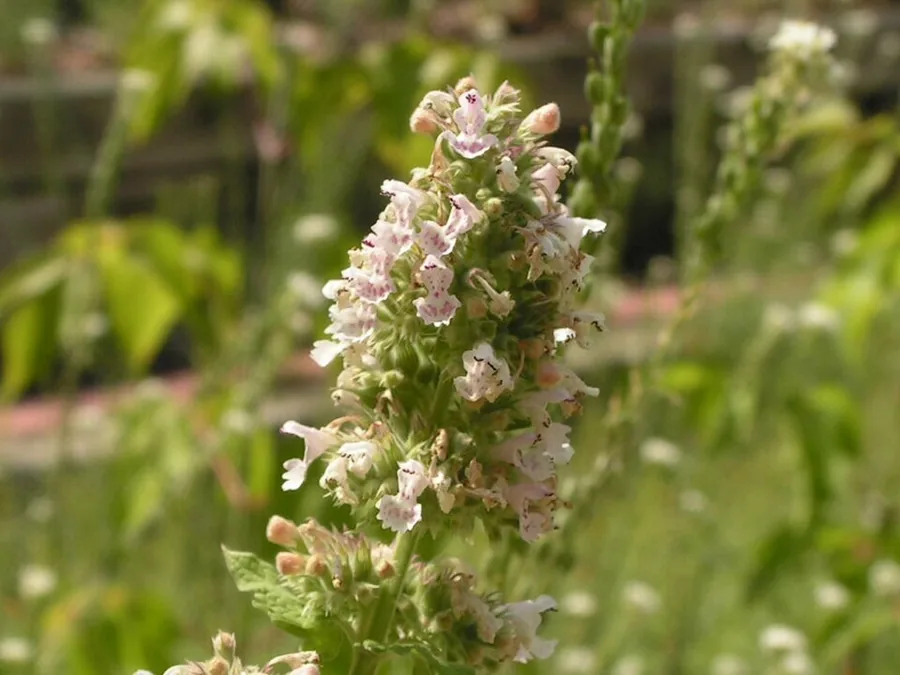
Catnip is a vigorous, fast-growing perennial in the mint family (Lamiaceae), recognized by its soft gray-green foliage and small white flowers marked with purple spotting. Native to Eurasia, it has naturalized through much of the temperate world and performs equally in garden beds and containers. Its hardiness across zones 3 to 9 reflects a tolerance for both cold winters and dry summers.
The plant owes its name and reputation to nepetalactone, a volatile oil concentrated in the foliage that triggers a brief behavioral response in many cats, expressed as rolling and rubbing. The leaves also have a long human use as a mild herbal tea. In the garden the flowers attract bees and other pollinators, and the foliage has a recognized insect-repellent property.
Catnip earns its easy rating because its needs are minimal: sun, sharp drainage, and little intervention. Excess generosity works against it, since fertile soil and heavy feeding produce lax growth that flops. The principal management concern is its tendency to spread, so most cultural effort goes toward confining it where you want it.
Care
The short version: full sun, lean and well-drained soil, and a deep but infrequent irrigation only after the top half has dried. Shear after bloom, fertilize minimally, and confine it if you want to prevent self-seeding throughout the garden.
Light
Catnip requires full sun to develop sturdy stems and the highest concentration of aromatic oil. It tolerates partial shade, but reduced light produces etiolated, floppy growth and a measurably weaker scent.
Water
An established plant is drought-tolerant and physiologically suited to dry conditions rather than wet ones. Irrigate deeply but only every 7 to 14 days, allowing the top half of the profile to dry first. Saturated soil induces root rot, and prolonged winter wetness is frequently fatal.
Soil
Plant it in average, well-drained loamy or sandy soil; high fertility is unnecessary, since it performs on poor, dry ground. A pH between 6.0 to 7.5 is suitable. Sharp drainage is the single non-negotiable requirement.
Temperature
The plant grows actively across roughly 59°F to 86°F (15°C to 30°C). Its cold hardiness extends through winter in zones 3 to 9, and it withstands summer heat without check to growth.
Humidity
Ambient humidity around 30% to 60% is entirely adequate and requires no adjustment. The more consequential variable is air movement, because stagnant, crowded conditions create the leaf-surface microclimate that powdery mildew exploits.
Feeding
Fertilize sparingly, at most a light application of balanced fertilizer or compost in spring. Excess nitrogen redirects the plant toward soft, floppy vegetative growth at the expense of aroma and form.
Pruning
Shearing back by one-third to one-half after the first flush of bloom removes spent growth, induces a compact rebloom, and limits self-seeding. Cut the spent stems to ground level in late fall or early spring as the season closes.
Repotting
Divide clumps every 2 to 3 years to maintain vigor, and repot container specimens in spring. Roots circling the pot, diminished leaf size, water passing straight through, and a woody, congested center all indicate the time has come.
Size & spacing
Catnip forms a rounded clump of roughly 24 to 35 inches (60 to 90 cm) in height and comparable width. Space plants to that dimension so air circulates through the canopy and suppresses mildew.
When to plant
Catnip's schedule keys to the spring frost date, as with most garden herbs. Seed started indoors in late winter, transplanted out after the cold has passed in mid to late spring, will flower from late spring through summer. Harvest the leaves as the buds form, when aromatic oil concentration peaks.
Northern hemisphere
Southern hemisphere
Typical months for a temperate climate: start earlier in warm zones, later where spring frosts linger.
- Sow: 6-8 weeks before the last spring frost
- Plant: After the last spring frost, in mid to late spring
- Harvest: White-to-pale-lavender, purple-spotted flowers from late spring through summer; harvest leaves just before or at flowering for peak aroma
Hardiness
USDA hardiness zones: 3–9
Temperature: down to -40°C
Troubleshooting
Catnip presents few serious problems, and most of what occurs is cosmetic rather than threatening to the plant. The recurring issues are cats damaging the stems, the post-flowering flop, and seedlings emerging well beyond where they were sown. Identify the symptom below, and the correction is generally straightforward.
Volunteer seedlings colonizing the surrounding bed
Attribute this to two spreading mechanisms working together: catnip is a profuse self-seeder and it also extends short rhizomes that form clonal colonies. Interrupting seed set by deadheading or shearing before the flowers ripen cuts off the first route, and removing volunteers while their roots are shallow keeps them from establishing. Container culture isolates both the seed rain and the rhizomes for reliable containment.
Fix:
- Deadhead or shear before seed set
- Pull or hoe volunteer seedlings while young
- Grow in a container to contain spread
Stems crushed flat with the clump matted down
Read this as cat damage, the most common cause by far. Nepetalactone draws cats to roll, rub, and chew, and their weight on the soft, herbaceous stems crushes them, while heavy rain or wind adds to the flattening. Because young tissue lacks the woody base that resists this, cage a prized plant until it matures, and set out spare clumps to absorb the traffic.
Fix:
- Protect young or prized plants with a wire cloche or low cage
- Plant extra clumps so cats can use some freely
- Stake or surround floppy stems for support
Leaves distorted, stippled, or coated in white
Three distinct agents converge on this symptom. Aphids distort new growth as they feed on it, spider mites stipple foliage when hot, dry air favors their populations, and powdery mildew colonizes the white film on plants where crowding stalls airflow. Dislodge the arthropods with a forceful water spray, follow with insecticidal soap on persistent infestations, and correct the mildew by opening the canopy so humidity at the leaf surface drops.
Fix:
- Hose off pests with a strong jet of water
- Apply insecticidal soap or horticultural oil for aphids and mites
- Improve spacing and airflow and remove affected foliage for mildew
Plant gone leggy and splaying open after bloom
Recognize natural post-bloom decline, which shade and over-rich soil aggravate by driving weak, soft, etiolated growth that cannot hold itself up. Shearing the plant back by a third to a half once the first flush fades removes that lax growth and stimulates a tighter second flush. Sustain the habit by growing it in full sun on lean soil with minimal feeding.
Fix:
- Shear the plant back by one-third to one-half after the first bloom
- Move container plants into full sun
- Reduce fertilizer
Toxicity
Catnip is safe across the board. It contains no significant toxin, so cats, dogs, horses, rabbits, livestock, birds, and people can all share its company without concern. Cats respond to the nepetalactone with a harmless interval of euphoria, while for people the foliage steeps into a gentle tea.
Safe for
People · Cats · Dogs · Horses · Rabbits · Livestock · Birds
Cats None
This is the plant's defining interaction with cats, and it remains safe. Nepetalactone provokes a brief behavioral response, so a cat typically rolls, rubs, licks, and shakes its head for about 10 minutes before disengaging. Only consuming a large quantity of leaves prompts mild, self-limiting vomiting or loose stool.
Dogs None
Dogs show no meaningful response to catnip. The species largely disregards it, and incidental ingestion produces no harm.
Horses None
A horse may graze catnip without consequence. As a member of the mint family, it contains no toxic principle relevant to equines.
Rabbits None
Rabbits tolerate catnip in the modest quantities they would consume. As with any fresh forage, an abrupt large portion is best introduced gradually.
Livestock None
Cattle, goats, and sheep can browse catnip safely. The plant carries no compound toxic to grazing ruminants.
Birds None
Catnip poses no risk to pet or backyard birds, and many disregard it. Its foliage contains nothing injurious to avian species.
People None
Catnip has a long culinary and medicinal history with people, prepared as a mild herbal infusion. The foliage is safe to handle and to ingest as tea, and the volatile aroma exerts no comparable effect on humans.
Smelling or eating catnip causes a temporary euphoric response in many cats (rolling, rubbing, head-shaking, drooling, vocalizing) lasting roughly 10 minutes, after which the cat loses interest; this behavioral effect is harmless, while eating very large amounts may cause mild, transient vomiting or diarrhea. The aroma is harmless to people.
Helpline numbers

United States
ASPCA Animal Poison Control: (888) 426-4435 (fee applies)

United Kingdom
Animal PoisonLine: 01202 509000 (fee applies)

Australia
Animal Poisons Helpline: 1300 869 738
Varieties
Most gardens grow the species itself, but one named selection merits attention.
Nepeta cataria 'Citriodora'
Lemon catnip is distinguished by a pronounced lemon note overlaying the standard minty catnip aroma.
How to propagate
Catnip propagates readily by several routes. It comes from seed, from division of an established clump, or from cuttings, and frequently propagates itself through prolific reseeding.
SeedEasy
Sow indoors 6-8 weeks before the last frost, or direct sow in spring · 10-20 days to germinate; harvestable within the first season
Seed is the standard means of propagation. Sowing indoors 6 to 8 weeks before the last frost, or direct sowing in spring, yields germination in 10 to 20 days and a harvestable crop within the first season. Once established, the plant reseeds prolifically, frequently exceeding what a gardener intends.
DivisionEasy
Spring or early fall · 2-4 weeks to re-establish
Dividing an established clump in spring or early fall rejuvenates a declining plant and yields new plants at no cost. Each division re-establishes within 2 to 4 weeks. Performing it on a multi-year cycle prevents the woody, bare center that develops as the crown ages.
Stem cuttingsModerate
Late spring to summer, from non-flowering shoots · 2-3 weeks to root
Softwood cuttings taken from non-flowering shoots in late spring or summer root in 2 to 3 weeks when held in a moist, well-drained medium under high humidity. Because it demands closer environmental control than seed or division, this method rates as the most exacting of the three.
Myths
Catnip is a dangerous, addictive drug that gets cats high.
Nepetalactone elicits a transient behavioral response rather than an actual intoxication, and it produces no dependence. The effect fades in about 10 minutes, after which a cat enters a refractory period and remains unresponsive for a time before sensitivity returns.
Every cat goes wild for catnip.
The sensitivity is heritable, so only about half to two-thirds of cats respond to it. Kittens under roughly 3 months have not yet developed the response, and a notable proportion of adults never acquire it.