Herb · Lamiaceae
Basil
Ocimum basilicum
Supply steady warmth, strong sun, and regular pinching, and basil yields fresh kitchen leaves across the season.
Full sun
Every 7–10 days
50–86°F · 10–30°C
60–90 days
Overview
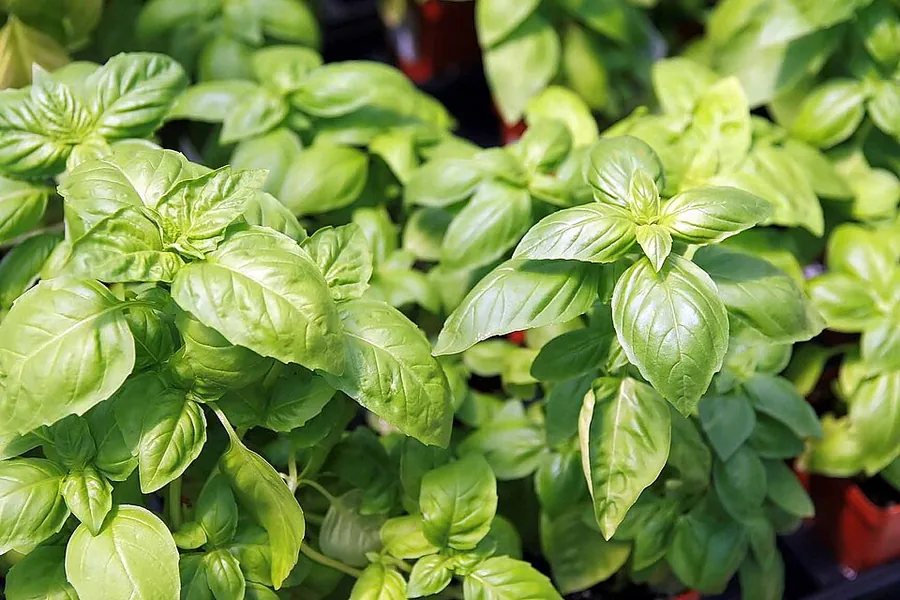
Among culinary herbs, basil is the one cooks turn to most, a frost-tender annual within the mint family with origins in the warm regions of Asia and Africa. Its rapid growth and appetite for heat suit it equally to a garden bed or a container on a bright sill. Supplied with warmth and light, it returns generous flushes of aromatic foliage.
Completing its full cycle within a single season, the plant ranges from 12 to 24 inches (30 to 60 cm) in height according to type. Unchecked, it elongates, flowers, and forms seed, yet routine pinching of the tips redirects that energy back toward foliage. No other practice has a greater bearing on total yield.
Basil is tolerant of beginner error but holds to two non-negotiables. It withstands neither frost nor cold soil, and it deteriorates rapidly in damp, congested air that favors downy mildew. Provide warmth, adequate spacing for air movement, and water delivered at the base, and its culture is largely undemanding.
Care
The short version: site basil in full sun with warmth, keep the soil evenly moist, and water at the base so the foliage stays dry. Feed sparingly, pinch the tips frequently, and avoid setting it into cold ground.
Light
Basil performs best in full sun, with six or more hours each day, because that exposure drives the oils responsible for its flavor. Some afternoon shade is acceptable in regions with severe summer heat, but insufficient light produces leggy, feeble growth.
Water
Maintain the soil evenly moist, watering deeply every 7 to 10 days as rainfall dictates. Containers lose moisture more rapidly and warrant more frequent inspection. Apply water at the base, since foliage left wet invites downy mildew.
Soil
Establish basil in rich, well drained loam improved with compost. A pH from 6.0 to 7.5 suits it, so most reasonable garden soil meets its requirements with little adjustment.
Temperature
Warmth suits basil, broadly 50°F to 86°F (10°C to 30°C), with the fastest growth occurring near the upper end. Frost is fatal to it, and cold soil checks young plants, so warmth takes priority over every other factor.
Humidity
Ordinary humidity in the 40% to 60% range is sufficient, leaving no target worth pursuing. Far more consequential is airflow, because the still, moist air surrounding crowded plants is precisely what initiates downy mildew.
Feeding
Restraint is the rule. A balanced fertilizer such as 5-10-5 applied once or twice through the season meets basil's full need, and feeding sparingly preserves flavor strength, since excessive growth dilutes the oils.
Pruning
Pinch the growing tips regularly to drive bushy lateral branching, and remove flower buds as soon as they form. This continual pinching sustains both leaf production and full flavor.
Repotting
As an annual, basil seldom calls for genuine repotting. Simply pot up seedlings into larger containers as they outgrow the previous one, before roots begin circling and the medium dries too quickly.
Size & spacing
Mature plants stand 12 to 24 inches (30 to 60 cm) tall and reach 12 to 18 inches (30 to 45 cm) across. Allot each that much space so air circulates and disease pressure stays low.
When to plant
Warmth governs every stage of basil, and the plant has no resistance to frost whatsoever. Begin seed indoors during late winter, move plants out only after cold weather has departed and the soil has warmed, and gather leaves throughout the summer until frost brings the season to a close.
Northern hemisphere
Southern hemisphere
Typical months for a temperate climate: start earlier in warm zones, later where spring frosts linger.
- Sow: 6-8 weeks before the last spring frost; germinates best at media temperatures of at least 70°F
- Plant: After all danger of frost when soil is warm and nighttime temperatures stay above 50°F
- Harvest: Harvest leaves continually once plants have several sets of leaves; pinch off flower buds to delay bolting and prolong leaf production
Hardiness
USDA hardiness zones: 2–11
Temperature: down to -46°C
Troubleshooting
The foliage is usually where basil first signals a problem, be it disease, feeding damage, or the onset of flowering. Recognizing the earliest indications lets you respond before the issue advances. Compare your plant against the cases below, then take action while it remains effective.
Yellow patches above with gray-purple spores beneath
The pattern points to basil downy mildew, caused by the pathogen Peronospora belbahrii. It advances quickly under leaf wetness and stagnant air, and infected tissue cannot be salvaged once the underside sporulates. Remove and destroy the plant on sight, widen the spacing, direct water at the soil, and favor resistant lines such as 'Prospera' in future plantings.
Fix:
- Remove and destroy affected plants immediately
- Increase plant spacing and prune for airflow
- Water at the base to keep foliage dry
Abrupt collapse with brown streaking inside the stem
The signs indicate Fusarium wilt, a soil-borne fungus that blocks the plant's water-conducting tissue from within, for which no treatment exists once it establishes. Lift the plant and discard it in the trash rather than the compost, then begin again elsewhere in fresh, sterile media. The reliable defenses are resistant cultivars and certified disease-free seed.
Fix:
- Remove and destroy infected plants
- Do not compost affected material
- Replant in a different location or use fresh sterile media
Soft, dark roots on a plant struggling in cold, wet ground
Root rot develops where soil stays saturated or too cold for the roots to function. Sound roots feel firm and look white, while affected ones turn soft, brown, and foul-smelling. Correct the drainage, scale back watering, and hold transplanting until the soil has warmed above 50°F (10°C).
Fix:
- Improve drainage and reduce watering frequency
- Remove severely affected plants
- Allow soil to dry between waterings
Flowering tips and leaves that lose their flavor
The plant is bolting, redirecting its resources into flowering and seed once it reaches maturity or meets long, hot days. As the spikes develop, fresh growth emerges smaller and noticeably milder. Remove the buds as they appear and continue harvesting, which holds the plant in its leafy, well-flavored vegetative phase.
Fix:
- Pinch off flower buds as soon as they appear
- Harvest and prune leaves regularly to delay flowering
Ragged feeding holes that skeletonize the foliage
Two chewing pests produce this damage. Japanese beetles feed in daylight and reduce the blade to a network of veins, whereas slugs and snails work after dark and leave a glistening trail beside their holes. Drop the beetles into soapy water, deploy traps or barriers against the molluscs, and intervene early before either population builds.
Fix:
- Hand-pick beetles into soapy water
- Apply insecticidal soap for soft-bodied pests
- Set out slug traps or barriers
Toxicity
There is little cause for concern here. Basil is non-toxic and cultivated for the table, making it safe in the company of cats, dogs, horses, rabbits, livestock, birds, and children. The most an inquisitive pet risks from a generous mouthful is a short, mild bout of stomach upset that resolves unaided.
Safe for
People · Cats · Dogs · Horses · Rabbits · Livestock · Birds
Cats None
Basil carries no toxins for cats, so a casual nibble is harmless. Should a cat overindulge on any greenery, it may vomit briefly, then settle without intervention.
Dogs None
Dogs tolerate basil with no adverse effect. At most, a large helping might prompt a short bout of mild digestive upset that resolves on its own.
Horses Safe
Basil presents no hazard to horses, since the plant contains no compound that affects them.
Rabbits Safe
Rabbits may browse basil at will, and the fresh foliage is often readily accepted.
Livestock Safe
Grazing animals such as goats, sheep, and cattle can consume basil without any harmful consequence.
Birds Safe
Basil holds no danger for birds, and domestic poultry will readily forage on the leaves.
People Safe
Cultivated as a culinary herb, basil is meant for consumption, raw or cooked, and poses no concern for adults or children.
No special handling precautions are needed; basil is non-toxic and edible.
Varieties
Basils number in the dozens, spanning sweet Italian forms through spicy and ornamental kinds, yet only a few appear in most plantings. The selections below are the ones worth recognizing by name.
Genovese
The large-leaved Italian sweet basil regarded as the standard for pesto, prized for flavor yet also the most prone of all types to downy mildew.
Thai basil
A purple-stemmed type carrying anise and licorice notes, reaching 24 to 36 inches and central to much of Southeast Asian cuisine.
Purple Ruffles
Valued chiefly for ornament, this selection bears deep purple, ruffled foliage that also serves the kitchen.
Spicy Globe
A compact mounding form that stays just 8 to 10 inches high, well suited to containers and low edging.
Prospera
A Genovese-type selection bred for downy mildew resistance, its compact habit lending itself to container culture.
Companions
Basil earns its old reputation as a tomato's best neighbor, sharing the same warm, sunny, well-drained ground the two crops both want.
Plant near
Tomato: Basil is a traditional interplanting companion for tomatoes in the vegetable garden, sharing similar warm-season, full-sun, well-drained growing conditions.
How to propagate
Few plants increase as readily as basil, whether you begin with a packet of seed or take cost-free copies from a specimen already in the garden.
SeedEasy
Sow indoors 6-8 weeks before last frost or direct sow after frost when soil is warm · Germinates in 5-10 days at about 70°F; transplant-ready in roughly 3-4 weeks
Seed is the usual route into basil. Set it roughly a quarter inch deep, 6 to 8 weeks ahead of the last frost, and hold the media at 70°F (21°C) or above, since warmth drives dependable germination. Emergence follows in 5 to 10 days and seedlings reach transplant size in about 3 to 4 weeks, with direct sowing a sound option once the ground has warmed.
Stem cuttingsEasy
Any time during the growing season from healthy non-flowering shoots · Roots form in water in about 1-2 weeks
Vegetative propagation is straightforward and yields an exact copy of the parent. At any point in the growing season, cut a 4-inch length from a vigorous, non-flowering shoot, remove the lower leaves, and suspend the base in water, where roots emerge within one to two weeks ahead of potting.
Myths
Basil leaves become poisonous after the plant flowers and must be discarded.
Foliage from a flowering plant remains entirely edible. What changes is intensity: as resources shift toward seed production, the leaves grow milder, which is why growers remove the buds, not from any safety concern.
Vigorous growth in basil depends on heavy, frequent feeding.
The plant performs better with restraint. Excess fertilizer dilutes the aromatic oils that carry the leaf flavor, so one or two applications across the season serve it well.