Herb · Lamiaceae
Creeping Thyme
Thymus serpyllum
Sited in full sun with sharp drainage, creeping thyme forms a tough, aromatic mat built to withstand drought.
Full sun
Every 10–14 days
USDA 4–9
1–4 in · 2–10 cm
Overview
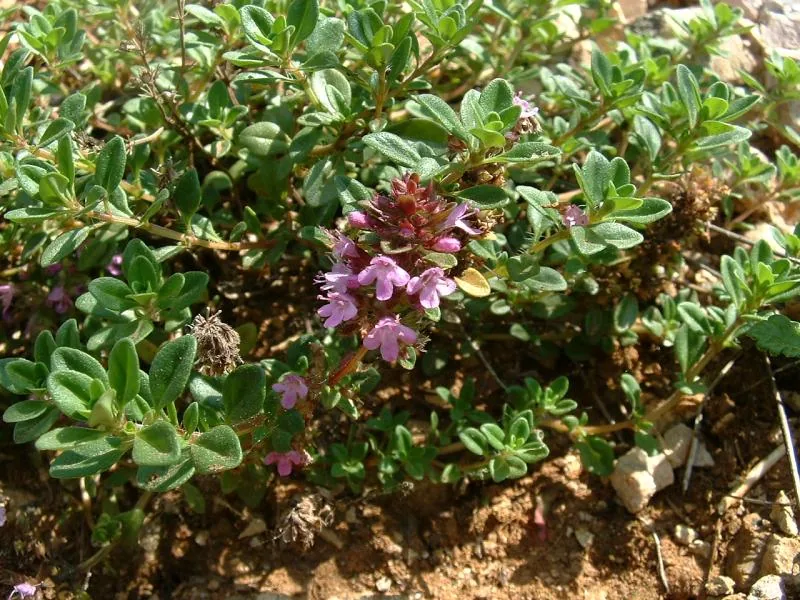
Creeping thyme is a prostrate, woody groundcover in the Lamiaceae that knits into a dense evergreen mat only an inch or two tall. The aromatic oils held in its foliage account for the warm, herbal scent released when the leaves are crushed underfoot or brushed. Its low, spreading habit suits it to seams between pavers, the faces of dry walls, and ground where turf performs poorly.
Stress tolerance is its defining trait. Established plants withstand drought, infertile stony substrates, and severe cold, with hardiness extending through USDA zones 4 to 9. From early summer the mat carries dense tiny pink-to-purple flowers, a strong nectar source that draws bees in numbers.
Its requirements are modest but unforgiving on one point. Sharp drainage and full sun govern its health, while fertile soil or saturated roots compromise it more readily than any pest. Once the site satisfies those two conditions, the plant is largely self-sustaining.
Care
The short version: full sun and lean, gritty, sharply drained soil. Water deeply but infrequently once established, withhold fertilizer, and shear after bloom to maintain a dense mat.
Light
Provide full sun for best performance. The plant persists in partial sun, but reduced irradiance yields a thin, lax mat and markedly diminished flowering, so the most open, brightly lit position is preferable.
Water
Established plants are drought-tolerant and favor dry to medium moisture. Irrigate deeply but infrequently, on the order of every 10 to 14 days during drought, allowing the upper half of the soil profile to dry between applications. Saturated soil is the principal cause of decline.
Soil
Low fertility is the objective. Establish it in loose, sandy, gritty or rocky soil with sharp drainage, since fertile media reduce hardiness and suppress flowering. It tolerates a broad pH range from 6.0 to 8.0.
Temperature
This is a notably cold-hardy species, enduring a wide thermal range from -29°F to 86°F (-34°C to 30°C). Severe winter cold does not damage it, and it withstands summer heat provided drainage is adequate.
Humidity
It performs best under low humidity and gains nothing from humid air. Air movement is the more important factor, because stagnant, moist conditions predispose the plant to rot and to spider mites.
Feeding
Minimal feeding is correct. As a light feeder, it is set back by fertile conditions, which reduce both winter hardiness and bloom. A modest spring application is the most that is warranted, if any.
Pruning
Shear or cut the stems back after flowering to restore form, restrain spread, and slow the accumulation of woody growth that thins the mat center with age. An annual shearing maintains density and appearance.
Size & spacing
Mature height remains low at 1 to 4 inches (2 to 10 cm), while individual plants spread into a mat 12 to 18 inches (30 to 45 cm) wide. Spacing equal to that spread allows plants to coalesce into continuous cover.
When to plant
As a hardy perennial, creeping thyme is established once and persists across seasons. Sow seed indoors in late winter, transplant in spring after frost has cleared, and the mat will flower through summer, with foliage available for harvest at any point.
Northern hemisphere
Southern hemisphere
Typical months for a temperate climate: start earlier in warm zones, later where spring frosts linger.
- Sow: Late winter to early spring, 6-8 weeks before last frost
- Plant: Spring, after danger of frost has passed
- Harvest: Tiny deep pink to purple flowers appear early-to-mid summer (June-September) and are highly attractive to bees; aromatic leaves can be harvested anytime.
Hardiness
USDA hardiness zones: 4–9
Temperature: down to -34°C
Troubleshooting
In a correctly chosen site creeping thyme remains largely problem-free, and the disorders that do appear trace almost entirely to excess moisture or to the senescence of an aging mat. The early indicators below allow intervention before a section is lost. Identify the symptom, then act while correction is still effective.
Crown blackening and progressive collapse of mat sections
The cause is root and crown rot, a physiological response to saturated soil rather than a treatable infection. Poor drainage or excessive irrigation deprives the roots of oxygen until the tissue turns soft, dark, and malodorous. Excise the affected sections, incorporate sand or grit to raise porosity, and substantially reduce irrigation frequency.
Fix:
- Remove affected sections
- Improve drainage by amending with sand or grit
- Reduce watering frequency
- Replant healthy divisions in a faster-draining site
Central dieback with bare woody stems and a green perimeter
This reflects the natural woody aging of the oldest central stems, not a pathogen or pest. The interior becomes brown and defoliated while the perimeter remains green and continues to spread. Shear the entire mat after flowering to stimulate fresh basal growth, and lift and divide the vigorous outer sections every few years to renew the planting.
Fix:
- Shear back after flowering to encourage fresh basal growth
- Divide and replant vigorous outer sections to rejuvenate
Fine leaf stippling with light webbing on the foliage
The agent is spider mites, which colonize the leaf undersides during hot, dry summer conditions and feed on cell contents. Fine stippling appears first, followed by sparse webbing as the population rises. Dislodge them with a forceful water spray, improve airflow to discourage reestablishment, and apply insecticidal soap only for persistent infestations.
Fix:
- Rinse foliage with a strong jet of water
- Increase airflow
- Treat persistent infestations with insecticidal soap or horticultural oil
Toxicity
There is no toxicity concern with this species. Creeping thyme is non-toxic throughout, posing no risk to cats, dogs, horses, rabbits, livestock, birds, or people. Its foliage is edible as well, so incidental ingestion by a pet or child warrants no concern.
Safe for
People · Cats · Dogs · Horses · Rabbits · Livestock · Birds
Cats None
Non-toxic to cats; ingestion of the aromatic foliage produces no adverse effect.
Dogs None
Non-toxic to dogs, so contact with the mat or consumption of a leaf carries no risk.
Horses Safe
Listed as safe for horses, with no toxic constituents in the foliage or stems.
Rabbits Safe
Safe for rabbits to graze, with no associated risk, and the scented foliage is often readily taken.
Livestock Safe
Tolerated by grazing cattle, goats, and sheep without adverse effect.
Birds Safe
Presents no hazard to birds; the summer flowers function primarily as a bee attractant.
People Safe
Safe for human consumption, the foliage being edible though milder in flavor than culinary Thymus vulgaris.
No special handling precautions; foliage is aromatic and safe to touch and taste.
Varieties
Commerce favors the plain species, but two named selections merit attention for their distinct stature or flower color.
Elfin
An extremely dwarf, tightly cushioned selection holding at roughly an inch in height, which suits it to planting between stepping stones.
Coccineus
A vigorous mat-forming selection bearing deep magenta-red flowers of far greater intensity than the soft pink-purple of the species.
How to propagate
Creeping thyme propagates readily by three routes: division of an established mat, rooted cuttings, or seed for the species.
DivisionEasy
Spring or early fall · 4 to 8 weeks
Lift an established mat in spring or early fall and separate it into pieces, each retaining its own roots. The divisions establish over 4 to 8 weeks, and this is the dependable method for reproducing a named cultivar true to type.
Stem cuttingsEasy
Late spring to summer · 3 to 6 weeks
Collect softwood cuttings from non-flowering shoots in late spring or summer and insert them in a gritty, free-draining medium. Rooting follows in 3 to 6 weeks, and because the cuttings retain the parent's characteristics, a chosen cultivar is preserved.
SeedModerate
Late winter to spring, indoors before last frost · Several weeks to germinate; full mat coverage over a season or more
Seed is the conventional method for the species. Surface-sow the fine seed indoors before the last frost and maintain light moisture; germination takes several weeks and full mat coverage a season or more. Cultivars do not breed true from seed, so reserve this method for the species.
Myths
Creeping thyme is nothing more than kitchen thyme in groundcover form.
The two are closely related but distinct species. Culinary thyme is Thymus vulgaris, whereas creeping thyme is cultivated chiefly as an ornamental groundcover. It is edible but milder, and it seldom serves a culinary role.