Vegetable · Solanaceae
Potato
Solanum tuberosum
Set out cut seed pieces, hill the stems and water evenly, and lift a heavy tuber crop in fall.
Full sun
Every 3–7 days
50–77°F · 10–25°C
70–120 days
Overview
The potato is a cool-season member of the Solanaceae, the nightshade family that also includes tomato and pepper. It was domesticated in the Andes, where selection for food went on for thousands of years before the crop reached the wider world. The harvested organ is the tuber, a swollen underground stem in which the plant stores starch, so it is not a root despite growing below ground.
Yield is decided underground, which shapes how the crop is managed. Cut seed pieces, each bearing an eye, produce leafy shoots above while stolons below swell into tubers. The central practice is hilling: drawing soil up the stems keeps developing tubers buried and away from light. A tuber exposed to light forms chlorophyll and the glycoalkaloid solanine, which is why it turns green and bitter.
Grown in loose, fertile, acidic soil with steady moisture through tuber bulking, even a modest bed can supply a kitchen for months. Because mature tubers store well, a single fall harvest holds through much of the winter. The crop rewards attention to soil and water more than to the foliage above.
Care
The short version: full sun, loose slightly acidic soil rich in organic matter, and even moisture from tuber initiation onward. Feed at planting, restrain nitrogen so the plant partitions energy into tubers rather than foliage, and hill soil up the stems as growth proceeds.
Light
Potatoes require full sun, ideally 6 or more hours of direct light daily, to drive the photosynthesis that fills the tubers. Under partial sun the canopy grows weaker and tuber size falls, so the most open position gives the best return. Light is the input this crop can least afford to short.
Water
Maintain evenly moist soil, roughly 1 to 2 inches of water per week, with particular consistency once tubers begin to bulk, because fluctuating moisture at this stage encourages scab and misshapen tubers. Avoid waterlogging, since saturated soil excludes oxygen and favors rot and disease.
Soil
Use loose, well-drained sandy loam rich in organic matter. A pH of 5.0 to 6.0 suits the crop and suppresses common scab, whose causal bacterium is favored by higher pH. The open structure also lets tubers expand without resistance, improving size and form.
Temperature
Growth is optimal in cool conditions between 50°F and 77°F (10°C to 25°C). Tuber formation slows as temperatures rise, because heat shifts the plant's balance away from tuber bulking, so an early start captures the cool part of the season before summer heat sets in.
Humidity
No specific humidity target applies, since average outdoor conditions are adequate. What matters is air movement, since still, humid air within a dense canopy creates the leaf wetness that late blight requires to establish and spread. Adequate spacing lets foliage dry.
Feeding
Incorporate a balanced fertilizer at planting, then side-dress modest nitrogen as shoots emerge and hilling begins. Excess nitrogen drives vegetative growth at the expense of tubers, so restraint here directs the plant's resources toward the harvest rather than the canopy.
Pruning
No formal pruning is warranted. Remove diseased foliage as soon as it appears to limit spread, and continue hilling soil up the stems to keep enlarging tubers covered, which blocks the light exposure that drives greening and solanine formation.
Size & spacing
Plants reach 1 to 3 feet (30 to 100 cm) in height and spread 12 to 24 inches (30 to 60 cm). Adequate spacing supports airflow, and generous hilling expands the covered zone in which stolons set tubers, so both spacing and mounding influence final yield.
When to plant
Potatoes are planted early because they grow best in cool conditions. Set seed pieces 2 to 4 weeks before the last frost, once soil temperature reaches about 45°F to 50°F (7°C to 10°C), which is warm enough for sprouting without risking rot. New potatoes can be lifted from midsummer, while the main storage crop is dug in fall after the tops die back and the skins have set.
Northern hemisphere
Southern hemisphere
Typical months for a temperate climate: start earlier in warm zones, later where spring frosts linger.
- Plant: Early spring, about 2-4 weeks before the last expected frost once soil reaches roughly 45-50°F
- Harvest: Harvest new potatoes about 60-70 days after planting; harvest mature storage potatoes about 90-120 days after planting once tops die back
Hardiness
USDA hardiness zones: 3–9
Temperature: down to -40°C
Troubleshooting
Potato disorders divide neatly by where they appear: foliar problems during active growth and tuber problems revealed at harvest. Knowing the few that carry real consequence lets you intervene before they spread. Match the description below, then correct the underlying cause.
Spreading dark lesions and rapid foliar collapse in humid weather
This is late blight, caused by Phytophthora infestans, the same oomycete that destroys tomatoes and advances rapidly after cool, wet, humid spells. Confirm it by the brown-black lesions with pale margins and the white sporulation on leaf undersides during humid mornings. Remove and destroy infected plants at once rather than composting them, and cull any rotted tubers before storage to prevent carryover.
Fix:
- Remove and destroy infected plants immediately
- Do not compost infected material
- Apply an approved fungicide preventively where blight is present
- Harvest carefully and cull infected tubers before storage
Striped adults and red larvae defoliating the canopy
The Colorado potato beetle is the crop's most damaging insect, and a large population can defoliate a plant. Scout leaf undersides for orange egg clusters, soft red humpbacked larvae, and the striped adults bearing ten black lines. Handpick all stages into soapy water, exclude adults from young plants with row cover, and rotate the planting each year to break the pest's cycle.
Fix:
- Handpick adults, larvae, and egg masses into soapy water
- Use row covers early in the season
- Apply an approved insecticide if infestation is heavy
- Rotate planting location yearly
Green pigmentation in the tuber skin and flesh
Greening develops where light reaches a tuber near the surface, triggering chlorophyll and, alongside it, the toxin solanine, which makes the tuber bitter and unsafe. The usual cause is insufficient hilling that leaves tubers exposed. Mound soil over developing tubers, discard any that are heavily greened, and store the harvest in cool, dark conditions to prevent further accumulation.
Fix:
- Hill soil up over exposed tubers as plants grow
- Discard heavily greened tubers
- Store harvested potatoes in cool, dark conditions
- Cut away minor green areas before cooking
Shallow corky lesions roughening the tuber skins
These corky lesions are common scab, caused by a soil actinomycete that is favored by dry soil during tuber set and by high pH. A peeled tuber confirms the diagnosis: the damage is superficial and the flesh beneath is sound, so the crop remains edible. Hold even moisture through tuber initiation, keep pH around 5.0 to 5.5, and avoid fresh manure, which raises scab pressure.
Fix:
- Maintain even soil moisture during tuber formation
- Keep soil pH slightly acidic (around 5.0-5.5)
- Plant scab-resistant cultivars
- Avoid fresh manure and alkaline amendments
Toxicity
The cooked tuber is a safe dietary staple, but the rest of the plant is not, and the difference is chemical. Foliage, stems, sprouts, and any green or raw tuber accumulate the glycoalkaloid solanine, which is toxic to people and animals. Trim green tissue, discard heavily greened tubers, and keep vines and sprouts away from pets, livestock, and children.
Toxic to
Cats · Dogs · Horses · Rabbits · Livestock · Birds
Safe for
People
Cats Caution
A cat that ingests foliage, stems, or a green sprouted tuber takes in solanine, which first irritates the gut, producing drooling, vomiting, diarrhea, and lethargy. Larger doses can extend to cardiac and neurological effects, so veterinary advice is warranted if intake exceeds a nibble.
Dogs Caution
Dogs that unearth and chew raw or green tubers, or browse foliage, typically develop gastrointestinal upset with loose stools and lethargy from the glycoalkaloid load. Higher intake can disturb cardiac rhythm, so affected animals should be monitored closely.
Horses Caution
Vines and any green or sprouted tubers are unsafe for horses. Solanine produces colic, salivation, and a dull, unsteady gait, and a horse grazing fallen foliage can consume enough to require veterinary attention.
Rabbits Caution
Leaves, stems, and green tubers should be kept from rabbits entirely, since their small body size means even a small solanine dose has a marked effect. Reduced appetite, abdominal bloating, and weakness follow ingestion.
Livestock Caution
Cattle, sheep, pigs, and goats are poisoned by discarded vines or accumulations of green and cull tubers left in the field. Solanine causes digestive upset and, at higher intake, neuromuscular signs such as staggering and trembling.
Birds Caution
Chickens and other birds should be kept from foliage, sprouts, and greened scraps, all of which contain solanine. Small amounts of plain cooked potato are tolerated, whereas the green, raw material is not.
People Cooked tuber safe
A cooked, properly stored tuber is a safe dietary staple. The hazard is confined to green skin, sprouts and eyes, and all foliage and stems, which carry solanine that renders a tuber bitter and can cause illness, so green areas should be cut away, heavily greened tubers discarded, and vines excluded from food.
Cooked, properly stored potato tubers are a safe food. The hazard is the foliage and any green, raw, or sprouted tubers, which contain solanine.
Helpline numbers

United States
ASPCA Animal Poison Control: (888) 426-4435 (fee applies)
Poison Control: (800) 222-1222



Canada
Poison Centres: 1-844-764-7669
Varieties
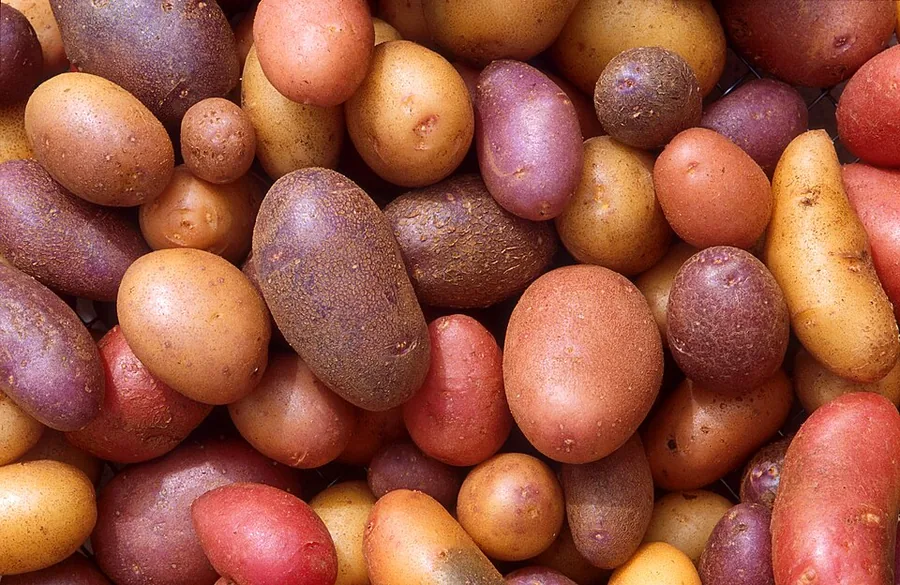
Hundreds of cultivars exist, separated mainly by skin color, flesh texture, and culinary use. The four below are among the most widely grown and illustrate the main types.
Yukon Gold
Yukon Gold is a thin-skinned yellow cultivar with buttery, all-purpose flesh that has become the standard kitchen potato.
Russet Burbank
Russet Burbank is a large, oblong, brown-skinned cultivar whose high starch content makes it the preferred choice for baking and frying.
Red Pontiac
Red Pontiac is a red-skinned, white-fleshed cultivar valued for consistent yields and strong storage performance.
Kennebec
Kennebec is a vigorous white cultivar that produces heavy crops and carries better disease tolerance than most.
Companions
Potatoes do well beside nitrogen-fixing beans and a few traditional partners, and badly beside their nightshade relatives and sprawling vines that crowd them and trade diseases.
Plant near
Bush beans: Legumes fix nitrogen and are reported to help repel some potato pests.
Corn: Traditional companion that does not compete heavily and shares no major potato diseases.
Cabbage-family crops: Generally compatible bed companions that do not share potato's key diseases.
Horseradish: Often planted near potatoes and is said to improve overall plant vigor and pest resistance.
Keep apart
Tomato: Another solanaceous crop that shares late blight and other diseases, increasing risk to both.
Cucumbers and squash: Sprawling cucurbits crowd potatoes and can increase disease pressure.
How to propagate
Two propagation routes are possible, but their outcomes differ sharply, so one dominates home production.
Bulbs & cormsEasy
Early spring, 2-4 weeks before the last frost · Sprouts emerge in about 2-4 weeks after planting
Commercial and home crops alike are grown from certified seed-potato pieces, each cut to carry one or two eyes and cured for a day or two so the cut surfaces suberize before planting. Set them out in early spring, 2 to 4 weeks before the last frost, about 4 inches deep, with emergence following in roughly 2 to 4 weeks. Continue hilling soil up the stems as growth advances to keep tubers covered.
SeedDemanding
Indoors in late winter · Several weeks to germinate and grow on before transplanting
Propagation from true botanical seed is a distinct and more demanding process, sown indoors in late winter and grown on for several weeks before transplanting. Because segregation produces variable seedlings, the method is confined largely to breeding programs and is seldom used by home growers.
Myths
Since the tubers are eaten routinely, every part of the potato plant is edible.
Only cooked, properly stored tubers that never greened are safe. Foliage, stems, sprouts, and any green or raw tuber contain the glycoalkaloid solanine, which is genuinely toxic, so the plant as a whole cannot be treated as food. The edible tuber is the exception, not the rule for the species.
Potatoes must be raised from true seed, as most vegetables are.
Home production relies almost entirely on certified seed-potato pieces, each cut to include one or more eyes and grown as clones of the parent. True botanical seed is used mainly in breeding, because sexual reproduction segregates the genetics and yields highly variable offspring not suited to a predictable crop.