Vegetable · Solanaceae
Tomatillo
Physalis philadelphica
Grow two plants for cross-pollination, site them in full sun, and the tart green husks fill all season.
Full sun
Every 4–7 days
59–86°F · 15–30°C
60–100 days
Overview
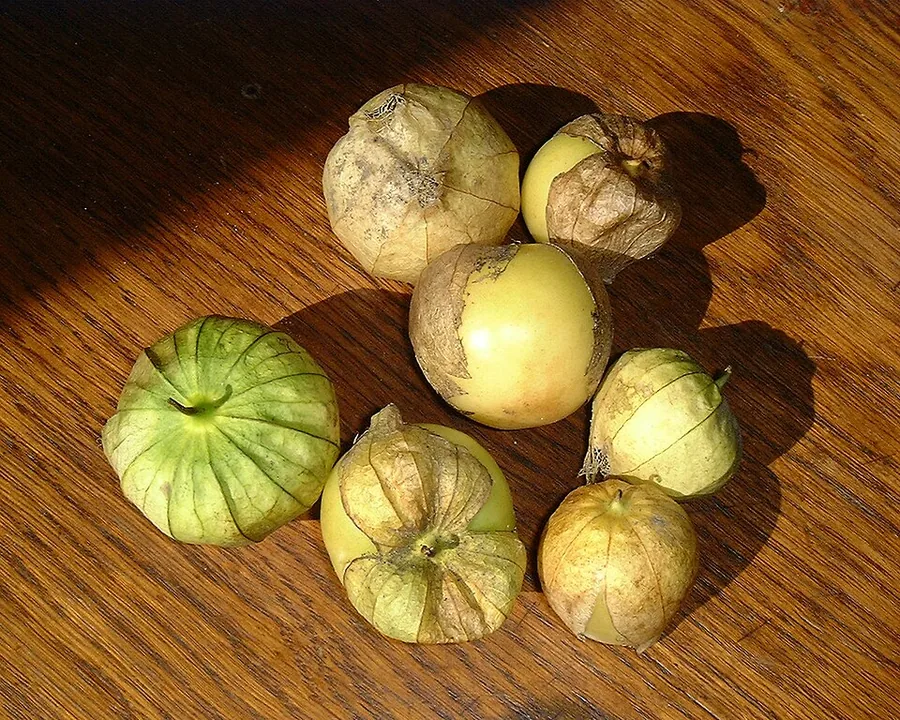
The tomatillo, Physalis philadelphica, produces the tart green fruit that defines salsa verde, each berry enclosed in its own papery husk. It belongs to the nightshade family with the tomato yet remains a distinct species, carrying a sharper flavor and firmer flesh. Cultivated across Mexico and Central America for centuries, it reaches eating quality while the fruit is still green.
As a warm-season annual it grows fast and easy, developing into a large, branching, indeterminate plant that needs a cage or stake to stay off the ground. The point every grower should note first is its reliance on cross-pollination: a solitary plant sets little fruit because its flowers are not effectively self-pollinated. Grow two or more together and the husks fill rather than remaining empty.
Supplied with full sun, consistent moisture, and adequate spacing, even a single pair of plants can out-produce a small household's needs. Harvest once the husk turns tan and begins to split, taking the fruit while it is firm rather than soft, which marks the point of full development.
Care
The short version: site tomatillos in full sun on rich, free-draining soil, supply close to an inch of water each week, and grow no fewer than two plants nearby so their flowers can cross-pollinate and set a crop.
Light
Tomatillos require full sun, meaning as many hours of direct light per day as the site allows, because their fruiting depends on high light. Under insufficient light the plant grows leggy and flowers and fruits poorly.
Water
Supply about 1 inch of water a week and keep the soil evenly moist, since consistent moisture produces uniform fruit quality. Established plants tolerate short drought, so water deeply once or twice weekly rather than lightly and often. Deliver it at the base and avoid wetting the foliage, which reduces the spread of disease.
Soil
Grow tomatillos in rich, well-drained sandy or silty loam high in organic matter, and avoid heavy, wet clay that holds water around the roots. A pH of 6.0 to 7.0 supports good nutrient availability.
Temperature
Growth is best within 59°F to 86°F (15°C to 30°C), the range in which the plant develops and sets fruit efficiently. Frost kills the plant at either end of the season, so transplant only after the cold has fully passed.
Humidity
Ambient outdoor humidity is sufficient, so there is no target level to maintain. Air movement matters more, because still, damp foliage creates the conditions in which most foliar disease begins.
Feeding
Feed lightly at planting in spring and keep nitrogen low, applying phosphorus and potassium only as a soil test indicates. Excess nitrogen drives vegetative growth, which delays flowering and reduces fruit set.
Pruning
Tomatillos are generally not pruned. Stake or cage the sprawling, indeterminate plants and remove the lowest leaves that contact the soil to limit disease transfer, but withhold heavy pruning, which the plant does not need.
Size & spacing
Plants reach 3 to 4 feet (90 to 120 cm) tall with a comparable spread, so allow each one 3 to 4 feet (90 to 120 cm) of room. That spacing maintains air circulation and prevents the large, branching plants from crowding, which lowers disease pressure.
When to plant
Tomatillos demand warmth and have no frost tolerance, so timing follows soil temperature rather than the calendar alone. Start seed indoors in late winter, transplant once the soil has warmed in late spring, and harvest from midsummer into autumn as the husks fill and split.
Northern hemisphere
Southern hemisphere
Typical months for a temperate climate: start earlier in warm zones, later where spring frosts linger.
- Sow: 6-8 weeks before the last spring frost
- Plant: After all danger of frost has passed and the soil has warmed (late spring)
- Harvest: Harvest about 60-75 days after transplanting, when fruit fills the husk and the husk turns tan and begins to split
Hardiness
USDA hardiness zones: 5–11
Temperature: down to -29°C
Troubleshooting
Most tomatillo problems reduce to three that a grower can read directly from the plant: empty husks, defoliated leaves, and lodged stems. Each responds well to early intervention. Identify the symptom below and correct the underlying cause while the plant can still recover.
Husks develop but enclose little or no fruit
This traces to a pollination failure rather than a soil deficiency. Because tomatillo flowers depend on cross-pollination, an isolated plant sets almost no fruit and produces papery husks that stay empty. Grow two plants near one another, reduce nitrogen inputs, and support bee activity with nearby flowering plants to restore fruit set.
Fix:
- Grow at least two plants, ideally two different varieties, for cross-pollination
- Encourage pollinating insects
- Avoid high-nitrogen fertilizer
Foliage chewed ragged or reduced to the veins
Several insects feed on the leaves, principally the three-lined potato beetle, together with tomato hornworms, cutworms, and flea beetles. Because the papery husk encloses each fruit, the crop usually escapes damage even as the foliage is grazed. On a small planting, remove beetles and caterpillars by hand, destroy egg masses, and scout regularly so an infestation is caught at low numbers.
Fix:
- Handpick beetles, larvae, and hornworms on small plantings
- Remove and destroy egg masses
- Scout plants regularly
Vigorous foliage with sparse flowering and fruit
Excess nitrogen shifts the plant toward vegetative growth at the expense of fruit. The foliage looks dark green and vigorous while flowering and fruit development lag behind. Discontinue high-nitrogen fertilizer and supply only the phosphorus and potassium indicated by a soil test.
Fix:
- Stop applying high-nitrogen fertilizer
- Apply phosphorus and potassium per soil test only as needed
Stems lodging and lying across the soil
The tomatillo is a large, branching, indeterminate plant, and as the fruit load increases the stems bend to the ground. Cage or stake the plant and tie the main stems upward as they extend. Install the support at transplanting, before the plant is too large to train.
Fix:
- Stake or cage plants for support
- Tie up main stems as they grow
Toxicity
The ripe, husked fruit is edible, but the remaining tissues are not. Leaves, stems, and unripe green fruit accumulate solanine, a glycoalkaloid that irritates the digestive tract. Keep this green material away from pets, livestock, and children, and reserve only the firm, ripe fruit for the kitchen.
Toxic to
Cats · Dogs · Horses · Rabbits · Livestock · Birds
Safe for
People
Cats Caution
A cat that ingests foliage or an unripe fruit may salivate, refuse food, and develop gastrointestinal upset. The solanine concentrated in the green tissues drives these signs, so the foliage should stay out of reach.
Dogs Caution
In dogs, chewing the leaves or green fruit can produce drooling, vomiting, and lethargy. Most exposures are mild, but the solanine in leaves and stems makes them unsuitable for a dog to browse.
Horses Caution
Grazing the green plant parts can leave a horse salivating and dull with gastric upset. Monitor horses near any stray plants at a paddock margin, since the same alkaloid is responsible.
Rabbits Caution
The solanine in the leaves and stems makes the foliage unsuitable for rabbits. Withhold the greens entirely rather than risk digestive disturbance.
Livestock Caution
Cattle, goats, and sheep can respond to the solanine in foliage and unripe fruit with gastrointestinal and neurological signs. Exclude them from the plants and remove any stems and husks within reach.
Birds Caution
The green parts should be kept from poultry and pet birds, because the same alkaloid affects avian species. A portion of the ripe, husked fruit is a far safer option for a bird.
People Ripe fruit safe
For people, the ripe, husked tomatillo is a culinary staple and safe to cook and eat. The leaves, stems, and unripe green fruit should be excluded, since they retain solanine.
The ripe, husk-filled, firm fruit is safe to eat and is the harvested vegetable. Only the leaves, stems, and unripe (immature) fruit are the concern; keep pets and children from chewing green plant parts and discard unripe fruit and husks.
Helpline numbers

United States
ASPCA Animal Poison Control: (888) 426-4435 (fee applies)
Poison Control: (800) 222-1222



Canada
Poison Centres: 1-844-764-7669
Varieties
A handful of reliable cultivars covers most needs, from early green types to large-fruited and purple selections. The following are the ones worth knowing by name.
Toma Verde
An early, widely grown selection producing flat, apple-green fruit with a bright, tangy flavor.
Purple de Milpa
Produces smaller fruit that turn purple and carry a sharper, more intense tartness than the green types.
Grande Rio Verde
A green tomatillo selected for heavy yields of large, sizable fruit.
Gigante
A vigorous cultivar that produces notably large green fruit.
How to propagate
Tomatillos propagate readily from seed started indoors, much as tomatoes do, with the one requirement that more than a single plant be raised.
SeedEasy
Start seeds indoors 6-8 weeks before the last spring frost; transplant after frost danger passes and soil warms · Transplant-ready in roughly 6-8 weeks; fruiting begins about 60-100 days after transplanting
Propagate tomatillos from seed sown indoors, in the same manner as tomatoes, about 6 to 8 weeks before your last spring frost. The resulting seedlings are ready to transplant within that interval, once frost has passed and the soil has warmed. Raise two or more plants to allow cross-pollination, and expect the first fruit approximately 60 to 100 days after transplanting.
Myths
Tomatillos are unripe green tomatoes.
They are a distinct species, Physalis philadelphica, developing inside a papery husk that the tomato lacks entirely. They mature while green and remain firmer and considerably tarter than any tomato.
A single tomatillo plant produces a full crop by itself.
An isolated plant sets almost nothing because the species depends on cross-pollination. Grow at least two together, ideally two varieties, and fruit set follows.
The entire tomatillo plant is edible, as the fruit is.
Only the ripe, husked fruit is safe to eat. The leaves, stems, and unripe fruit contain solanine-type alkaloids and are toxic, so they belong neither in the kitchen nor within reach of grazing animals.