Shrub · Solanaceae
Goji Berry
Lycium barbarum
Give it full sun, lean alkaline soil, and room to sprawl, and this tough nightshade rewards you with superfood berries.
Full sun
Every 7–14 days
USDA 4–7
3–12 ft · 0.9–3.7 m
Overview
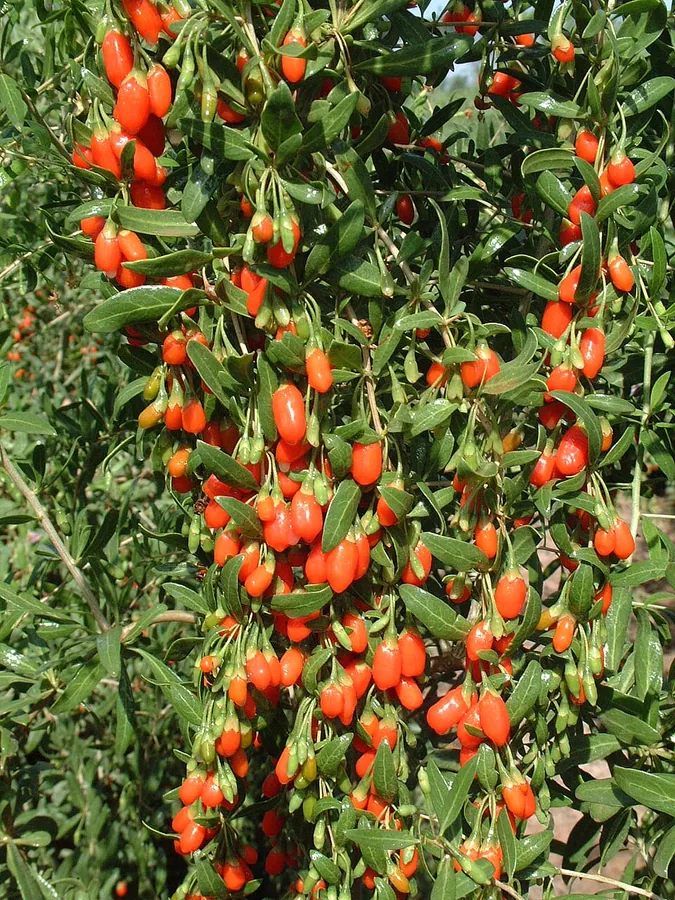
Goji berry is a cold-hardy shrub in the nightshade family, cultivated for the bright red superfood berries familiar from health-food shelves. Native to China and grown there for centuries, it is considerably more resilient than its delicate reputation implies. The plant withstands cold to -20°F (-29°C) and tolerates summer heat, drought, and marginal soils that would defeat many fruit crops.
Its architecture explains much of its behavior. Long, arching canes extend 3 to 12 feet (91 cm to 3.7 m) and readily lean, layer where they contact soil, and throw suckers, giving the plant its characteristic sprawling, thorny form. Purple flowers open in late spring, and fruit follows roughly 35 days later, ripening from midsummer through late fall.
The species is easy to establish and difficult to confine, a direct consequence of its free suckering and self-seeding. Once settled it fruits with little intervention, but that same vigor has allowed it to escape and become weedy in several regions. Sited where its spread won't become a problem, it remains productive for years.
Care
The short version: full sun, lean and slightly alkaline well-drained soil, roughly an inch of water a week, and an annual prune to keep the thorny, suckering canes in check.
Light
Goji is a full sun species and performs best with maximum exposure, where fruiting and disease resistance are both strongest in hot, bright sites. It tolerates partial shade, but reduced light diminishes yield and raises mildew pressure on shaded, crowded foliage.
Water
Supply about 1 inch of water a week, allowing the top half of the soil to dry between irrigations. New transplants require consistent moisture to establish, whereas established plants are notably drought-tolerant. The critical failures to avoid are waterlogged ground and abrupt swings from saturated to bone dry.
Soil
Grow it in well-drained light loam, though the species accommodates a broad range of soils. It favors alkaline conditions at a pH of 6.8 to 8.2, the inverse of most berry crops, which is precisely why it underperforms in acidic ground.
Temperature
This is a genuinely hardy shrub, rated from -20°F to 100°F (-29°C to 38°C). It endures severe winters and extreme summer heat alike, and that broad tolerance is part of why it naturalizes so readily once established in the landscape.
Humidity
Goji is adapted to dry conditions, around 20% to 50% humidity, consistent with its hot, arid native range. Because damp, stagnant air favors powdery mildew, improving airflow benefits the plant far more than any attempt to raise ambient moisture.
Feeding
Apply a balanced 16-16-16 fertilizer through spring and summer, timed to budbreak, flowering, and fruit ripening to match peak demand. Roughly 4 to 5 tablespoons per 10 square feet per year, divided into three applications, satisfies a plant of this low nutrient requirement.
Pruning
Withhold pruning in the first year. Thereafter, prune during dormancy to remove weak or damaged wood and shorten the laterals 6 to 18 inches, then pinch the terminals back 2 to 3 inches in early summer to stimulate branching and restrain the thorny, sprawling canes.
Repotting
Goji is grown in the ground rather than as a container subject, so repotting seldom applies. Where it is potted, move it up when roots circle the container, water runs straight through, or top growth stalls, all signs of a root-bound plant.
Size & spacing
Anticipate a large, arching shrub of 3 to 12 feet (91 cm to 3.7 m) in height with an even greater spread of 4 to 8 feet (120 to 244 cm). Allot that space at planting, since the canes lean, sucker, and occupy ground quickly.
When to plant
Goji is a cold-hardy perennial shrub suited to zones 4 to 7. Start seed indoors in late winter, or set plants out after the last spring frost once the soil has warmed, and expect purple flowers in late spring followed by ripe berries from midsummer into late fall.
Northern hemisphere
Southern hemisphere
Typical months for a temperate climate: start earlier in warm zones, later where spring frosts linger.
- Sow: 8 to 10 weeks before last frost (seed); or propagate from cuttings or suckers
- Plant: after last spring frost once soil has warmed
- Harvest: purple flowers in late spring; berries ripen mid-summer to late fall, about 35 days after full bloom
Hardiness
USDA hardiness zones: 4–7
Temperature: down to -34°C
Troubleshooting
Goji is a durable species with comparatively few problems, and nearly all of them present on the foliage. Familiarity with the small set of pests and the single common disease detailed below allows early intervention. Identify the symptom accurately, then treat before it moves through the bush.
Wart-like leaf galls with thickened, distorted tissue
These deformities trace to the goji gall mite, a microscopic eriophyid that feeds within the leaf tissue and provokes the plant to form green to yellow warty galls, thickening and distorting the foliage in the process. Because the mite overwinters in buds, timing matters: prune out and burn the heavily galled growth, then treat the buds with horticultural oil or sulfur as they break in spring, when the emerging mites are most exposed.
Fix:
- Prune out and destroy heavily galled growth
- Apply horticultural oil or sulfur per label as buds break
- Remove and dispose of fallen infested leaves
Powdery white bloom spreading across the foliage
The white bloom that wipes off the leaf is powdery mildew, a fungus favored by cool, humid air rather than the hot, dry conditions goji prefers. Because the pathogen thrives in still, moist microclimates, the primary control is cultural: thin crowded stems to open the canopy and water at the base to keep foliage dry, reserving a labeled fungicide for cases that continue to spread.
Fix:
- Improve air circulation by thinning crowded stems
- Avoid overhead watering
- Apply a labeled fungicide or sulfur if severe
Honeydew-sticky shoots and colonies of minute insects
Sticky residue and curled tips are classic sap-feeding damage, most often from aphids colonizing the soft new shoots, though spider mites and potato leafhoppers produce a comparable presentation. Confirm the culprit by examining the leaf undersides for soft-bodied insects, honeydew, or fine webbing. Dislodge them with a strong jet of water, follow with insecticidal soap, and conserve the natural predators such as ladybugs that keep populations in check.
Fix:
- Dislodge with a strong jet of water
- Apply insecticidal soap or horticultural oil to affected growth
- Encourage natural predators such as ladybugs
Toxicity
The ripe berries are a well-established superfood, safe to eat fresh, cooked, or dried, so they present no hazard. The qualification is the foliage: as a nightshade, the leaves and unripe tissue contain trace alkaloids that constitute a mild caution for cats, dogs, horses, and other grazing animals. The sharp thorns on the stems warrant care as well.
Toxic to
Cats · Dogs · Horses · Rabbits · Livestock · Birds
Safe for
People
Cats Mild
The ripe fruit poses no hazard, but the foliage holds trace nightshade alkaloids. A cat ingesting the leaves may show light salivation or a mild gastric upset, which is reason enough to discourage access to the plant.
Dogs Mild
Fallen berries pose no problem for a dog, yet the leaves and green stems carry the trace alkaloids and can produce mild drooling or minor digestive upset if chewed. Limiting foliage grazing keeps the risk negligible.
Horses Mild
The foliage represents only a low-level risk to horses, in which the trace alkaloids may cause mild abdominal discomfort where browsing occurs. The fruit itself carries no such concern.
Rabbits Mild
Ripe berries can be offered without concern, but the leaves and unripe tissue hold the same trace alkaloids and may disturb a rabbit's sensitive digestive tract. Foliage is best restricted to an occasional nibble.
Livestock Mild
Cattle, goats, and sheep can browse in the vicinity of goji with little consequence, though sustained grazing on the leaves may induce mild digestive upset attributable to the nightshade alkaloids they contain.
Birds Mild
Birds consume the ripe fruit without harm and serve as seed dispersers. The trace alkaloids reside in the leaves, so any caution applies to the foliage rather than to the berries.
People Ripe fruit safe
Ripe goji berries are a recognized superfood, consumed fresh, cooked, or dried without concern. Avoid the leaves and unripe tissue, which hold trace alkaloids, and take care around the sharp thorns borne on the stems.
Stems carry sharp thorns that can scratch people and pets, and the leaves and unripe parts contain only trace solanaceous alkaloids, so discourage pets from grazing foliage.
Helpline numbers

United States
ASPCA Animal Poison Control: (888) 426-4435 (fee applies)
Poison Control: (800) 222-1222



Canada
Poison Centres: 1-844-764-7669
Varieties
Goji is offered under a handful of named cultivars, and selecting a known name secures the predictable fruiting that seed-grown plants cannot guarantee. Those most commonly encountered are described below.
Crimson Star (Ningxia #1)
A widely planted cultivar that comes into bearing 1 to 2 years after planting and reaches full production in 3 to 5 years.
Phoenix Tears
A productive selection valued for the heavy yield of fruit it sets.
Wolfberry Agrodevco
A named cultivar marketed for home gardens and small-scale plantings.
How to propagate
Goji can be propagated by several methods, from slow-bearing seed to freely produced suckers, and the choice determines both time to first harvest and whether the offspring reproduce the parent's traits.
SeedEasy
Start indoors in late winter to spring · 2 years to first fruit, full production in 3 to 5 years
Seed sown indoors in late winter or spring germinates readily, but the resulting seedlings segregate and vary, and bearing lags roughly 2 years to first fruit and 3 to 5 years to full production. Where a defined cultivar and predictable fruiting are the goal, a named nursery plant is the sounder starting point.
Stem cuttingsModerate
Softwood cuttings in early summer or hardwood cuttings during dormancy · Several weeks to root, fruiting within a couple of years
Softwood cuttings taken in early summer or hardwood cuttings taken during dormancy will root over several weeks and begin fruiting within a couple of years. Because cuttings are clonal and come true to type, this method preserves a chosen cultivar's characteristics.
DivisionEasy
Dig and transplant suckers in dormancy · Establishes quickly once moved
A mature plant produces suckers freely from about year 3, and lifting those rooted suckers during dormancy is the simplest way to propagate new plants. Dug and transplanted at that stage, they reestablish quickly.
Myths
Membership in the Solanaceae makes goji's berries inherently toxic.
Membership in the nightshade family does not make the fruit unsafe, and the ripe berries are eaten worldwide as a superfood, fresh, cooked, or dried. The trace solanaceous alkaloids are confined to the leaves and unripe tissue, and even there they warrant only a mild caution. The fruit is safe to eat.
Goji needs rich, acidic soil to thrive.
The species is adapted to slightly alkaline ground and performs best at a pH of 7 to 8, so its requirements run counter to acid-loving berries. Acidic soil actually holds it back, which means the acidifier appropriate for blueberries is exactly the wrong amendment here.