Ornamental · Solanaceae
Calibrachoa
Calibrachoa × hybrida
Meet its three demands, full sun, steady moisture, and acidic media, and calibrachoa pours bloom from spring to frost.
Full sun
Every 1–3 days
USDA 9–11
3–12 in · 8–30 cm
Overview
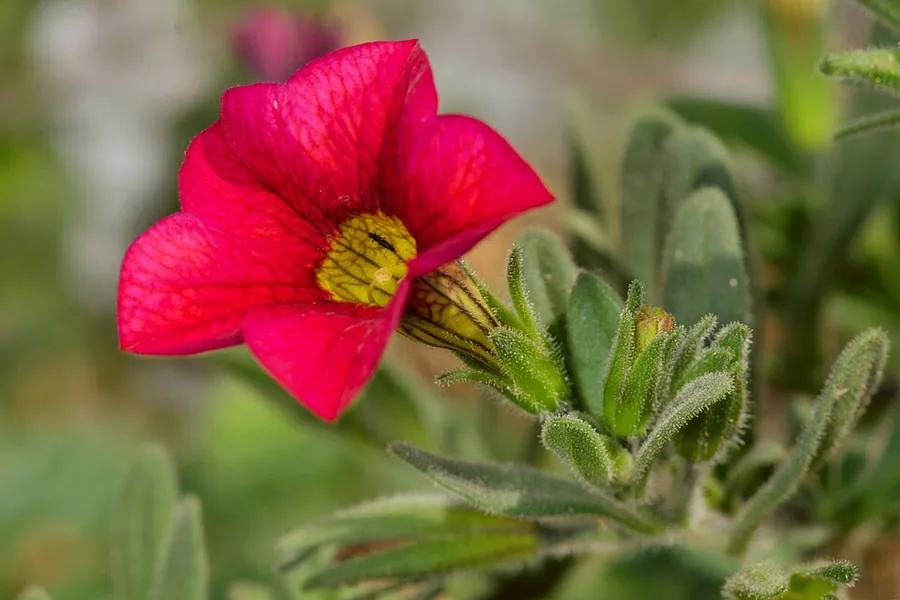
Calibrachoa, sold to most gardeners as Million Bells, is a trailing flower that cascades small petunia-like blooms over the rim of a pot or basket all season. It sits in the nightshade family as a near relative of petunia, yet it holds its own name for sound reasons: the flowers run smaller, the habit leans mounding and trailing, and the color palette goes deeper.
In most of the country it is grown as a warm-season annual, because it is a tender perennial that only persists through winter in the mildest zones. Heat and sun are what it wants, it sidesteps the chore of deadheading, and it flowers without a break. That pairing of resilience and nonstop color is the reason it anchors so many summer containers.
The trade-off is a short list of needs it will not compromise on. It is a hungry, thirsty feeder that expects slightly acidic media and consistent moisture, and it stalls in shade. Supply the sun, the feeding, and the right pH, and the plant largely runs itself.
Care
The short version: full sun, even moisture in a fast-draining pot, and a slightly acidic mix that you feed every couple of weeks. Pinch the tips occasionally to hold its shape, and leave the spent flowers alone.
Light
Calibrachoa wants full sun, 8 or more hours a day, because bloom production is driven by light and tapers off quickly under shade. A site that takes strong afternoon sun returns the fullest, most colorful plant.
Water
Hold the mix evenly moist but never soggy. In summer heat the surface can dry within a day or two, so baskets and pots may need water daily, sometimes more. Always grow in a container with drainage holes, since standing water is what sets up root rot.
Soil
Use a well-draining, organically rich potting mix on the acidic side, roughly pH 5.0 to 6.5, which keeps iron available to the roots. A peat-based mix suits it well. Keep it out of heavy clay beds, which retain too much water for these roots.
Temperature
It tolerates a broad range, about 41°F to 95°F (5°C to 35°C), and takes summer heat without strain. Frost is the absolute limit, which is why most gardeners run it as an annual.
Humidity
Average humidity of 40% to 60% keeps it content, so it is not a plant that needs coddling on moisture in the air. Good airflow through crowded baskets does more for it than any meter reading.
Feeding
Treat it as a heavy feeder. Work a slow-release balanced fertilizer into the mix at planting, then follow with a dilute water-soluble balanced feed every other week. If the new growth yellows, supply chelated iron or iron sulfate to correct it.
Pruning
There is no deadheading to do, since the spent flowers drop on their own. Pinch the stem tips back about 2 in (5 cm) at planting or midseason to keep the plant compact and drive fresh branching and bloom.
Repotting
Calibrachoa is not really repotted. It is grown as a single-season container plant and replaced each spring, so once it settles into its pot or basket it stays put for the year.
Size & spacing
Plants stay low and spreading, around 3 to 12 inches (8 to 30 cm) tall with a trailing reach of 12 to 24 inches (30 to 60 cm). That mounding, cascading form is what lets them spill so cleanly over a basket edge.
When to plant
Calibrachoa is built for warmth and stops at frost. Set plants out in spring once the cold has lifted and the soil has warmed past 55°F (13°C), which is the threshold these roots need to take hold, and they will flower from late spring until the first frost ends the run.
Northern hemisphere
Southern hemisphere
Typical months for a temperate climate: start earlier in warm zones, later where spring frosts linger.
- Plant: spring, after the last frost once soil temperatures exceed 55°F (13°C)
- Harvest: late spring continuously until first frost
Hardiness
USDA hardiness zones: 9–11
Temperature: down to -7°C
Troubleshooting
Nearly every calibrachoa problem comes back to one of three levers, soil pH, watering, or light, and it surfaces in the foliage and the flowering before anywhere else. Catch the early signal and you can reverse a decline while it still matters. Match the symptom below, then act.
Wilting in saturated mix with a browning base
A plant that flags while sitting in wet mix is showing you a root-zone failure, not thirst: the roots can no longer move water even though water surrounds them, which points to root or stem rot driven by Pythium or Phytophthora. Lift it from the pot and read the roots. White and firm means healthy; brown, mushy, and sparse means the pathogens have already destroyed the absorbing tissue. A plant that far gone will not recover, so discard it and move any sound survivors into fresh, fast-draining mix in a container that actually sheds water.
Fix:
- Stop watering until the top of the mix dries
- Remove and discard badly affected plants
- Replant survivors in fresh, fast-draining mix in a container with working drainage holes
Youngest leaves go yellow between green veins
That yellow-on-the-newest-leaves pattern, with veins still green, is classic iron deficiency. It strikes the new growth first because calibrachoa draws down more iron than most bedding plants, so any shortfall shows at the actively growing tips. The trigger is almost always chemistry rather than supply: once the media pH climbs past 6.5, iron converts to forms the roots cannot absorb, even when iron is present. Acidify the mix back toward 5.5 to 6.0 with iron sulfate to free up what is locked, then drench with chelated iron to feed the new leaves directly.
Fix:
- Lower the media pH toward 5.5 to 6.0 using iron sulfate per label directions
- Drench with chelated iron to green up new growth
- Resume feeding every other week with a balanced water-soluble fertilizer
Sticky film, speckled leaves, or warped tips
Sticky residue, stippling, and twisted shoots are feeding damage from aphids, thrips, or spider mites, the trio most likely to visit calibrachoa. Each leaves its own trace: aphids cluster on the soft growing tips, spider mites spin fine webbing as they rasp the leaf surface, and thrips are slim enough that you confirm them by tapping a stem over white paper and watching them scatter. Because the populations are usually light, a firm jet of water displaces most of them, and insecticidal soap or horticultural oil cleans up the remainder.
Fix:
- Knock pests off with a strong spray of water
- Treat infestations with insecticidal soap or horticultural oil per label
- Discard heavily infested stems
Thin bloom on long, stretched stems
Stems that reach and skip flowering are responding to too little light, since bloom production tracks sun directly and falls away as shade increases. A second factor compounds it: this is a heavy feeder, and a plant running on empty cannot fund both growth and flowers. Relocate the container into full sun to restore the flowering signal, cut the leggy tips back about 2 in (5 cm) so dormant buds break into new branches, and feed every other week to refuel the plant.
Fix:
- Move containers to a spot with full sun
- Trim back leggy stem tips by about 2 in (5 cm) to force branching
- Feed every other week with a balanced water-soluble fertilizer
Toxicity
There is reassuring news for pet owners and parents: calibrachoa is safe to grow around the whole household. The genus does not appear on the ASPCA toxic plant lists, and its close relative the petunia is listed as non-toxic. The most a curious nibble is likely to cause is the kind of mild, passing stomach upset that any plant can trigger.
Safe for
People · Cats · Dogs · Horses · Rabbits · Livestock · Birds
Cats None
Cats can share a room with it safely. The genus is absent from the ASPCA toxic list, so the worst a sampling cat risks is the brief stomach upset that plant fiber can prompt in any species.
Dogs None
Dogs are equally fine around it. A chewed trailing stem may pass as mild digestive grumbling from the fiber, but there is no toxic compound behind it.
Horses Safe
Horses can graze beside it without consequence, since the plant holds no constituent known to poison them.
Rabbits Safe
Rabbits take no harm from the foliage or flowers; a few nibbled stems amount to nothing more than bulk in the gut.
Livestock Safe
Cattle, goats, and sheep can be kept near it freely, as it carries no toxins that affect grazing animals.
Birds Safe
Aviary and garden birds are safe alongside the blooms, so there is no need to screen the baskets from them.
People Safe
It poses no hazard to people, though it is grown to look at rather than to eat. Children playing close by face no risk from contact.
No special handling precautions are needed
Varieties
Calibrachoa comes to gardeners as a small set of named series rather than standalone varieties. These are the ones worth recognizing by name.
Million Bells
The first trademarked series, it brought calibrachoa to US gardeners in the 1990s and lent the whole plant its familiar common name.
Superbells
A strong trailing series spanning solid, double, and patterned color forms, with reliable performance recorded in university trials.
MiniFamous
A series prized for double-flowered selections including Uno Yellow and Uno Pink Star, names extension horticulturists call out.
Cabaret
A tidy, even-growing series built for hanging baskets and mixed pots that rates well in extension trials.
Callie
A semi-trailing series that carries the extension nickname callie and flowers in baskets right through the season.
How to propagate
Calibrachoa is increased from cuttings rather than seed, though patents place firm limits on doing it yourself.
Stem cuttingsModerate
Spring to summer
Cuttings are the realistic route to more plants, because calibrachoa sets so few viable seeds that sowing is rarely worth the effort. Pull cuttings from healthy, actively growing stems in spring or summer. The legal caveat matters as much as the technique: most named cultivars are patented, so propagating them at home is not permitted.
Myths
Like a petunia, calibrachoa needs its old flowers picked off to keep blooming.
The flowers are self-cleaning, which means spent blooms abscise and fall on their own. There is no pinching to keep the display running. It carries bloom from spring to frost with zero deadheading.
Calibrachoa is really just a small petunia you can raise from saved seed.
It stands as its own genus rather than a dwarf petunia, and it sets very few seeds. That is why almost every garden hybrid is raised from cuttings instead. Most cultivars are patented, which puts home propagation off the table.
Any yellow leaf on calibrachoa is a sign of overwatering.
When the yellowing lands on new growth and spares the veins, the real driver is usually iron deficiency from a media pH that has crept too high. The plant demands more iron than most bedding flowers and performs best in a slightly acidic mix near pH 6.0.