Ornamental · Solanaceae
Nicotiana
Nicotiana alata
Grown for the night-scented flowers that release their fragrance across the summer evening garden.
Full sun
Every 3–7 days
50–86°F · 10–30°C
55–75 days
Overview
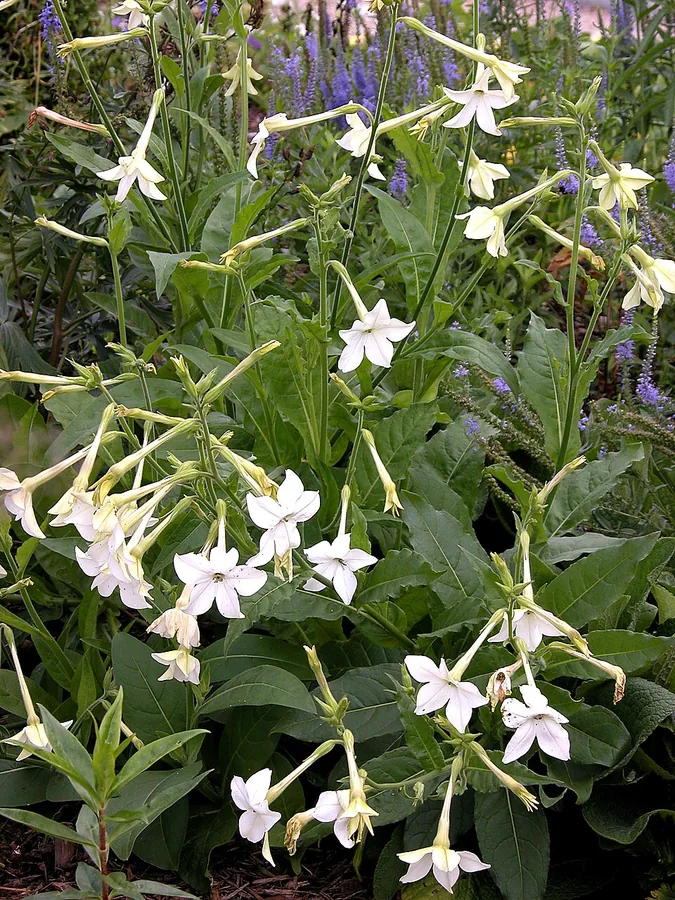
Nicotiana, commonly called flowering tobacco, is a fast-growing garden annual in the nightshade family and a close relative of the tomato and pepper. Its ornamental value is expressed at dusk rather than midday, when the long tubular flowers open and release a sweet, jasmine-like fragrance that the plant uses to draw night-flying pollinators. Positioned near an evening seating area, it perfumes the surrounding air once light fades.
The heirloom forms grow tall and upright at 3 to 5 feet (91 to 152 cm), carrying open clusters of white, lime-green, or colored trumpets above broad, sticky leaves. It behaves as a tender perennial only in the warmest zones, so it is grown as an annual across most gardens, with fresh plants raised each spring. Left undisturbed, it commonly self-seeds and reappears the following year.
Ease of culture aside, flowering tobacco carries a real hazard. Every part contains nicotine and related alkaloids, which renders the entire plant toxic to people, pets, and grazing animals on ingestion. It is a plant to appreciate visually and by scent, and never to eat.
Care
The short version: site it in full sun to light afternoon shade, hold rich soil at even moisture, feed monthly through the season, and deadhead spent flowers to sustain bloom.
Light
Site nicotiana in full sun for the most vigorous plants and the heaviest flowering, since light drives both. It performs in partial shade as well, and afternoon shade is advantageous where summers are hot, because the plant fades quickly under prolonged intense sun.
Water
Hold the soil evenly moist, watering as soon as the surface begins to dry, which typically falls every 3 to 7 days. Its tolerance for drought is low, so it wilts and stalls under water stress, and allowing it to dry out between waterings sets that decline in motion.
Soil
Grow it in organically rich, well-drained soil that retains moisture without becoming waterlogged, which the roots require to stay evenly supplied. A slightly acidic pH of 5.5 to 6.5 suits it, and generous compost supplies both the moisture retention and fertility it draws on.
Temperature
It grows across a broad range of roughly 50°F to 86°F (10°C to 30°C). It is frost-tender, so freezing ends it, and it tends to slow and decline once the peak of summer heat exceeds its comfortable range.
Humidity
Ambient outdoor humidity meets its needs, so no target figure applies. The operative factors are instead steady soil moisture and adequate airflow around the broad, sticky leaves, which airflow helps keep dry.
Feeding
Feed monthly through the growing season with a balanced fertilizer formulated for flowering annuals. Regular feeding sustains the nutrient demand of a fast grower and keeps it producing fresh buds rather than exhausting its reserves.
Pruning
Deadhead spent flowers to redirect energy from seed set back into new blooms, and pinch young plants to break apical dominance and induce branching. A leggy plant or one flagging in midsummer heat responds well to a hard cutback, from which it will often rebound.
Size & spacing
Mature plants stand 3 to 5 feet (91 to 152 cm) tall and spread 12 to 24 inches (30 to 61 cm) wide, so space them on that footprint. Adequate spacing keeps air moving through the stand and gives the tall stems room to remain upright.
When to plant
Because nicotiana is frost-tender, its schedule follows the frost dates. Sow the seed indoors in late winter, transplant only after the last frost and warm soil arrive, and the plants flower from early summer through to the first frost of fall.
Northern hemisphere
Southern hemisphere
Typical months for a temperate climate: start earlier in warm zones, later where spring frosts linger.
- Sow: 6 to 8 weeks before the last spring frost; seed needs light and should be surface sown
- Plant: After all danger of frost has passed and soil has warmed in late spring
- Harvest: Blooms from early summer (June) until first fall frost; fragrant tubular flowers open at night
Hardiness
USDA hardiness zones: 10–11
Temperature: down to -1°C
Troubleshooting
Most disorders of flowering tobacco register on the foliage, whether the cause is viral, insect feeding, or heat stress. Reading those early signs correctly lets you intervene before a problem advances. Match the symptom below to what you observe, then apply the response while it still changes the outcome.
Mottled mosaic patterning with persistent stunting
Mottled, puckered foliage that stays stunted points to tobacco mosaic virus, which moves in from neighboring nightshade vegetables or on hands that have handled them. Because the pathogen is systemic and incurable, the only sound response is to remove and destroy every affected plant. Sanitize hands and tools afterward, and separate future plantings from tomatoes and peppers to break the transmission route.
Fix:
- Remove and destroy infected plants
- Wash hands and disinfect tools after handling
- Avoid planting near tomatoes, peppers and other Solanaceae
Irregular chewed holes across foliage and blooms
Irregular holes in leaves and flowers are the feeding damage of beetles and other chewing insects, whose activity peaks as temperatures climb. Handpicking removes the adults at the source and, done consistently, keeps light infestations in check. Reserve a labeled insecticide for the point at which feeding pressure becomes heavy.
Fix:
- Handpick beetles
- Use an appropriate labeled insecticide or insecticidal control if infestation is heavy
Heat and drought stress driving midseason decline
Nicotiana has limited tolerance for drought and intense summer heat, so it wilts as soil moisture falls and afternoon sun intensifies transpiration. Maintaining even soil moisture keeps water supply ahead of demand, and mulch slows evaporation to hold that reserve. In hot southern gardens, afternoon shade reduces the heat load enough to prevent the plant from burning out.
Fix:
- Keep soil consistently moist
- Provide afternoon shade in hot southern climates
- Mulch to conserve soil moisture
Honeydew film over insect-clustered new growth
Soft-bodied insects massed on buds and leaf undersides, along with a sticky film, indicate aphids excreting honeydew as they feed on sap. A firm jet of water dislodges the colony mechanically and is the first line of control. Where populations rebuild, insecticidal soap or horticultural oil provides follow-up by smothering the survivors.
Fix:
- Wash aphids off with a strong spray of water
- Apply insecticidal soap or horticultural oil if needed
Toxicity
This species belongs out of reach. Every part of flowering tobacco contains nicotine and related alkaloids, and ingestion can poison cats, dogs, horses, rabbits, birds, livestock, and people alike. Drooling, vomiting, and tremors are typical, progressing to dangerous cardiac and respiratory effects at higher doses, so site it well away from pets, grazing animals, and small children.
Toxic to
Cats · Dogs · Horses · Rabbits · Livestock · Birds · People
Cats Severe
In cats, the nicotine that any bite delivers first produces agitation and then depression, alongside drooling, vomiting, and an unsteady gait. Because the alkaloid acts on nicotinic receptors, larger doses progress to tremors, tachycardia, weakness, and, at the extreme, collapse.
Dogs Severe
Dogs chew the leaves and stems, and the nicotine is absorbed quickly enough to produce rapid signs. Early drooling, vomiting, an uncoordinated gait, and tremors can advance to a pounding heartbeat, weakness, and even paralysis when the ingested dose is large.
Horses Severe
A grazing horse first becomes agitated, then dull and weak as the alkaloid takes effect. Vomiting, stumbling, and muscle trembling follow, and a heavy dose carries genuine danger.
Rabbits Toxic
The nicotine distributed throughout the plant makes it unsafe for rabbits. Even a small quantity of leaf can produce drooling, loss of appetite, and trembling, so flowering tobacco should stay entirely out of reach.
Livestock Severe
In cattle, sheep, and goats, the nicotine and anabasine cause weakness, tremors, and a staggering gait, with respiratory failure in severe cases. Pregnant animals face added risk, since the alkaloids are teratogenic and can produce crooked-calf limb deformities.
Birds Toxic
The alkaloids present in every part of the plant are toxic to birds as well. A bird that ingests foliage or seed can become weak and unbalanced and develop labored breathing, so flock and pet birds should be kept away.
People Caution
No part of flowering tobacco is edible, and ingesting the leaves, flowers, or seed delivers a meaningful nicotine dose. Nausea, vomiting, and drooling are expected, with tremors and dangerous cardiac and respiratory effects at higher intake, so keep curious children well away.
Keep all plant parts away from pets, children, and grazing animals; wash hands after handling.
Helpline numbers

United States
ASPCA Animal Poison Control: (888) 426-4435 (fee applies)
Poison Control: (800) 222-1222



Canada
Poison Centres: 1-844-764-7669
Varieties
Flowering tobacco is offered in several distinct strains, ranging from tall night-scented heirlooms to compact day-blooming hybrids. The following are the forms most often available.
Lime Green
Distinguished by its uncommon chartreuse to yellow-green flowers, a color prized for cut arrangements.
Grandiflora
A tall heirloom form whose highly fragrant white flowers open after dark.
Nicki Series
A compact hybrid strain reaching about 1 to 2 feet, bred for a broad color range and flowers that remain open through the day.
How to propagate
Nicotiana is propagated almost exclusively from seed, and it sets and drops enough that it frequently returns of its own accord the following year.
SeedModerate
Start indoors 6 to 8 weeks before the last frost or direct sow after frost; surface sow because seed needs light to germinate · Germination in about 1 to 2 weeks, with blooming plants in roughly 2 to 3 months from sowing
Nicotiana propagates readily from seed. Start it under cover 6 to 8 weeks before the last frost, or direct sow into warm soil once frost has passed, and press the seed onto the surface rather than covering it, because germination is light-dependent. Seedlings emerge within about 1 to 2 weeks and reach flowering size in roughly 2 to 3 months, after which an established plant will frequently self-sow for the following year.
Myths
Flowering tobacco is a harmless ornamental because it is not the smoking tobacco plant.
It is a genuine Nicotiana, and nicotine with related alkaloids is present in every part. Eating any of it can poison people, pets, and livestock, so the showy flowers warrant the same caution given to any toxic species.
Nicotiana flowers are fragrant and showy all day long.
The tubular flowers reserve their fragrance for evening, opening fully and scenting the garden after dark. Each bloom lasts only a single night, yet the plant produces new flowers in succession through the season.