Vegetable · Brassicaceae
Horseradish
Armoracia rusticana
Set one root into deep, loose soil and this hardy perennial returns fiery taproots each fall.
Full sun
Every 7–10 days
140–180 days
USDA 3–9
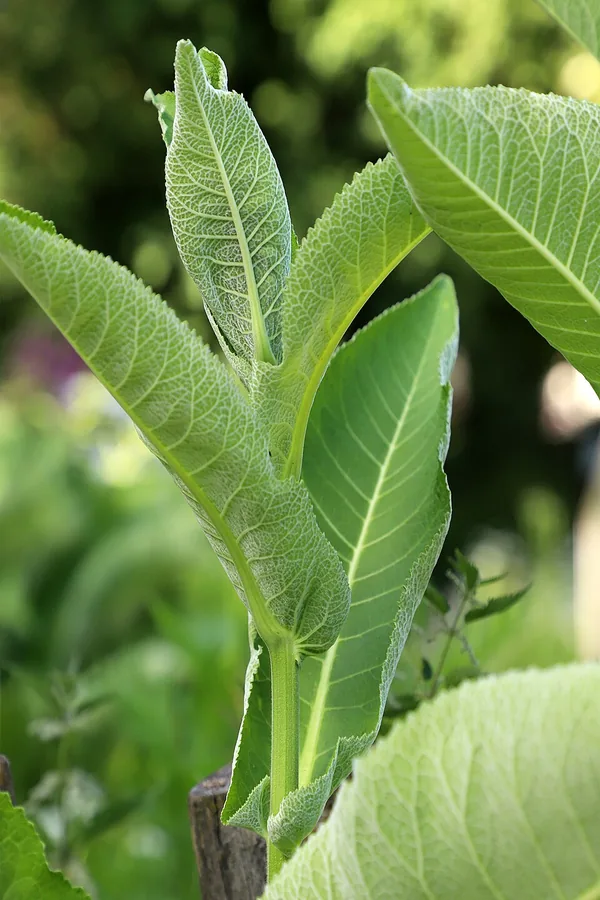
Overview
Horseradish is cultivated for a single product: the pungent taproot grated into sauces and dressings. As a member of the mustard family alongside cabbage and kale, it carries the sharp mustard oils characteristic of the group. Left in the soil it persists as a hardy perennial, tolerating cold that ends the season for most garden crops.
Little skill is required to keep it growing. A root section pushed into good soil in spring, with adequate sun and water, establishes fast and demands almost no attention. The genuine management challenge is containment, since horseradish spreads readily from its own roots.
The raw root gives almost no sensation at first, followed by a heat that clears the sinuses. That pungency stays latent within intact cells and appears only when grating or chewing ruptures them, which is why freshly prepared sauce is markedly sharper than jarred product.
Care
The short version: full sun and deep, loose, fertile soil, with roughly an inch of water a week producing the smoothest roots. Withhold heavy nitrogen, remove the flower stalks, and confine the plant to a dedicated bed so it cannot spread.
Light
Horseradish performs best in full sun, the exposure that drives the strongest root development. It tolerates some afternoon shade and continues to produce, though the resulting root is milder and smaller.
Water
Supplying about 1 inch of water a week yields larger, smoother roots. Once established the plant withstands drought, but sustained moisture is what supports a strong crop.
Soil
The taproot grows straightest in deep, loose, fertile loam with abundant organic matter. Target a pH between 6.0 and 7.5, and till deeply before planting to give the root an unobstructed descent.
Temperature
This is a genuinely cold-hardy species, enduring winter lows near -31°F (-35°C) and unharmed by frost. It grows through the warm season up to about 86°F (30°C), and a hard autumn freeze concentrates the flavor.
Humidity
Ambient outdoor air near 40% to 70% humidity suits it, and no adjustment is called for. The plant is far too robust for atmospheric moisture to be a limiting factor.
Feeding
Incorporating a balanced fertilizer or compost into the bed at planting normally meets its needs. Restraint matters, because excess nitrogen shifts growth into leafy tops and produces forked, branchy roots.
Pruning
Removing the flower stalks as they emerge redirects the plant's energy into the root rather than flowering. In late spring some growers additionally rub off the upper side shoots, a practice termed suckering that channels growth into one large taproot instead of several thin ones.
Repotting
Horseradish is not suited to containers. Grown in a confined bed, it is lifted and replanted from fresh root sets each year to sustain vigor and keep it within bounds.
Size & spacing
Plants reach 24 to 35 inches (60 to 90 cm) in height with a leafy spread of 12 to 24 inches (30 to 60 cm). Allow each plant room and a bed of its own so it develops without overtopping neighbors.
When to plant
Horseradish is governed by cold. Set the root sets out in early spring as soon as the ground is workable, allow a full season of bulking, and lift the roots in late fall after the first frosts, when cold has driven the flavor to its peak.
Northern hemisphere
Southern hemisphere
Typical months for a temperate climate: start earlier in warm zones, later where spring frosts linger.
- Plant: Plant root cuttings (sets) at a 45-degree angle in early spring, 4 to 6 weeks before the last frost as soon as soil can be worked.
- Harvest: Harvest roots in late fall after the first frosts; flavor is sharpest after cold weather. Roots can also be dug in early spring before new growth.
Hardiness
USDA hardiness zones: 3–9
Temperature: down to -40°C
Troubleshooting
Horseradish presents few problems, and those that arise concentrate in the root or in unwanted spread of the plant. Identify the symptom below and intervene early. Attention to the bed at planting forestalls most of what follows.
New shoots emerge from every fragment of buried root
Each severed piece of root carries dormant buds, so a bed-wide colony rises from the fragments a single harvest leaves behind. Removing every visible piece reduces the reserve, and repeated pulling of regrowth eventually drains the stored energy that fuels resprouting. A buried barrier installed before planting is the only reliable way to confine that regrowth from the outset.
Fix:
- Dig out as much root as possible
- Repeatedly remove regrowth to exhaust the root reserves
- Confine plantings to a contained bed or buried barrier
Taproot forks or turns knobby rather than growing straight
A taproot needs an unobstructed vertical path, so compacted, rocky, or shallow soil forces it to fork and knob around each barrier. Surplus nitrogen drives the same result by favoring branching top growth, and leaving the upper side shoots in place lets several thin roots compete with the leader. Deep tilling clears the path, restrained nitrogen keeps growth in the root, and one early-summer removal of side shoots concentrates it into a single leader.
Fix:
- Loosen and deeply till soil before planting
- Remove side shoots from the upper portion of the root in early summer
- Reduce high-nitrogen feeding
Foliage peppered with small shot-holes and pits
The characteristic shot-holes come from flea beetles, which chew tiny pits that dry into holes, while imported cabbageworms and diamondback caterpillars remove larger sections of leaf tissue. Floating row cover excludes the adults from young plants, handpicking clears the caterpillars, and Bacillus thuringiensis controls a caterpillar flush that outpaces you. Because the plant is grown for the root, foliar damage seldom translates into lost yield.
Fix:
- Use floating row covers on young plants
- Handpick caterpillars
- Apply Bacillus thuringiensis for caterpillars if needed
Toxicity
For people the grated root is eaten without concern, and that pungency is the object of cultivation. For animals the assessment differs: the same mustard oils responsible for the heat irritate the mouth and digestive tract of cats, dogs, horses, and other pets. The plant does not poison them, but ingestion causes genuine discomfort, so keep roots and trimmings beyond their reach.
Toxic to
Cats · Dogs · Horses · Rabbits · Livestock · Birds
Safe for
People
Cats Mild
When a cat bites into the root, the released mustard oils irritate the oral mucosa, prompting drooling, mouth-pawing, and a temporary loss of appetite. The same volatiles then unsettle the stomach.
Dogs Mild
Dogs are the animals most inclined to unearth and chew a root, and the mustard-oil burn typically triggers drooling, vomiting, or loose stools. Signs usually resolve without treatment, but a large ingestion warrants a veterinary call.
Horses Mild
Horses seldom sample the harsh foliage, yet an exploratory bite irritates the mouth and gut and may leave the animal temporarily off its feed. Siting the plant beyond a grazing animal's reach removes the risk.
Rabbits Mild
A rabbit's sensitive digestive tract tolerates the fiery isothiocyanates poorly, so even a small nibble can provoke gut upset. It is not a suitable green for them.
Livestock Mild
Cattle, sheep, and goats almost always graze around the peppery foliage, though any that consume it may develop mouth and stomach irritation. Fencing horseradish away from pasture prevents the exposure.
Birds Mild
Backyard poultry generally ignore the sharp leaves, and an occasional peck mostly irritates the crop and gut. Trimmings are best kept out of foraging areas.
People Edible root safe
For people the grated root is a safe culinary ingredient valued precisely for its pungency. The volatile fumes released during grating sting the eyes and nose, so prepare it in a ventilated space and keep it away from the face.
Grating or processing the fresh root releases sharp volatile mustard oils that irritate the eyes, skin, nose, and mouth; work in a ventilated area and avoid touching the face. The plant is not on ASPCA headline toxic lists but is an irritant.
Helpline numbers

United States
ASPCA Animal Poison Control: (888) 426-4435 (fee applies)

United Kingdom
Animal PoisonLine: 01202 509000 (fee applies)

Australia
Animal Poisons Helpline: 1300 869 738
Varieties
The cultivated range is narrow, divided between selections raised for the kitchen and a single one grown for its foliage. The following names cover what is generally available.
Common (Bohemian)
A narrow, smooth-leaved selection valued for its strong disease resistance, accepting a modestly lower yield than the broad-leaved types.
Maliner Kren (Big Top)
Broad, dark, crinkled foliage tops vigorous, high-quality roots on a selection that also resists disease well.
Variegata
An ornamental selection distinguished by white-marbled, variegated foliage and grown for display rather than the kitchen.
How to propagate
Horseradish is not raised from seed. It multiplies vegetatively from root sections, which is one reason a single planting can persist for years.
DivisionEasy
Early spring (or fall lifting for spring planting) · One growing season; roots are usually harvestable the first autumn after spring planting.
Propagation relies on vegetative root cuttings rather than seed. Cut pencil-thick sets 8 to 14 inches long and orient them in early spring at a 45-degree angle with the wider crown end uppermost, or divide an established crown directly. A spring planting establishes within one season and yields harvestable roots by that same autumn.
Myths
Horseradish is just a milder relative of the radish.
Beyond a shared pungency the two are unrelated in habit. Horseradish is a mustard-family perennial whose heat forms as isothiocyanates only when cell walls rupture and release the reaction. It is a distinct species from the radish.
Once you plant horseradish you can easily pull it out later.
Removal, not establishment, is the difficulty. Any root fragment left in the soil regenerates from its dormant buds, so the planting entrenches and spreads over successive years. A buried barrier installed at planting is the practical route to reclaiming the ground.