Herb · Boraginaceae
Borage
Borago officinalis
Sow it a single time and the blue star flowers and bees return season after season unaided.
Full sun
Every 3–7 days
50–86°F · 10–30°C
55–75 days
Overview
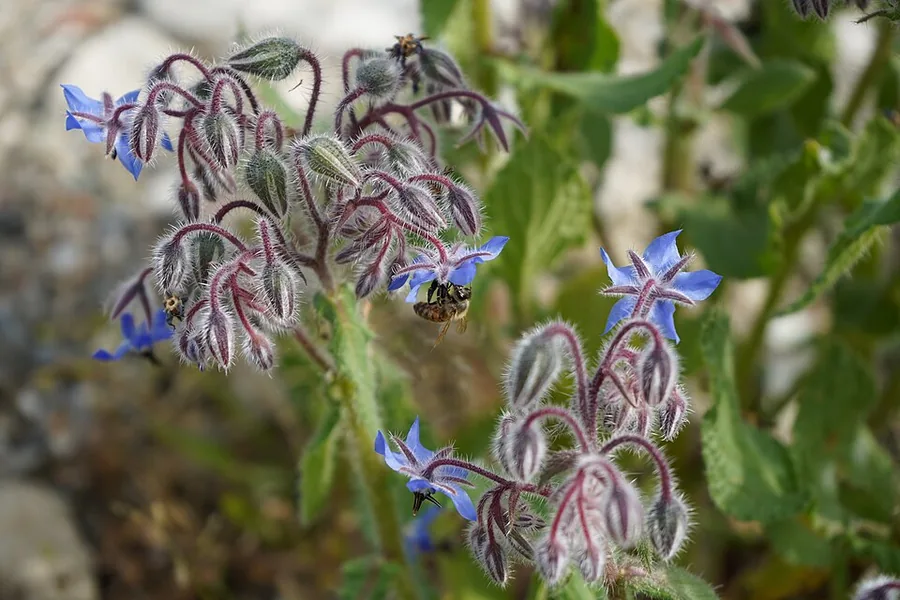
Borage is a low-demand herb prized for the bright blue, star-shaped flowers that bees find irresistible. A fast-growing annual in the borage family, it performs best in full sun and tolerates the poor, dry ground that checks more demanding plants. A single sowing usually establishes it for the long term.
The young leaves and open flowers deliver a clean, cucumber-like flavor that finds its way into summer drinks, salads, and candied garnishes. Because stiff bristly hairs cover the entire plant, gloves are well worth wearing at harvest. Both leaves and flowers are best gathered young and tender.
The ease borage offers comes with a tendency to spread. Allowed to flower and shed seed, it reseeds freely and germinates throughout the garden the next year, so routine deadheading is what keeps it confined to where you want it.
Care
The short version: give it full sun and well-drained soil, ideally on the lean, dry side. Water to establish it, then taper off once it has settled, withhold heavy feeding, and deadhead the flowers to curb its vigorous self-seeding.
Light
Borage needs full sun to develop a stocky frame and flower freely, though it accepts partial shade. Insufficient light produces etiolated, weak-stemmed growth that leans and collapses.
Water
Water often enough to hold the soil evenly moist while the plant is rooting in. Once established it becomes fairly drought-tolerant and handles lean, dry ground, so reduce watering and simply guard against waterlogging.
Soil
Ordinary well-drained garden soil serves it well, and it even succeeds in the poor, dry sites that defeat other herbs. A pH of 6.0 to 7.0 is ideal, though drainage matters far more to borage than fertility.
Temperature
It grows over a broad range, roughly 50°F to 86°F (10°C to 30°C). Frost terminates an annual borage, so allow the cold to pass before sowing.
Humidity
Typical outdoor air in the 40% to 60% band is sufficient. Air movement matters more than any humidity figure, because crowded, stagnant air sets up the leaf-surface conditions that powdery mildew needs.
Feeding
Borage is a light feeder with minimal needs. A little compost or balanced fertilizer at planting is enough on poor soils, while overly rich ground only drives weak, floppy stems.
Pruning
Pinch the growing tips early to force branching into a bushier, sturdier plant, and deadhead spent flowers to sustain bloom and rein in the heavy self-seeding. Cut back any leggy or flopping growth to renew the foliage.
Repotting
Borage is not suited to container culture. Its taproot resents disturbance, so it is direct-sown in place rather than potted on or repotted.
Size & spacing
Plants grow 18 to 35 inches (45 to 90 cm) tall and spread 12 to 24 inches (30 to 60 cm) across. Allow each plant that full spacing so air can circulate and mildew is kept at bay.
When to plant
Borage is driven by warmth and resents disturbance, so its season opens only after frost has cleared. Sow the seed straight into warm spring soil, expect the blue flowers from early summer onward, and harvest young leaves and blooms through to fall.
Northern hemisphere
Southern hemisphere
Typical months for a temperate climate: start earlier in warm zones, later where spring frosts linger.
- Sow: Generally not recommended; borage has a taproot and resents transplanting. If started indoors, sow in deep pots 3-4 weeks before last frost.
- Plant: Direct-sow after the last spring frost once soil has warmed
- Harvest: Blue star-shaped flowers appear from early summer through fall; harvest young, tender leaves and open flowers as needed
Hardiness
USDA hardiness zones: 2–11
Temperature: down to -46°C
Troubleshooting
Borage withstands most pressures, and the few problems it encounters tend to be mild and easy to diagnose. Check the new growth and the shaded lower leaves for the earliest signs. Match what you observe to the cases below and respond early.
Waves of volunteer seedlings emerging across the garden
Borage is a prolific self-seeder: a single plant allowed to flower and ripen its seed scatters enough to raise a crowd of volunteers the following season. Deadheading the spent blooms before the seed matures interrupts that cycle at its source, and hoeing or pulling the seedlings while their taproots are still shallow lifts them easily. Cutting plants down before the seed drops is the surest way to limit the spread.
Fix:
- Deadhead spent flowers before seed sets to limit reseeding
- Pull or hoe unwanted volunteer seedlings while young
- Harvest or cut plants before mature seed drops
Colonies of soft-bodied insects working the tender tips and leaf undersides
Those colonies are aphids, sap feeders that target the soft new growth and shelter on the lower leaf surfaces, excreting the sticky honeydew you notice. Because they pierce the phloem to feed, a firm jet of water physically dislodges most of them, and the flowers borage produces recruit ladybugs and lacewings that prey on the rest, which is why a modest colony seldom warrants action. Hold insecticidal soap in reserve for a severe outbreak.
Fix:
- Spray plants with a strong jet of water to dislodge aphids
- Tolerate minor populations, as borage attracts beneficial predators such as ladybugs and lacewings
- Use insecticidal soap only if infestation is severe
A chalky white film advancing over the upper leaf surfaces
That chalky film on the upper leaves is powdery mildew, a fungus favored by warm days paired with cool, humid nights, conditions that intensify wherever plants stand too close. The spores thrive in the still, moist air of a crowded planting, so thinning the stand to open up airflow disrupts those conditions; remove the worst leaves and keep irrigation off the foliage to deny the fungus the leaf moisture it exploits. It tends to surface late in the season and rarely proves fatal.
Fix:
- Improve air circulation by thinning crowded plants
- Remove and discard heavily affected foliage
- Avoid overhead watering
Top-heavy stems leaning and collapsing after rain or wind
Borage grows fast on hollow stems, and when rich soil or shade pushes that growth even harder the plant turns leggy and brittle, unable to support its own top-heavy mass. Pinching the tips early forces lateral branching, producing a shorter, stockier framework, while light staking or sturdy neighbors lend mechanical support until then. Siting it in full sun on lean ground restrains the soft growth so the stems hold themselves upright.
Fix:
- Pinch tips early to promote bushier, sturdier growth
- Provide light staking or grow among supporting companion plants
- Site in full sun and avoid over-fertilizing
Toxicity
Borage occupies an unusual position: its flowers and young leaves are eaten by people, yet the plant carries pyrrolizidine alkaloids that can damage the liver in quantity. Enjoy it sparingly as a garnish, and exclude horses, livestock, rabbits, and birds entirely, since these animals are far more vulnerable than a person taking an occasional taste.
Toxic to
Cats · Dogs · Horses · Rabbits · Livestock · Birds
Safe for
People
Cats Mild
An occasional nibble seldom does more than upset the stomach briefly, but the pyrrolizidine alkaloids in the leaves accumulate in the liver with repeated exposure. Prevent a cat from grazing the plant on a regular basis.
Dogs Mild
A single chewed leaf is likely to cause only passing nausea, yet repeated portions become a genuine liver risk as the alkaloids build up in the tissue. Keep dogs away from the foliage.
Horses Toxic
Horses are particularly sensitive to pyrrolizidine alkaloids, which scar liver tissue as the dose accumulates. Because the injury develops gradually, weight loss, a dull coat, and abnormal behavior may not appear until well after grazing. Exclude borage from pasture and hay.
Rabbits Toxic
The bristly, alkaloid-bearing leaves hold no value for a rabbit, and every feeding adds to the liver's toxic burden. Never offer borage as forage.
Livestock Toxic
Cattle, sheep, and goats that browse borage ingest pyrrolizidine alkaloids that injure the liver silently over weeks and months. Listlessness, weight loss, and poor condition signal that slow damage. Keep it well away from grazing ground.
Birds Toxic
The same liver-toxic alkaloids make borage foliage unsuitable for poultry and pet birds; keep it out of their diet entirely.
People Edible in moderation
The young leaves and blue flowers are a long-established kitchen herb, safe to enjoy occasionally for their cool, cucumber flavor. The qualifier is the pyrrolizidine alkaloids, which can stress the liver under heavy or sustained use, so use borage as a garnish rather than a daily green.
Wear gloves or long sleeves when handling or harvesting, as the stiff bristly hairs can mildly irritate skin. Consume flowers and young leaves only in moderation due to pyrrolizidine alkaloid content.
Helpline numbers

United States
ASPCA Animal Poison Control: (888) 426-4435 (fee applies)

United Kingdom
Animal PoisonLine: 01202 509000 (fee applies)

Australia
Animal Poisons Helpline: 1300 869 738
Varieties
Borage is offered in just a couple of forms, distinguished chiefly by flower color. Both share the same growth habit and flavor.
Borago officinalis (common borage)
The type species bears the familiar bright blue, star-shaped flowers and bristly, cucumber-flavored leaves that define the herb for most growers.
Borago officinalis 'Alba' (white borage)
A color selection that swaps the blue blooms for pure white, identical to the species in all other respects.
Companions
Borage earns its place beside fruiting crops by pulling in bees and other pollinators that lift their yields.
Plant near
Tomato: Borage attracts pollinators and beneficial insects and is a traditional companion planted near tomatoes
Strawberry: Borage is a classic companion for strawberries, drawing pollinators that improve fruit set
Squash: Its abundant blue flowers attract bees and other pollinators that benefit pollination of squash and other cucurbits
How to propagate
Borage effectively propagates itself, which leaves seed as the only relevant method and the only one you'll ever require.
SeedEasy
Direct-sow outdoors after the last spring frost once the soil has warmed · Seeds typically germinate in 1-2 weeks and plants establish within several weeks
Sow borage directly into its final position, because the deep taproot is easily damaged by transplanting and the plant resents the move. Wait until the last spring frost has passed and the soil has warmed; germination follows in 1 to 2 weeks, with plants bulking up over the following few weeks. Once established, it reseeds itself for years afterward.
Myths
Borage is a completely safe culinary herb you can eat in any amount.
The leaves and stems contain pyrrolizidine alkaloids capable of damaging the liver when consumed in quantity or over an extended period. The flowers and young leaves pose no concern as an occasional garnish, but treat borage as a flavoring rather than a staple green.
Planting borage once is enough because it's only an annual.
The plant does die back each season, but it sheds seed so freely that it returns of its own accord year after year. Allowed to set seed, one plant can populate an entire bed and behave like a weed.