Ornamental · Boraginaceae
Brunnera
Brunnera macrophylla
Sited in shade with steady moisture, Brunnera illuminates dark corners with silvered leaves and small blue spring flowers.
Partial shade
USDA 3–8
12–18 in · 30–46 cm
Overview
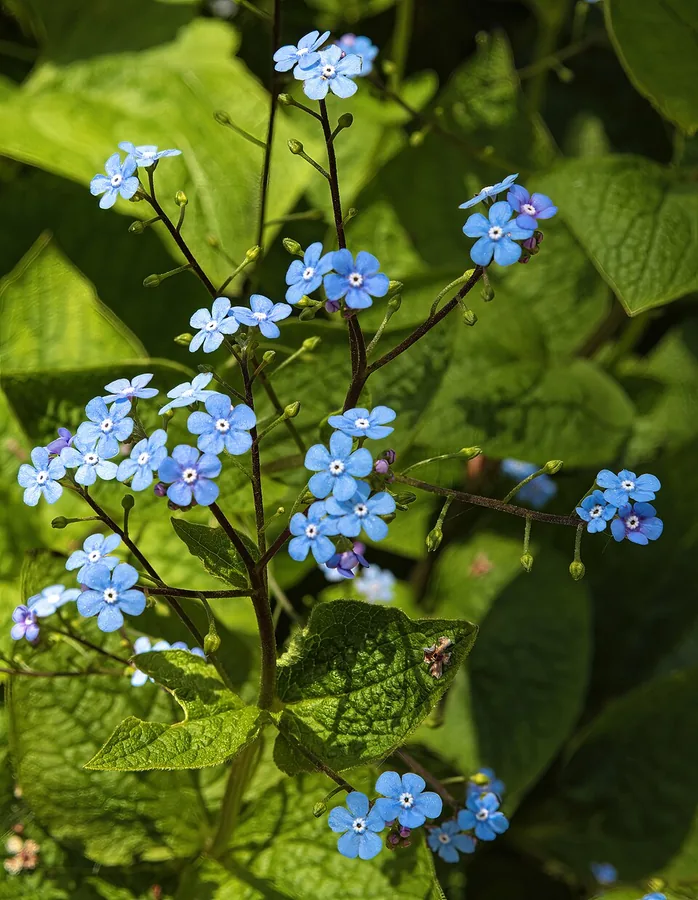
Brunnera performs in shade, where its broad heart-shaped leaves sustain interest well past the flowering period. A member of the borage family known also as Siberian bugloss, it is a clump-forming perennial that extends slowly by a creeping rhizome. Early spring brings open sprays of small blue flowers whose close likeness to Myosotis produced the common name false forget-me-not.
The foliage is the principal ornamental feature. The species carries plain green leaves, while the selected forms bear silver overlay, prominent veining, or creamy white margins that reflect the limited light of a shaded bed. Mature plants remain low at roughly 12 to 18 inches (30 to 46 cm) tall and broaden into an even mound that combines well with hostas and ferns.
Maintenance demands are minimal once the plant is established. It requires shade, fertile soil, and reliable moisture, and it resists both deer and rabbit browsing. Its principal limitation is intolerance of heat and drought, which scorch the leaf margins and depress vigor by midsummer in warmer conditions.
Care
The short version: part to full shade away from hot afternoon sun, soil held evenly moist and never allowed to dry out, and a fertile root zone mulched to conserve moisture and moderate root temperature.
Light
Brunnera is adapted to shade and performs best in part to full shade sheltered from hot afternoon sun. Direct light scorches the foliage and bleaches its color, because transpirational demand under full exposure exceeds supply. A dappled position beneath trees provides the appropriate light level.
Water
Maintain consistently and evenly moist soil, as this species does not tolerate drought at the root zone. A mulch layer conserves that moisture and moderates root temperature, a function most critical during summer heat when evaporative loss peaks.
Soil
Establish it in fertile, organically rich loam that drains freely while retaining steady moisture. It accepts a broad pH range from 6.0 to 8.0, so most beds amended with compost meet its requirements without further correction.
Humidity
Ambient garden humidity is sufficient, so no target value applies. The limiting factor is exposure to hot, humid summers such as those of the deep South, where the combination of heat and moisture stress exceeds the plant's tolerance.
Feeding
Apply a balanced fertilizer at low rates through the growing season, or incorporate compost and organic matter into the soil in spring. A fertile root zone maintains full foliage and supplies most of this plant's nutritional needs.
Pruning
Remove scorched or tattered leaves as they develop, and cut spent flower stems once the blue blooms have finished. In late fall or early spring, cut the declining foliage to the ground to clear the crown for new growth.
Size & spacing
Plants attain about 12 to 18 inches (30 to 46 cm) in height and spread slowly to 18 to 30 inches (46 to 76 cm). Allotting each clump that spacing allows it to close into an even, ground-covering mound.
When to plant
As a perennial, Brunnera requires no annual replanting once established in the bed. Install new plants or divisions in the mild conditions of spring or fall, then expect the blue flowers from early to mid-spring before the foliage assumes the display for the remainder of the season.
Northern hemisphere
Southern hemisphere
Typical months for a temperate climate: start earlier in warm zones, later where spring frosts linger.
- Sow: Usually propagated by division rather than seed; sow indoors is not typical.
- Plant: Plant in spring or fall during mild weather to avoid heat or cold stress.
- Harvest: Blooms early to mid-spring (about April to May), sometimes into early summer.
Hardiness
USDA hardiness zones: 3–8
Temperature: down to -40°C
Troubleshooting
Brunnera presents few problems, and the majority of those reduce to excess sun or inadequate moisture. The earliest indications register at the leaf margins and across the foliage in high summer, so monitor there first. Compare the observed symptom against the entries below and intervene before damage progresses.
Midsummer collapse and weak growth under heat and humidity
Decline in this plant tracks hot, humid weather, the conditions of the deep South and of warm-summer regions generally, where sustained heat exceeds its physiological tolerance. Deep shade and steady soil moisture buffer the worst of that heat, and a heavy mulch keeps root-zone temperatures down. Because its comfort range runs through zones 3 to 8, a cooler and shadier microclimate addresses the cause rather than the symptom.
Fix:
- Provide deep shade and consistent soil moisture in summer
- Mulch heavily to cool soil
- Grow in cooler microclimates or northern zones where possible
Scorched brown margins and bleached foliage color
Browning margins and bleached color point to leaf scorch, the result of transpiration outrunning what the roots can supply when hot sun and dry soil coincide. Resite the plant in part to full shade beyond the reach of afternoon sun, hold the soil evenly moist, and mulch so the surface holds water rather than losing it to evaporation. Cutting away the worst leaves removes spent tissue and prompts fresh foliage to take its place.
Fix:
- Move or transplant to part to full shade with afternoon shade
- Keep soil consistently moist
- Mulch to cool and conserve soil moisture
- Remove badly scorched leaves to encourage fresh growth
Irregular perforations in foliage accompanied by mucus trails
The chewed holes and silvery trails are diagnostic of slugs and snails, which thrive in exactly the cool, moist shade Brunnera favors. Handpicking after dark removes the feeding adults at their most active. Clearing the wet mulch and leaf litter strips away their daytime refuge, and iron phosphate bait controls a population that persists past those measures.
Fix:
- Handpick slugs and snails in the evening
- Reduce excess moisture and remove debris hiding spots
- Use iron phosphate slug bait if needed
Toxicity
For households with pets or children the assessment is straightforward: Brunnera is not toxic. It is absent from the ASPCA's list of plants dangerous to cats and dogs, and no hazard to other animals or to people is documented. It may be planted without restriction in gardens shared with pets and children.
Safe for
People · Cats · Dogs · Horses · Rabbits · Livestock · Birds
Cats None
Brunnera is absent from the ASPCA's list of plants toxic to cats, so feline contact with the foliage carries no recognized risk.
Dogs None
No toxin documented in this plant affects dogs, so a leaf taken by a curious animal poses no recognized hazard.
Horses Safe
No poisoning risk is documented for horses grazing in proximity to the planting.
Rabbits Safe
Rabbits generally avoid Brunnera, and the foliage is non-toxic to them in the event of feeding.
Livestock Safe
Cattle, goats, and sheep may browse it without ill effect, though it seldom registers as palatable to them.
Birds Safe
The seeds and foliage contain no documented toxin, leaving birds unaffected.
People Safe
No toxic compounds are recorded that would make handling or cultivation a hazard around children. As an ornamental rather than a food crop, it has no edible use and no reason to be ingested.
Varieties
Cultivation centers on the named foliage selections rather than the plain green species, and the following are the forms most often encountered.
Jack Frost
Identified by frosted silver foliage retaining green veins and a narrow green margin, on a clump of roughly 12 to 15 inches tall.
Looking Glass
Its heart-shaped leaves develop almost uniform metallic silver, with green reduced to negligible traces.
Variegata
Marked by green leaves bordered in broad creamy white at about 12 to 15 inches tall, it adds brightness to low-light beds.
Alexander's Great
A larger selection bearing broad silvered leaves veined and margined in green, attaining roughly 12 to 18 inches.
How to propagate
Brunnera is increased most dependably by division of an established clump, which suits its rhizomatous habit far better than seed.
DivisionEasy
Divide clumps in early spring or fall. · Usually establishes within one growing season.
Because the plant grows from a creeping rhizome, vegetative division is the reliable method of increase. Lift an established clump in early spring or fall, separate the rhizome into sections, and replant each, with establishment typically complete within a single growing season. Note one legal constraint: patented cultivars may not be propagated, so verify the name before dividing.
Myths
Brunnera is just another forget-me-not.
The floral resemblance is genuine, and the common name false forget-me-not reflects it, but the two are taxonomically distinct. Brunnera macrophylla is a rhizomatous perennial in the borage family rather than a Myosotis. Its value in the garden lies in the large heart-shaped leaves, not in flowers mistaken for those of the true species.
Brunnera performs and blooms best only with full sun exposure.
This is a shade species by adaptation, performing best in part to full shade sheltered from hot afternoon sun. Full exposure does not improve flowering; instead, excess sun scorches the leaf tissue, since transpirational demand under direct light exceeds what the plant can sustain.