Ornamental · Boraginaceae
Forget-me-not
Myosotis sylvatica
One planting yields a spring sheet of small blue flowers, then regenerates from its own seed.
Full sun
Every 3–7 days
56–70 days
USDA 3–8
Overview
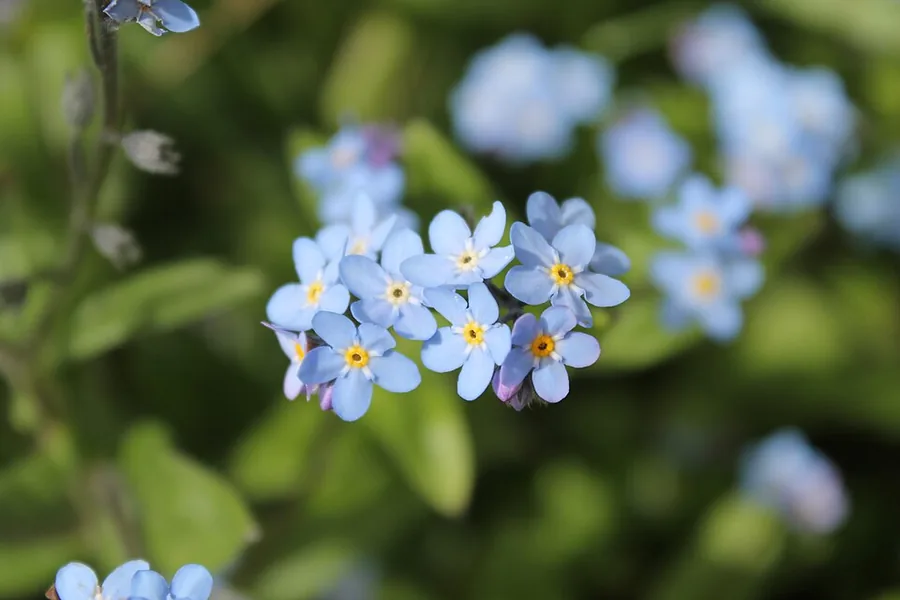
Forget-me-not produces the sheets of small sky-blue flowers that knit through spring bulb plantings. A member of the borage family native to Europe and Asia, it occupies damp woodland and streambank habitats, which explains its preference for steady moisture. In cultivation it remains low and unassuming, a biennial that withholds bloom until its second spring and then relies on seedlings for continuity.
The vigor that makes it dependable also makes it expansive. It sets seed prolifically and roots from creeping, stolon-like stems, so a single planting progresses to a patch and then to a clonal colony. Beneath tulips and daffodils that colonizing tendency is an asset, but it warrants monitoring where the species can move into uncultivated ground.
Given rich, consistently moist soil and afternoon shade in hot regions, the plant is largely self-sustaining. Bloom falls in April and May, with sporadic flowers continuing into summer, and its cold tolerance is exceptional, the foliage surviving winter lows near the limit of temperate hardiness.
Care
The short version: supply rich, consistently moist soil, full sun to part shade with afternoon shade under hot summers, and a single light feed at planting. Deadhead after bloom, because that interrupts the seed set that drives its self-sowing.
Light
The species accepts full sun through partial shade, but performs best with morning sun and relief from the afternoon where summers are hot. The reason is disease pressure: heat combined with insufficient shade stresses the foliage and creates the conditions powdery mildew exploits.
Water
Maintain consistently moist soil and never allow it to dry, particularly under heat, which matches the streamside conditions of its native range. The plant tolerates occasional saturation and even shallow standing water, so the safe error is toward moisture rather than drought.
Soil
Use rich, well-drained loam or clay with a high organic fraction, reflecting the humus-laden soils it evolved in. A pH of 6.1 to 7.5 suits it, a band running from slightly acidic to mildly alkaline that most cultivated beds already fall within.
Temperature
Cold hardiness is the plant's defining strength: it is comfortable to roughly 86°F (30°C) and endures winter lows near -40°F (-40°C). Heat, not cold, is the limiting factor, because warm, humid conditions favor the fungal pathogens that attack the leaves.
Humidity
No specific humidity target applies, since ambient outdoor levels are adequate. Air movement is the operative variable, because the still, saturated microclimate around crowded foliage is precisely where powdery mildew and rust establish.
Feeding
Forget-me-not has a low nutritional demand. A single light application of balanced fertilizer or compost incorporated into rich soil at planting is sufficient, and repeated feeding through the season confers no benefit.
Pruning
Remove the spent flower cymes by deadheading or shearing immediately after bloom, which both stimulates further flowering and intercepts seed set to limit self-sowing. Cut back exhausted or mildewed foliage in the same operation to reduce inoculum and tidy the plant.
Repotting
Repotting is seldom relevant, as the species is normally grown in open ground. For a containerized specimen, pot on only when roots circle or emerge from the drainage holes or when the medium dries abnormally fast, both signs the roots have filled the volume.
Size & spacing
Mature plants are compact at 6 to 12 inches (15 to 30 cm) tall with a spread of 6 to 10 inches (15 to 25 cm). Spacing to that footprint preserves the air circulation that keeps foliage dry and disease at bay.
When to plant
Forget-me-not operates on a two-year cycle, and timing the sowing to that cycle determines when it flowers. Seed started indoors 8 to 10 weeks before the last frost produces bloom the same year, while seed sown outdoors in mid-summer flowers the following spring as a true biennial. Peak bloom occurs in April and May, with sporadic flowers continuing into summer.
Northern hemisphere
Southern hemisphere
Typical months for a temperate climate: start earlier in warm zones, later where spring frosts linger.
- Sow: 8-10 weeks before the last spring frost for bloom the same year
- Plant: Direct sow in mid-summer for bloom the following spring, or transplant seedlings after frost
- Harvest: April to May, with sporadic intermittent bloom into mid-summer
Hardiness
USDA hardiness zones: 3–8
Temperature: down to -40°C
Troubleshooting
Problems in forget-me-not concentrate in two places: the foliage, where fungal disease follows moisture and crowding, and the seed, where its fecundity outpaces a bed. Reading the early symptoms matters, because the response differs by cause. Identify the disorder below, then intervene before it advances.
Volunteer seedlings colonizing the surrounding bed
Numerous volunteers around the parents, together with stems creeping and rooting along the soil, confirm the plant's habit as a prolific self-seeder that forms clonal colonies. Unchecked it can dominate a bed and escape cultivation. Deadhead the cymes before seed drops, remove unwanted volunteers, and lift the rooted creeping stems to contain the spread.
Fix:
- Deadhead and remove flower cymes immediately after bloom to limit seeding
- Pull unwanted volunteer seedlings
- Remove rooted creeping stems to control spread
A dusty white film across the upper leaf surfaces
A powdery white coating that rubs off but recurs indicates powdery mildew, a fungus driven by crowding, poor air circulation, and humidity. It is largely cosmetic, but it persists until airflow improves. Thin or space the plants, water at the soil line to keep foliage dry, and shear back the worst-affected plants after bloom.
Fix:
- Improve air circulation by thinning or spacing plants
- Remove and discard severely affected foliage
- Avoid overhead watering and water at the soil line
- Shear back heavily infected plants after bloom
Raised orange or brown pustules on the leaves
Rusty raised pustules on leaf surfaces and undersides point to rust, a fungal infection favored by persistently wet foliage. Remove and destroy affected leaves promptly to reduce spore load. Withhold overhead water and increase spacing so the leaves dry quickly after rain.
Fix:
- Remove and destroy infected leaves
- Avoid overhead watering to keep foliage dry
- Improve spacing and air movement
- Clean up plant debris at season end
Toxicity
For households with pets or children the verdict is favorable: Myosotis sylvatica is not recorded as toxic. The NC State Extension Plant Toolbox, which catalogs poison data where it exists, lists none for this species, and the ASPCA does not flag it. The caution is taxonomic, since Chinese forget-me-not, a separate genus, carries the harmful alkaloids people attribute to the true species.
Safe for
People · Cats · Dogs · Horses · Rabbits · Livestock · Birds
Cats None
Safe for cats. The species poses no toxic risk, so a nibble of leaf or flower will not poison a cat, though a large quantity of any plant material can cause transient drooling or mild gastric upset.
Dogs None
Safe for dogs. The plant contains no toxin of concern to a dog, so an incidental bite from the garden carries no risk.
Horses Safe
Safe for horses. The true species is not the toxic Chinese forget-me-not, so grazing adjacent to a stand presents no genuine hazard.
Rabbits Safe
Safe for rabbits, which can browse the foliage without harm. Introduce any new forage gradually rather than all at once, as a general dietary precaution.
Livestock Safe
Safe for cattle, goats, and sheep. The species contains only trace alkaloids and is not listed among poisonous pasture plants.
Birds Safe
Safe for birds. Poultry and wild species can take the seeds and foliage with no adverse effect.
People Safe
Safe for people, and the small blue flowers are occasionally used as an edible garnish. No exclusion of children is warranted.
Generally considered safe; as with any plant, discourage pets and small children from eating large amounts of foliage or flowers.
Varieties
The forget-me-nots offered to gardeners are overwhelmingly selections within this one species, differentiated by flower color and growth habit rather than by any structural change. These are the named forms most often encountered.
Victoria Blue
A compact cultivar selected for rich blue flowers carried on a tidy, mounded habit.
Victoria Rose
A pink-flowered selection that substitutes soft rose for the species' characteristic sky blue.
Snowball
A white-flowered form that registers cool and clean against darker foliage.
Blue Basket
A taller blue-flowered selection that carries its bloom slightly above the others.
Ultramarine
A selection valued for the unusual depth of its dark-blue flowers.
Companions
Forget-me-not earns its keep woven among spring bulbs, where its low blue haze fills the gaps and sets off taller flowers above it.
Plant near
Spring-flowering bulbs such as tulips and daffodils: Forget-me-not is recommended for interplanting with spring bulbs, where its blue flowers complement bulb displays and fill in around them.
How to propagate
Forget-me-not is functionally self-propagating, yet two deliberate methods give control over timing and placement: sowing seed, and dividing a clump that has already rooted from its creeping stems.
SeedEasy
Start indoors 8-10 weeks before last frost for same-year bloom, or sow outdoors in mid-summer for bloom the following spring · Several weeks to germinate and establish; biennial sowings bloom the next season
Seed is the standard method and germinates readily. Sow indoors 8 to 10 weeks before the last frost for same-year bloom, or sow outdoors in mid-summer to flower the following spring as a true biennial. Germination and establishment take several weeks; thereafter an established stand self-seeds freely, at times beyond what is wanted.
DivisionEasy
Spring or after flowering · A few weeks once rooted
Division exploits the plant's own clonal habit. The creeping, stolon-like stems root as they extend and produce offsets, so in spring or after flowering, lift a rooted section, separate it, and replant it. It re-establishes within a few weeks and, being clonal, is genetically identical to the parent.
Myths
All forget-me-nots are dangerously poisonous to pets.
True forget-me-not, Myosotis sylvatica, carries no reported toxicity and is absent from the ASPCA toxic plant list. The hazard belongs to a separate genus, Chinese forget-me-not (Cynoglossum amabile), whose pyrrolizidine alkaloids can induce liver disease in horses under large or prolonged ingestion.
Forget-me-not is a North American native wildflower.
The species is native to Europe and Asia, not to North America. It has escaped cultivation and naturalized across parts of the continent, to the point that several Midwestern jurisdictions now classify it as a noxious weed.