Ornamental · Boraginaceae
Heliotrope
Heliotropium arborescens
Meet its need for full sun and steady moisture, and heliotrope produces clusters of deep violet, sweetly fragrant bloom.
Full sun
Every 2–4 days
50–86°F · 10–30°C
USDA 10–11
Overview
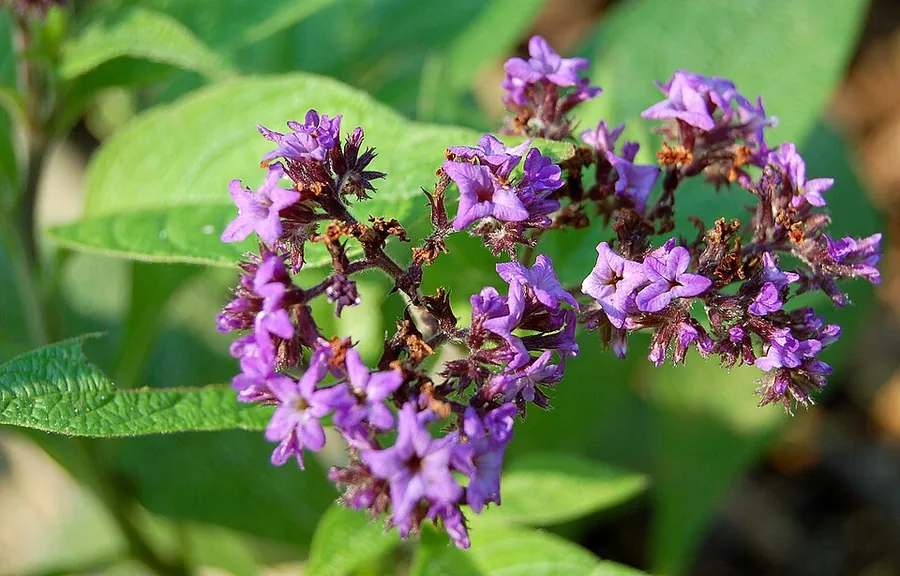
Heliotrope is a tender shrubby perennial native to Peru, cultivated across most of the country as a warm-season annual for its dense cymes of violet to deep blue flowers. Its defining trait is fragrance, a rich sweetness that gave the plant its vernacular name, cherry pie. It performs well in a sunny border or a patio container, where the scent carries across warm evenings.
Peak flowering depends on meeting a few clear requirements. The plant demands full sun, rich soil, and consistent moisture, and it responds to pinching with a denser, more floriferous habit. In zones 10 to 11, where it survives year-round, it can develop into a small woody shrub, though most growers cultivate it as a single-season annual or overwinter cuttings.
One characteristic distinguishes heliotrope from most border ornamentals. All tissues contain pyrrolizidine alkaloids that are toxic to animals and humans, so its value lies solely in appearance and scent and never in any edible use.
Care
The short version: full sun, with afternoon shade in hot-summer regions, soil held evenly moist and never allowed to dry out, a rich medium high in organic matter, and early pinching to establish a bushy framework.
Light
Heliotrope flowers most freely in full sun, tolerates some partial shade, and benefits from afternoon shade where summer heat is extreme, which reduces heat and moisture stress. Under insufficient light it etiolates and sets few flowers.
Water
The plant has medium water needs and no drought tolerance, so hold the soil evenly moist and irrigate every 2 to 4 days, more often in containers or during heat, since the smaller soil volume of a pot dries faster. A moisture deficit produces rapid wilting and leaf drop.
Soil
Use moist, organically rich, well-drained soil amended with ample organic matter, which supplies both the fertility and the water-holding capacity the plant favors. It grows across a fairly wide range at a slightly acidic pH of 6.0 to 7.5.
Temperature
Heliotrope grows best between 50°F and 86°F (10°C to 30°C) and has no frost tolerance, so plant it out only after the cold has passed and lift, protect, or replace it before temperatures fall in autumn.
Humidity
Average ambient humidity meets the plant's needs, and the record specifies no target percentage. Adequate airflow matters more than air moisture, particularly for specimens overwintered indoors, where still air favors pest buildup.
Feeding
Through the growing season, apply a balanced water-soluble fertilizer every two weeks, since continuous flowering draws steadily on nutrient reserves. Consistent feeding sustains heliotrope's prolonged bloom.
Pruning
Pinch the stem tips while the plant is young to release lateral buds and build a bushy framework, then deadhead spent flower clusters through the season to prevent seed set and prolong bloom.
Size & spacing
Heliotrope reaches 12 to 24 inches (30 to 60 cm) in height with a spread of 12 to 18 inches (30 to 45 cm). Allot that spacing so air moves freely through the canopy and limits pest and disease pressure.
When to plant
Heliotrope requires warmth and has no frost tolerance, so schedule around the last spring frost. Start seed indoors about 10 to 12 weeks before that date, transplant only after the danger of cold has fully passed and the soil has warmed, and expect bloom from summer into fall.
Northern hemisphere
Southern hemisphere
Typical months for a temperate climate: start earlier in warm zones, later where spring frosts linger.
- Sow: Start seed indoors about 10 to 12 weeks before the last spring frost.
- Plant: Transplant outdoors after all danger of frost has passed and soil has warmed.
- Harvest: Blooms from summer into fall.
Hardiness
USDA hardiness zones: 10–11
Temperature: down to -1°C
Troubleshooting
Most heliotrope problems reduce to a short list of causes: a soil moisture deficit, inadequate light, or pest colonization that follows a plant indoors for winter. Recognize the early indicators below and intervene before a minor issue escalates.
Sticky residue, webbing, and stippled chlorosis on leaves
These symptoms mark an infestation of sap-sucking pests: whiteflies, spider mites, aphids, and mealybugs, which feed on plant fluids and reach their worst on specimens overwintered under low airflow indoors. Confirm the culprit by examining leaf undersides for the insects themselves, a white cloud that rises when the plant is disturbed, or fine webbing left by mites. A forceful jet of water dislodges much of the population, insecticidal soap or horticultural oil finishes the rest by smothering soft-bodied insects, and isolating an affected indoor plant prevents the pests from moving to healthy stock.
Fix:
- Rinse foliage with a strong spray of water
- Treat with insecticidal soap or horticultural oil
- Isolate affected indoor plants to prevent spread
Wilting, abscission, and arrested growth from dryness
Because heliotrope carries medium water needs and no drought tolerance, a soil moisture deficit registers quickly as turgor loss, leaf abscission, and stalled extension. The mechanism is simple: without enough water in the root zone the plant cannot hold turgor pressure, so leaves wilt and shed and growth halts. Diagnose it by noting soil that dries rapidly at the surface and a container that has gone light, with foliage that regains turgor within hours of irrigation. Deep watering rewets the entire root zone, a mulch layer slows evaporative loss, and moving containers out of intense afternoon sun in hot climates cuts the transpiration load.
Fix:
- Water thoroughly to rewet the root zone
- Mulch to conserve soil moisture
- Move containers out of intense afternoon sun in hot climates
Sparse bloom on elongated, leggy stems
Elongated internodes and thin bloom indicate etiolation, the stem stretch a plant makes when light is short, compounded here by missed pinching and deadheading. Insufficient sun drives the stretch, while the absence of pinching leaves growth unbranched and the failure to deadhead lets seed set suppress further flowering. Relocating the plant to full sun corrects the light deficit, pinching the stem tips releases lateral buds into side branches, and removing faded flower clusters redirects energy back into new bloom.
Fix:
- Move to a full-sun location
- Pinch back stem tips to encourage branching
- Deadhead spent flower clusters regularly
Toxicity
Heliotrope is toxic, and the hazard extends to the entire plant. All tissues contain pyrrolizidine alkaloids that damage the liver cumulatively, and the risk applies to cats, dogs, horses, rabbits, livestock, birds, and people alike. No part is edible, so grow it strictly for form and fragrance and keep it well clear of grazing animals, curious pets, and children.
Toxic to
Cats · Dogs · Horses · Rabbits · Livestock · Birds · People
Cats Moderate
A single nibble typically produces drooling and gastrointestinal upset, but the material concern is the pyrrolizidine alkaloids, which accumulate in hepatic tissue across repeated exposures. Site the plant beyond a cat's reach.
Dogs Moderate
Ingestion of leaves or stems can produce drooling, vomiting, and reduced appetite, and the alkaloids responsible for liver injury in livestock are present in this tissue as well. Prevent a dog from grazing on it.
Horses Severe
The horse ranks among the most susceptible species. Sustained grazing produces cumulative hepatic damage that can progress to liver failure, presenting as weight loss, jaundice, photosensitization, and the ataxia and disorientation of hepatic encephalopathy.
Rabbits Moderate
The pyrrolizidine alkaloids that injure other species are no less hazardous to a rabbit, so the foliage should be excluded from its diet. A nibble brings digestive upset, and larger intake burdens the liver.
Livestock Severe
Cattle, sheep, and goats consuming heliotrope, whether fresh or dried in contaminated hay, develop progressive hepatic degeneration, wasting, jaundice, and photosensitization. Chronic ingestion can prove fatal.
Birds Moderate
Birds are equally subject to the hepatic toxin, so pecking at leaves or flowers carries the same cumulative liability. Exclude them from the plant and from any dried trimmings.
People Caution
No part of heliotrope is intended for consumption. The alkaloids distributed throughout the tissue are hepatotoxic to humans, so treat the plant as strictly ornamental and prevent curious children from chewing leaves or flowers.
Keep grazing animals away from heliotrope and PA-contaminated hay; pyrrolizidine alkaloids accumulate in the liver over time.
Helpline numbers

United States
ASPCA Animal Poison Control: (888) 426-4435 (fee applies)
Poison Control: (800) 222-1222



Canada
Poison Centres: 1-844-764-7669
Varieties
A small number of named heliotropes recur in cultivation, selected for compact habit, color intensity, or fragrance strength. The following two are the ones worth knowing.
Marine
A widely grown compact cultivar that presents deep violet-blue flower clusters against dark green foliage.
Scentropia Dark Blue
A selection valued for its strongly fragrant, deep blue-purple blooms.
How to propagate
Heliotrope propagates readily by two methods: rooting stem cuttings to maintain a favored cultivar, or raising new plants from seed.
Stem cuttingsModerate
Take cuttings from garden plants in late summer to overwinter, or in spring. · Roots typically form in a few weeks under warm, humid conditions.
Vegetative propagation by cutting preserves a named cultivar exactly, since the offspring is genetically identical to the parent, and it carries a chosen plant through winter indoors. Take cuttings from garden plants in late summer for overwintering, or in spring, and hold them under warmth and humidity to drive rooting. Roots generally develop within a few weeks.
SeedModerate
Sow indoors about 10 to 12 weeks before the last spring frost. · Germination and growth to transplant size take several weeks; warmth aids germination.
Seed propagation is workable, though the seedlings may differ from the parent because of genetic recombination. Sow indoors about 10 to 12 weeks before your last spring frost and keep the tray warm and well lit. Germination and growth to transplant size occupy several weeks, with warmth serving as the main driver of germination.
Myths
Heliotrope induces severe neurological poisoning in dogs and cats as soon as they nibble it.
Poison control and extension references direct the principal warning at horses and grazing livestock, which accumulate the pyrrolizidine alkaloids across repeated feedings. The ASPCA classifies heliotrope as toxic to horses, whereas a casual bite by a cat or dog generally produces no more than mild gastrointestinal upset. The operative hazard is cumulative hepatic damage from repeated ingestion, not an acute neurological event.
A single bite of heliotrope will poison an animal on the spot.
Pyrrolizidine alkaloids act by slow accumulation, injuring the liver incrementally rather than at once. Clinical poisoning in horses and livestock follows large or repeated intake, not one small taste. Risk scales with total exposure, so the sound management goal is permanent exclusion of animals from the plant.