Ornamental · Boraginaceae
Lungwort
Pulmonaria saccharata
Match it to cool shade and steady moisture and lungwort animates the dim corners with early spotted leaves and pink-to-blue flowers.
Partial shade
Every 7 days
USDA 3–9
10–18 in · 25–46 cm
Overview
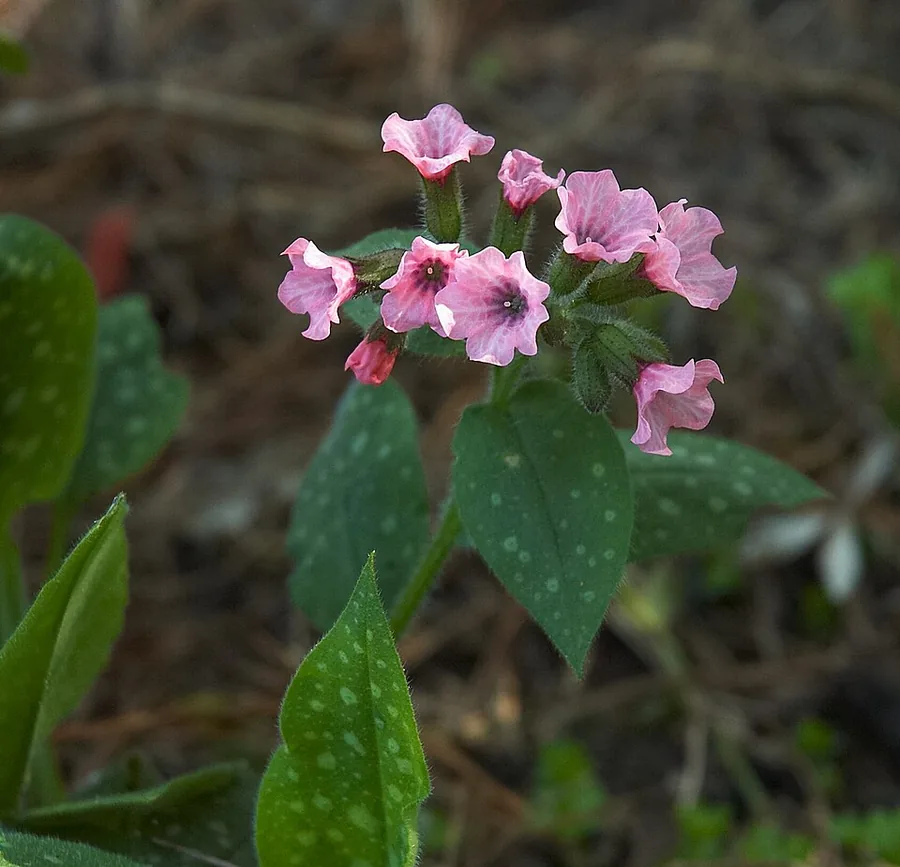
Lungwort is a low, clumping perennial valued for two features working together, its silver-spotted leaves and its early flowers that open pink and turn blue on a single stem as the bloom ages. It sits within the borage family, and the name traces to early herbalists who read the speckled foliage as a likeness of diseased lungs. The spots are simply the natural leaf pattern, but the name persisted.
It is a genuine woodland shade species. It performs in the low-light ground beneath trees and on the north side of a wall, positions where sun-dependent plants falter, and it flowers in late winter to spring ahead of the wider garden. The early bloom supplies forage for the first bees, and the patterned foliage sustains the display long after the flowers pass.
Once established, its demands are modest. Hold the soil cool and evenly moist in true shade and it extends into a slow, orderly ground cover. Its one intolerance is hot, dry sun, which scorches the foliage and forces the plant into a protective dormancy, a direct consequence of moving it away from the shaded, moist conditions it evolved for.
Care
The short version: site lungwort in part to full shade, keep the soil cool, rich, and evenly moist, apply a light seasonal feed, and divide the clumps in fall once they crowd.
Light
Lungwort requires part to full shade, the deep, cool exposure found under trees or on a building's north aspect. It tolerates full shade and still flowers, because direct sun raises leaf temperature and water loss beyond what the plant can sustain, scorching the foliage and forcing early dormancy.
Water
Hold the soil cool and evenly moist but never waterlogged, watering about once a week through dry spells. If it dries, the leaves lose turgor and wilt, and the plant enters dormancy as a protective response to conserve water.
Soil
Provide cool, humus-rich ground that retains moisture while still draining. Incorporate ample compost or leaf mold, reproducing the organic, moisture-holding profile of the woodland floor it originates on.
Humidity
Average
Feeding
A slow-release all-purpose fertilizer once per season meets its needs. Apply it during the growing season and rely on the rich, organic soil to supply the balance.
Pruning
Remove the older, tattered, or mildewed leaves as they appear over the season to limit inoculum and tidy the crown. Cutting the foliage back after flowering triggers a fresh, clean flush of leaves for summer.
Size & spacing
Plants remain low at 10 to 18 inches (25 to 46 cm) tall and spread wider than tall, reaching 18 to 24 inches (46 to 61 cm) across. Allow that spacing and the plant closes into a slow ground cover.
When to plant
Lungwort is keyed to the cool part of the season. Establish new plants in spring or fall in a shaded bed, and the flowers open in late winter to spring, pink initially and maturing to blue, ahead of most perennials.
Northern hemisphere
Southern hemisphere
Typical months for a temperate climate: start earlier in warm zones, later where spring frosts linger.
- Sow: Seldom grown from seed; if used, sow seed in early spring.
- Plant: Spring or fall in a shaded site.
- Harvest: Blooms late winter to spring (April to May), flowers opening pink and maturing to blue.
Hardiness
USDA hardiness zones: 3–9
Temperature: down to -40°C
Troubleshooting
Sited correctly, lungwort remains healthy, so nearly every problem resolves to excess sun or the wrong soil moisture. Examine the leaves and crown for the early indicators below. Correct the site and the plant generally recovers.
Darkened crown and roots ahead of full collapse
The cause is crown and root rot, which develops when waterlogged, poorly drained soil starves the roots of oxygen and lets rot organisms turn them dark and soft. Amend the ground with organic matter to open its structure and drainage, and avoid any low pocket where water stands. Divide the still-firm crowns and reset them into free-draining soil to carry the planting forward.
Fix:
- Improve drainage with organic matter
- Avoid waterlogged sites
- Divide and replant healthy crowns in well-drained soil
Marginal browning and midday collapse of the foliage
This is leaf scorch, the result of sun and summer heat driving water out of the leaves faster than dry soil can resupply it, so margins brown and the canopy wilts at midday. Relocate the plant to part to full shade to lower the demand, keep the soil evenly moist to restore supply, and mulch to hold that moisture and cool the root zone. As a woodland shade species, lungwort simply needs the site to match its origin.
Fix:
- Move or transplant to part to full shade
- Water to keep soil evenly moist
- Mulch to keep roots cool and reduce moisture loss
White powdery colonies coating the leaf surface
This coating is powdery mildew, a fungus that colonizes foliage when dry soil stresses the plant and stagnant air lets spores settle on crowded leaves. Remove the worst leaves to cut the spore load, then thin the stand so moving air dries the surfaces, and hold the soil evenly moist to ease the stress. A hard cutback replaces the infected canopy with clean growth.
Fix:
- Remove and discard affected leaves
- Improve air circulation and keep soil evenly moist
- Cut back foliage to promote clean new growth
Irregular holes and slime trails across the foliage
The holes come from slugs and snails, night feeders that rasp through soft leaves and leave mucus trails, with damage peaking after wet weather that keeps them active. Collect them by hand at dusk when they emerge, and clear the leaf litter that gives them cool, damp daytime shelter. Baits or barriers close the gap when hand-picking cannot keep pace.
Fix:
- Hand-pick slugs in the evening
- Remove leaf litter and debris that shelter them
- Use slug baits or barriers if damage is heavy
Toxicity
For households with pets or children, the verdict is clear: lungwort is not toxic. The ASPCA does not list Pulmonaria as poisonous to cats or dogs, and no reports document harm to other animals or people. An incidental nibble warrants no concern.
Safe for
People · Cats · Dogs · Horses · Rabbits · Livestock · Birds
Cats None
Lungwort holds no compounds toxic to cats, so an exploratory bite on a leaf carries no consequence.
Dogs None
The foliage poses no hazard to dogs that chew or push through it, and the ASPCA records no listing as poisonous.
Horses Safe
Horses face no risk, as the plant contains nothing that would affect a grazing animal of that mass.
Rabbits Safe
Rabbits pass through a planting unharmed, and the bristly, hairy leaves generally deter feeding in the first place.
Livestock Safe
Cattle, goats, and sheep graze near it without incident, with no recorded cases of poisoning from the foliage.
Birds Safe
Neither the leaves nor the flowers present any toxic hazard to birds.
People Safe
Cultivating and handling lungwort presents no poisoning risk to people, children in the garden included.
Varieties
Lungwort is selected as much for foliage as for flower, and the named cultivars below separate chiefly by the degree of silver marking and the final color the blooms reach.
Mrs. Moon
A long-established cultivar defined by heavy silver leaf spotting and pink buds that resolve into soft blue flowers.
Raspberry Splash
An upright habit distinguishes this one, paired with silver-spotted leaves and blooms in raspberry-pink to violet.
Spot On
A vigorous silver-spotted selection notable for coral-pink blooms that transition to blue with age.
How to propagate
Lungwort increases readily, and dividing an established clump is considerably more reliable than raising it from seed.
DivisionEasy
Fall, when clumps become overcrowded · One growing season
Division is the dependable method of increase for lungwort. Lift the clump in fall once crowding sets in, separate the crown into sections, and remove the older leaves as you reset each piece to reduce transplant stress. A division needs a single growing season to establish.
SeedModerate
Early spring · Seedlings reach blooming size in about a year
Seed is the slower method, and because the named cultivars do not breed true, the resulting seedlings seldom match the parent plant. Sow in early spring where seed is worth attempting, and allow roughly a year for the young plants to reach blooming size.
Myths
The spotted leaves mean lungwort cures lung disease.
Under the historical doctrine of signatures, the leaf spots were interpreted as evidence the plant could treat the lungs, yet those spots are only an inherent foliar marking. The common name and the herbal tradition derive from that visual resemblance, not from any demonstrated pulmonary effect.
Lungwort spreads fast and turns invasive.
Its rhizomes extend outward at a slow pace, so it never establishes the aggressive spread that defines an invasive species. Where a clump outgrows its space, lifting and dividing it restores the intended scale.