Ornamental · Boraginaceae
Lacy Phacelia
Phacelia tanacetifolia
One sowing, and the flowers pull bees in droves, a haze of lavender-blue feeding pollinators all summer.
Full sun
Every 5–10 days
42–56 days
USDA 3–10
Overview
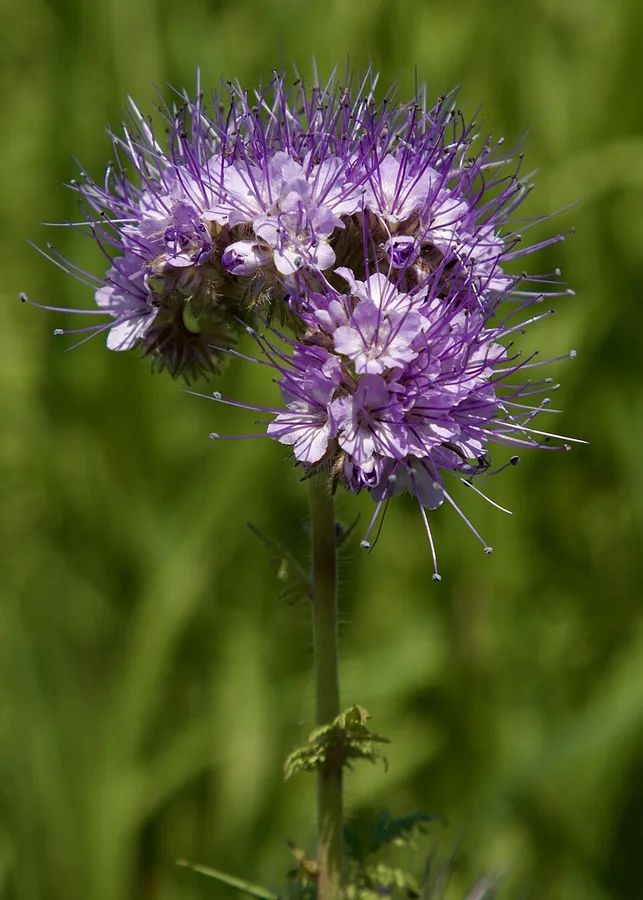
Lacy phacelia is a fast-growing annual native to California and the western states, its common name drawn from the finely divided fern-like leaves and the coiled inflorescences of lavender-blue bells that uncurl in the manner of a fiddlehead. Taxonomically it sits in the borage family rather than the Asteraceae, a distinction the tansy-like foliage tends to obscure. Behind its simple culture lies a genuinely productive plant.
The defining trait is its exceptional value to bees. Honey bees, native bees, hoverflies, and parasitic wasps all forage the flowers, which explains why it features in cover-crop and pollinator seed mixes more often than in ornamental borders. It also earns a place as a green manure, scavenging free soil nitrogen and suppressing weeds through dense, fast growth.
Managed correctly it behaves as a quick annual, flowering within a few weeks of sowing and completing its cycle in a single season. Sow in spring or fall, provide full sun and free-draining soil, and stagger sowings where a longer display is wanted. Allowed to set seed, it regenerates on its own the following year.
Care
The short version: full sun and free-draining soil, irrigation only until the stand establishes and then very little, succession sowing to lengthen the display, and termination before seed set to check volunteering.
Light
Site phacelia in full sun, where it flowers most heavily and draws the strongest bee activity. It tolerates partial sun or light shade, but reduced light thins the flowering and encourages the stems to etiolate and lodge.
Water
Irrigate young seedlings until they establish, then withhold water, because phacelia becomes drought tolerant once rooted and performs on 7 to 18 inches of rainfall or irrigation a year. Allow the top half of the soil to dry between waterings, and never let the plant stand in saturated ground.
Soil
Phacelia grows best in well-drained sandy, gravelly, or loamy soil and tolerates the poor, dry ground that limits more demanding plants. Its pH amplitude is broad, from 6.4 to 8.5, so most garden soils are suitable provided drainage is adequate.
Temperature
The plant operates across a wide thermal range, roughly 18°F to 95°F (-8°C to 35°C), and young plants withstand light frost. A hard freeze at the lower bound kills the foliage outright, which is why it functions as a spring or fall crop rather than a winter one.
Humidity
Ambient outdoor humidity meets its needs, so no target figure applies. Air movement is the operative factor, since still, congested plantings favor the aphids and root rot that otherwise trouble it little.
Feeding
Withhold fertilizer except in the poorest soils. As a cover crop phacelia scavenges existing soil nitrogen rather than requiring inputs, and surplus nitrogen only produces soft, aphid-susceptible foliage.
Pruning
No formal pruning applies. Deadhead spent inflorescences to prolong flowering and limit self-seeding, and where the plant is grown as a cover crop, mow or till the entire stand at flowering, before seed set.
Repotting
none
Size & spacing
Mature plants reach 1 to 3 feet (30 to 91 cm) in height with a spread near 8 to 18 inches (20 to 45 cm). Sown densely as a cover crop the stand closes over and suppresses weeds, whereas a thinner sowing gives individual plants room and improves airflow.
When to plant
Phacelia moves on a compressed schedule. Direct sow in early spring once the soil is workable, or in fall in mild-winter regions, and expect flowering roughly 6 to 8 weeks from sowing. Staggering sowings at intervals of a couple of weeks sustains the display, while a hard frost reliably terminates the stand.
Northern hemisphere
Southern hemisphere
Typical months for a temperate climate: start earlier in warm zones, later where spring frosts linger.
- Sow: Generally direct-sown; if starting indoors, sow 4 to 6 weeks before last frost in darkness (light inhibits germination)
- Plant: Direct sow in early spring when soil is workable, or in fall in mild-winter climates; sow seed about 0.25 inch deep when soil temperatures are below 68 degrees F
- Harvest: Late spring through summer; blooms roughly 6 to 8 weeks after sowing over a long period
Hardiness
USDA hardiness zones: 3–10
Temperature: down to -40°C
Troubleshooting
Phacelia is comparatively trouble-free, and the few problems that arise nearly all trace to excess soil moisture or the plant's readiness to reseed. Diagnose against the entries below and intervene early. A minor issue caught in time seldom develops into a serious one.
Volunteer seedlings appearing where none were sown
Heavy volunteering follows directly from the plant's reproductive habit. As the coiled seed heads dry and split, phacelia sheds a persistent seed bank that germinates in flushes once the next rain rewets the soil. Because the trigger is mature seed, the control is to remove it before it forms: mow, till, or pull the stand at peak bloom, and deadhead spent clusters so none ripen.
Fix:
- Mow, till, or pull plants at flowering before seed matures
- Deadhead spent flower clusters before they dry and shatter
- Hand-pull or hoe volunteer seedlings while young
Wilt and yellowing over rotted roots in saturated soil
In saturated soil the roots are starved of oxygen, which opens the way to root rot that leaves them soft and discolored and decays the crown at the soil line. The damage is not reversible once a plant has collapsed, so remove it and correct the underlying drainage. Phacelia performs in sandy, gravelly, or loamy soil precisely because water moves through it, so keep the plant out of low ground that stays wet.
Fix:
- Improve drainage and stop overwatering
- Remove and discard collapsed plants
Flowering ending early as the stand declines
The brief display is a function of life cycle, not culture. Phacelia is a short-lived annual, so a single sowing carries only a few weeks of flower before the plants senesce, and the frost-tender foliage blackens once a hard freeze approaches 18°F (-8°C). Overlapping sowings every 2 to 4 weeks keep fresh plants coming into bloom across the season, and replanting after frost restores a killed stand.
Fix:
- Make successive (succession) sowings every 2 to 4 weeks to extend continuous bloom
- Replace winterkilled plantings with a new sowing once frost danger passes
Colonies of soft-bodied insects on new growth
The colonies are aphids, which settle preferentially on lush or stressed tissue and excrete the sticky honeydew you notice on the stems. A firm jet of water dislodges them mechanically, and light populations rarely warrant more, since phacelia recruits hoverflies, lacewings, and parasitic wasps whose larvae prey on aphids and hold numbers in check.
Fix:
- Spray off colonies with a strong jet of water
- Tolerate light infestations, as phacelia attracts predatory and parasitic beneficial insects that help control aphids
Toxicity
Phacelia is safe to grow around animals and people, non-toxic to pets, livestock, and people with no poisonous constituent in any tissue. The single qualification is dermal rather than internal: the glandular foliage can raise an itchy rash in sensitive individuals, so wear gloves before pulling or mowing a stand.
Safe for
People · Cats · Dogs · Horses · Rabbits · Livestock · Birds
Cats None
No toxicity applies to cats. Ingestion of the foliage produces no poisoning, because the plant contains no compound that affects them internally.
Dogs None
Dogs face no internal risk. Contact or chewing causes no harm, and the species is absent from recognized poison-control listings.
Horses Safe
Grazing horses are unaffected, since phacelia holds no constituent known to be toxic to them.
Rabbits Safe
Rabbits may browse the leaves without consequence, as no toxic compound is present.
Livestock Safe
Cattle, goats, and sheep tolerate phacelia, which is why it is included directly in pasture cover-crop mixtures.
Birds Safe
Birds incur no poisoning risk. Many forage the seed heads, and the plant presents no toxic hazard.
People Safe
There is no ingestion hazard to people. The one qualification is dermal: the glandular hairs carry skin-sensitizing compounds that can provoke an itchy rash in susceptible individuals, so wear gloves before handling or mowing a stand.
Phacelia foliage bears glandular hairs and contains skin-sensitizing compounds (geranylhydroquinone and related substances). Some people develop allergic contact dermatitis (an itchy skin rash) from handling the leaves. Wear gloves when handling or terminating the plants if you are sensitive, and supervise children who handle the foliage.
Varieties
Seed sold as phacelia is almost always the standard lacy species, though a close relative appears in wildflower plantings. The two below are the ones worth distinguishing.
Lacy phacelia (Phacelia tanacetifolia)
This is the standard cover-crop and bee-forage type, identified by finely dissected fern-like gray-green foliage and coiled, one-sided cymes of lavender-blue bell flowers whose long exserted stamens project well beyond the corolla.
California bluebell (Phacelia campanularia)
A related ornamental annual selected for its deep gentian-blue bells, it holds a lower, bushier habit than lacy phacelia and is valued as a desert wildflower rather than a cover crop.
How to propagate
Phacelia is raised from seed alone, and it does so with ease, both from purchased seed and from the seed an established stand sheds on its own.
SeedEasy
Direct sow in early spring, or in fall in mild-winter climates; make successive sowings to extend bloom · Germinates in about 15 to 30 days; flowers roughly 6 to 8 weeks after sowing
Phacelia is propagated from seed, and it transplants poorly, so direct sowing into the final position is the reliable route. Because light and warmth suppress germination, sow about a quarter inch deep once soil temperatures fall below 68°F (20°C). Emergence follows in 15 to 30 days and flowering about 6 to 8 weeks after sowing, after which established stands reseed themselves freely.
Myths
Names like scorpionweed and fiddleneck mean phacelia is a dangerous garden plant.
The vernacular names are morphological, not toxicological: they describe the coiled, scorpion-tail curvature of the inflorescence, nothing more. In practice phacelia ranks among the most valuable bee and beneficial-insect plants available, and it is non-toxic to pets and people. The sole reservation is dermal irritation from handling the glandular foliage in sensitive individuals.
Phacelia fixes nitrogen like clover or vetch.
Nitrogen fixation is confined to legumes with rhizobial nodules, and phacelia is not one. Placed in the borage and waterleaf family rather than the Fabaceae, it adds no new nitrogen to the soil. What it does as a cover crop is scavenge and immobilize soil nitrogen already present, then release it back into the profile as the residue decomposes.