Ornamental · Boraginaceae
Virginia Bluebells
Mertensia virginica
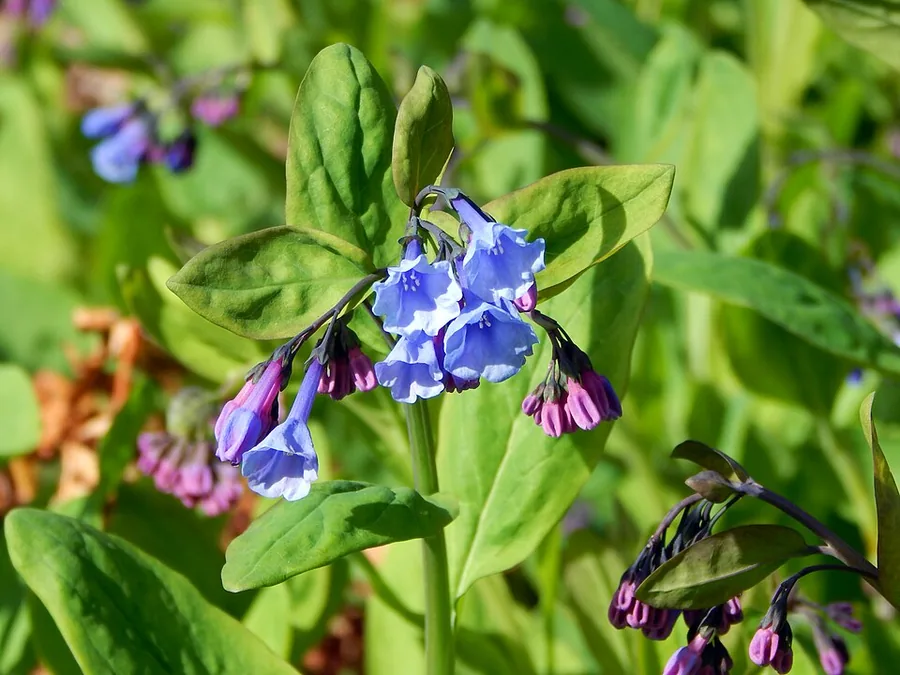
Sited in rich, moist shade, Virginia bluebells naturalizes into sweeps of sky-blue across the spring woodland floor.
Partial shade
Every 3–7 days
USDA 3–9
18–24 in · 46–61 cm
Overview
Virginia bluebells ranks among the signature spring displays of the eastern deciduous woodland. Pink buds open to nodding, sky-blue trumpets on arching stems while the canopy is still leafless, a timing that lets early bees work the flowers before competing bloom appears. A member of the borage family, it occurs naturally across rich, moist forests and floodplains, which explains its appetite for organic, evenly damp ground.
The trait that confuses growers is its brevity. As a spring ephemeral, the plant completes growth, flowering, and seed set within a few weeks, then the foliage yellows and dies to the ground by mid-summer. The rhizomes remain dormant through the heat of the season and resume growth the following spring, so the die-back reflects the plant's strategy rather than any failure of health.
Reproduce the conditions of a forest floor and the plant asks for little more. It wants cool part-to-full shade, soil kept moist and enriched with leaf mold, and space to expand into a slow colony. Established in a suitable site, it persists and self-sows across many seasons.
Care
The short version: part-to-full shade over rich, humusy soil held evenly moist through spring. Topdress with leaf mold, leave the deep root system undisturbed, and allow the foliage to senesce naturally once flowering ends.
Light
Site in part-to-full shade that mirrors the dappled light of a spring woodland floor. The plant tolerates somewhat brighter conditions where soil moisture stays reliable, but hot, dry, sunny exposure drives weak growth and sparse flowering, since it evolved to complete its cycle before the canopy closes.
Water
Hold the soil consistently moist throughout spring growth and bloom, watering every few days during dry spells, because active growth and flowering all draw on that brief moist window. After the foliage dies back by mid-summer the dormant rhizomes require almost no water and are prone to rot if left wet.
Soil
Provide rich, humusy, well-drained woodland soil high in organic matter, replicating the leaf litter of its native forest floor. A pH of 6.0 to 7.5 suits it, so most beds amended with compost fall within range.
Temperature
The species is exceptionally cold-hardy, enduring winter lows to -40°F (-40°C), and tolerates summer warmth to about 86°F (30°C). Its retreat into dormancy is the mechanism by which it avoids the metabolic stress of high summer heat.
Humidity
Ambient outdoor humidity is sufficient and requires no target, because the plant's water needs are met through the root zone rather than the air. The operative factor is steady soil moisture across the spring growing season.
Feeding
A light spring topdressing of leaf mold or compost worked into the soil supplies what this woodland native uses. Heavy synthetic fertilizer offers no benefit and can degrade the humus-rich, biologically active conditions it depends on.
Pruning
No pruning is warranted. Allow the yellowing foliage to senesce fully after bloom, since the leaves translocate stored reserves to the rhizome for the following season, and cutting green foliage early interrupts that transfer.
Repotting
Established clumps resent disturbance and seldom need lifting. Divide only when an aged planting becomes congested or flowering declines, and even then minimize disruption to the deep taproot, which recovers slowly from damage.
Size & spacing
Mature plants reach roughly 18 to 24 inches (46 to 61 cm) in height with a spread of 12 to 18 inches (30 to 46 cm). Spacing on those dimensions lets individual crowns merge into a continuous drift over successive seasons.
When to plant
The plant operates on an early, compressed schedule dictated by the woodland light window. Install dormant rhizomes in fall or young plants in early spring, expect flowers from roughly March to May, then watch the foliage decline as dormancy sets in.
Northern hemisphere
Southern hemisphere
Typical months for a temperate climate: start earlier in warm zones, later where spring frosts linger.
- Sow: Not typical; seed needs cold-moist stratification. Sow fresh seed outdoors or stratify 6 weeks before spring planting.
- Plant: Plant dormant rhizomes or bare roots in fall, or set out plants in early spring.
- Harvest: Blooms early to mid-spring, roughly March to May
Hardiness
USDA hardiness zones: 3–9
Temperature: down to -40°C
Troubleshooting
Most reported problems with this species prove to be normal phenology rather than pathology. The summer die-back is the leading example, alarming in appearance yet simply the dormant phase of a spring ephemeral. Match the symptom below before intervening.
Reduced flowering and generally weak growth
Poor performance typically traces to excess sun or insufficient soil moisture, conditions at odds with the plant's woodland origins. Recent transplanting or division is a second cause, because the deep taproot recovers slowly from disturbance. Relocate to part-to-full shade with rich, evenly moist soil, topdress with leaf mold, and then leave the clump undisturbed to recover.
Fix:
- Relocate to part-to-full shade with consistently moist, humus-rich soil
- Leave established clumps undisturbed to recover
- Topdress with leaf mold or compost
Foliage senescing to the ground by early summer
The symptom is summer dormancy, a normal phase rather than a disease. Being a spring ephemeral, the plant senesces after flowering and seed set, withdrawing reserves to the rhizome as the top growth dies to the ground. The clump re-emerges unaided the following spring, so the sound response is to leave it undisturbed and mark the site to avoid accidental digging.
Fix:
- Do nothing; allow foliage to die back naturally
- Mark the clump location so it is not dug up or damaged while dormant
- Interplant with ferns, hostas, or other shade perennials to fill the gap
Irregular holes grazed from leaves and flowers
Slime trails confirm the agents: slugs and snails, which forage nocturnally in exactly the cool, damp shade the plant favors. Hand-collection after dark plus removal of the damp debris and mulch that shelter them reduces the population at its source. Where damage persists, iron-phosphate bait lowers pressure without risk to pets.
Fix:
- Hand-pick slugs and snails in the evening
- Remove damp debris and mulch that harbor them
- Use iron-phosphate slug bait if pressure is heavy
Toxicity
The safety profile is reassuring. Virginia bluebells is not toxic to people or animals, appears on no poison advisory in extension references, and its young growth has a documented history as a foraged green. Even so, discourage habitual grazing by pets, since a large quantity of most plant material can provoke mild gastric upset.
Safe for
People · Cats · Dogs · Horses · Rabbits · Livestock · Birds
Cats None
Safe around cats, as the plant contains no recognized toxin; at most a curious nibble may cause mild, transient gastric upset.
Dogs None
No poisoning risk to dogs. A dog that ingests a mouthful of foliage may experience only a brief, self-limiting stomach ache.
Horses Safe
Regarded as safe for horses, with no compound in the foliage known to cause harm.
Rabbits Safe
Rabbits graze it without consequence, and the species is frequently cited as rabbit-resistant, so browsing tends to be light.
Livestock Safe
Cattle, goats, and sheep encounter no toxicity from this native wildflower on pasture.
Birds Safe
It presents no hazard to birds, which visit the spring flowers for nectar.
People Safe
Non-toxic to people, with its tender young growth documented as a foraged and eaten wild green.
Generally safe around pets and children; as with any plant, discourage habitual ingestion to avoid mild stomach upset.
Varieties
The genus offers little to choose here, because horticulture relies on the wild species rather than selected forms.
Mertensia virginica (straight species)
Cultivation rests almost entirely on the wild species, whose pink buds open to nodding, sky-blue trumpets, since no named selections reach the trade in meaningful quantity.
Companions
Virginia bluebells pair best with later-rising shade plants that fill the gap when the foliage dies back, keeping the bed from looking bare for the rest of the season.
How to propagate
The species is increased by dividing dormant clumps or by sowing fresh seed, and both methods hinge on timing tied to its ephemeral cycle.
DivisionModerate
Summer after foliage die-back, while the rhizomes are dormant · 1-2 growing seasons
Once the foliage has senesced in mid-summer and the rhizomes are dormant, lift and divide the clump. Because the plant is a spring ephemeral with a deep, disturbance-sensitive taproot, work quickly, minimize root exposure, and replant immediately. Divisions require 1 to 2 growing seasons to reestablish and flower well.
SeedModerate
Sow fresh seed in early summer right after it ripens, or cold-moist stratify 6 weeks before spring sowing · 2-3 years to first bloom
Sow seed fresh in early summer as soon as it ripens, since germination is best when the seed never dries; where storage is unavoidable, apply 6 weeks of cold-moist stratification ahead of a spring sowing. Seedlings need 2 to 3 years to reach flowering size, and in suitable woodland conditions the species self-sows and naturalizes on its own.
Myths
A summer disappearance of the foliage signals that the plant has perished.
The plant is fully alive. As a spring ephemeral, its foliage naturally yellows and dies to the ground by mid-summer while the rhizome persists in dormancy below. The clump re-emerges every spring, reliably, from that underground reserve.
Virginia bluebells is toxic to cats and dogs.
The species is absent from the ASPCA toxic plant list, and extension references record no poison warning. It is a non-toxic native wildflower, and its young growth has long been foraged and eaten.