Tree · Juglandaceae
Walnut
Juglans regia
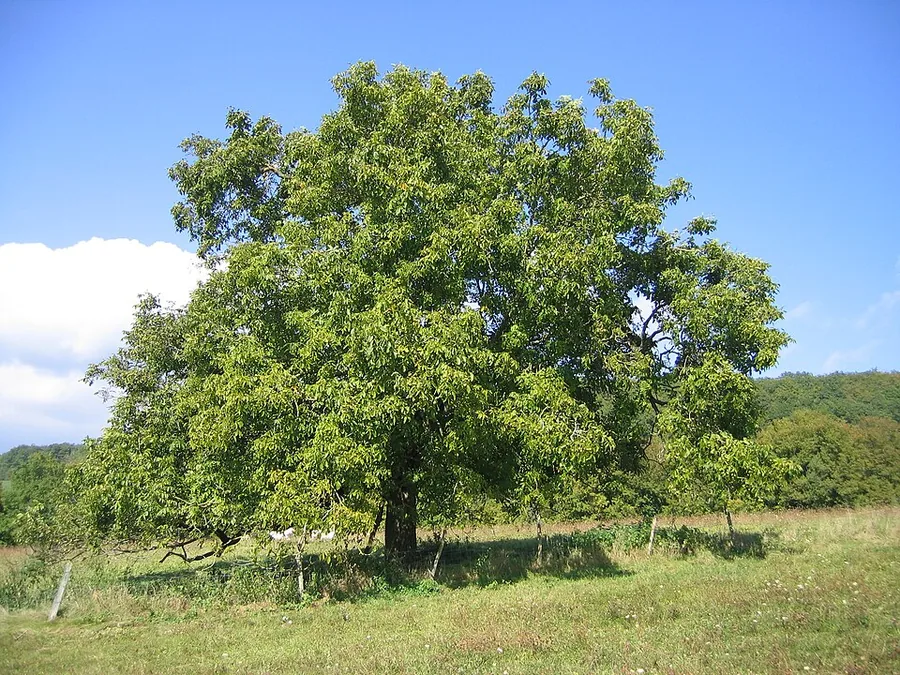
Sited in deep soil and full sun with room to spread, a walnut builds a broad crown that shades a yard for generations and crops each fall.
Full sun
Every 7–21 days
USDA 5–9
39–59 ft · 12–18 m
Overview
Juglans regia is a long-lived shade tree valued for its nuts and its landscape presence in equal measure. A member of the walnut family, it reaches 60 feet (18 m) with a wide, open crown, which is why it demands isolation from other plantings. Deep, fertile soil and full exposure let it both crop well and cast broad shade for generations.
Growers plant the English or Persian walnut for its kernels, while the native black walnut supplies harder-shelled nuts and dark timber. Both species exude juglone, an allelopathic compound released from roots and hulls that suppresses sensitive plants within reach. That chemistry dictates the tree's siting and the choice of understory beneath it.
A walnut rewards patience over intervention. Because named trees are grafted, several years pass before meaningful bearing, and the falling nuts with their staining hulls foul any paving below. Site the tree well away from the house and walks, and the return is durable shade and a dependable fall harvest.
Care
The short version: full sun and deep, well-drained loam suit it best, with regular deep watering while young and only periodic irrigation once established. Feed in early spring, prune in late summer to avoid heavy sap loss, and allow generous spacing.
Light
Walnuts crop reliably only under full sun, tolerating light partial shade at best. Shading from buildings or larger trees produces an asymmetric canopy and sharply reduced nut set, because limited light constrains both vigor and fruiting, so open exposure on every side is essential.
Water
Irrigate young trees deeply every 1 to 3 weeks through the first few seasons to drive root establishment. A mature walnut is fairly drought tolerant, yet it fills the heaviest crop when a deep periodic soak carries it through a dry summer, since nut development draws steadily on soil moisture.
Soil
Plant into deep, fertile, well-drained loam, which the taproot needs to run freely. A pH of 6.0 to 7.5 is ideal, and waterlogged or shallow ground is the critical failure, since saturated soil starves the roots of oxygen and invites decline.
Temperature
The species is cold hardy across a wide range, roughly -22°F to 95°F (-30°C to 35°C). The vulnerability is phenological: a late spring frost damages emerging growth and catkins, which is precisely why later-leafing cultivars hold an advantage in colder climates.
Humidity
Average outdoor humidity of 40% to 70% poses no issue for a walnut. What matters is canopy drying, because prolonged leaf wetness in a mild, wet spring favors bacterial blight, so open architecture that sheds moisture quickly outweighs any absolute reading.
Feeding
Apply nutrients in early spring ahead of the growth flush, using a nitrogen-focused balanced fertilizer keyed to a soil or leaf test. Walnuts have a high nitrogen demand, but testing guides the rate, since surplus nitrogen leaches beyond the root zone rather than building crop.
Pruning
Train young trees to a single central leader to establish sound scaffold structure, then remove dead, crossing, and low limbs over time. Confine cuts to late summer or early fall, because a walnut bleeds sap heavily from wounds made in late winter and spring.
Repotting
A walnut is a landscape and orchard tree, not a container subject, so field-planted specimens are never repotted. A young tree held too long in a nursery pot shows roots circling the container and stalled top growth, both signals to plant it out promptly.
Size & spacing
Allow for a large tree, 40 to 60 feet (12 to 18 m) in height with a 33 to 49 feet (10 to 15 m) spread. Position it well clear of buildings, walks, and neighboring trees so the crown develops symmetrically and the staining nuts do not fall on paving.
When to plant
A walnut's schedule tracks the season, and planting belongs in dormancy. Establish bare-root or balled trees in late winter to early spring, expect wind-pollinated catkins in spring, and harvest ripe nuts in fall as the hulls dehisce and split.
Northern hemisphere
Southern hemisphere
Typical months for a temperate climate: start earlier in warm zones, later where spring frosts linger.
- Plant: Plant bare-root or balled-and-burlapped trees during dormancy, late winter to early spring
- Harvest: Wind-pollinated catkins in spring (April to May); nuts ripen and are harvested in fall, September to October
Hardiness
USDA hardiness zones: 5–9
Temperature: down to -29°C
Troubleshooting
Most disorders surface on the developing nuts through summer or on the foliage as fall approaches. Recognizing a pest or a bacterial infection early lets you protect that season's crop before it drops. Match the symptom below, then intervene while the treatment window is open.
Black, slimy husks with maggots within
Black, softened husks and stained shells indicate the walnut husk fly, whose larvae feed within the husk and discolor the shell as the tissue decays. Deploy yellow sticky traps by June to time treatment, and apply a bait insecticide at the first sustained catch. Collecting and destroying the fallen, infested nuts removes the overwintering population.
Fix:
- Monitor with supercharged sticky traps from early summer
- Apply a bait insecticide spray at first sustained fly catch
- Pick up and destroy fallen, infested nuts
Frass-filled entry holes and premature nut drop
Frass at a clean entry hole with early drop is the signature of codling moth, whose larvae tunnel directly into the kernel. Establish pheromone traps in mid-March to set biofix, then time insecticide by a degree-day model and consider orchard-wide mating disruption. Removing infested drops and mummies suppresses the following generation.
Fix:
- Use pheromone mating disruption in the orchard
- Time insecticide sprays by degree-day models after biofix
- Remove infested drops and mummies
Greasy black lesions on young nuts and shoots in wet springs
Water-soaked to greasy black lesions on nuts, catkins, and shoots during mild, wet weather identify walnut blight, a Xanthomonas bacterium that can abort a large share of the crop. Schedule copper-based bactericide by a leaf-wetness model and open the canopy to shorten wetting periods. Selecting a later-leafing cultivar narrows exposure during the vulnerable wet window.
Fix:
- Apply copper-based bactericide sprays timed by a wet-weather model
- Improve air movement and avoid overhead wetting
Chlorotic foliage with dark blotches shedding in late summer
Dark angular leaf spots followed by early defoliation point to anthracnose and allied leaf-spot fungi, amplified by a wet spring or by drought stress in summer. Raking and destroying fallen leaves reduces the overwintering inoculum that reinfects in spring. Deep irrigation through dry spells maintains vigor and limits the stress that worsens the disease.
Fix:
- Rake and destroy fallen leaves to reduce inoculum
- Water deeply during dry spells to limit stress
Toxicity
The shelled kernels are edible and safe for people, but other parts of the tree warrant caution. The wood and shavings carry juglone and induce laminitis in horses, while a moldy fallen nut delivers tremorgenic mycotoxins that cause tremors and seizures in dogs. Clear the drops, discard anything moldy, and never bed a horse on walnut shavings.
Toxic to
Cats · Dogs · Horses · Rabbits · Livestock · Birds
Safe for
People
Cats Caution
A shelled kernel does not poison a cat, though the high fat can provoke vomiting and loose stools. The controlling risk is mold: keep fallen and moldy nuts inaccessible, since the mold on a walnut carries the tremorgenic toxins.
Dogs Caution
Plain kernels are not systemically toxic to dogs, but a whole nut can cause choking or intestinal obstruction, and the fat alone commonly induces vomiting. The decisive danger is a moldy walnut retrieved from the ground, which can produce muscle tremors and seizures within hours.
Horses Severe
Walnut shavings used as bedding cause laminitis in horses. Expect reluctance to move, distal limb swelling, heat in the hooves, and a bounding digital pulse, at times within a day of exposure, and exclude walnut wood and sawdust from the stable entirely.
Rabbits Caution
Walnuts are unsuitable for rabbits. The rich, fatty kernel disrupts a digestive system adapted to grass and hay, so keep the nuts and hulls clear of any hutch.
Livestock Caution
Grazing stock are best excluded from fallen walnuts and hulls. The fatty nuts can disturb rumen function, and accumulated moldy drops carry the same mycotoxins that affect dogs.
Birds Caution
A small portion of plain kernel is acceptable for some birds, but the fat load mounts quickly and a moldy nut is hazardous. Provide only fresh, sound fragments and remove any fallen material that has begun to rot.
People Shelled nuts safe
Shelled walnuts are a nutritious, safe food for people. Discard any nut with a musty odor or visible mold, and keep the staining hulls and walnut sawdust off the skin.
Keep fallen nuts and hulls raked up, discard any moldy nuts, and never use walnut shavings or sawdust as horse bedding.
Helpline numbers

United States
ASPCA Animal Poison Control: (888) 426-4435 (fee applies)

United Kingdom
Animal PoisonLine: 01202 509000 (fee applies)

Australia
Animal Poisons Helpline: 1300 869 738
Varieties
A small set of cultivars accounts for most home and orchard plantings, distinguished mainly by bearing habit and leafing date. These are the ones worth knowing.
'Chandler'
'Chandler' is a leading lateral-bearing English walnut valued for high yields of light, clean kernels, and its late leafing largely escapes the worst spring frosts.
'Franquette'
'Franquette' is a late-leafing, terminal-bearing French cultivar that also functions as a valuable pollinizer on cooler, frost-prone sites.
Black walnut (Juglans nigra)
Black walnut is the native North American species bearing darker, hard-shelled nuts and prized timber; it is the principal source of juglone, the agent toxic to horses, and the standard rootstock for English walnut.
'Carpathian'
'Carpathian' denotes a cold-hardy English walnut strain selected to survive winters to approximately USDA zone 5.
Companions
Walnuts make life hard for juglone-sensitive plants in their root zone, so the best neighbors are the few species that shrug off juglone and grow happily beneath the canopy.
Keep apart
tomato: Solanaceous crop highly sensitive to juglone; wilts and dies within the walnut root zone.
potato: Juglone-sensitive; stunts and yellows near walnut roots and hulls.
apple: Apple trees decline and can die from juglone exposure near walnuts.
blueberry: Highly juglone-sensitive; foliage yellows and plants collapse near walnuts.
How to propagate
Walnuts are propagated by grafting for a predictable, named crop, or from seed where the nut itself is the object, though seedlings are slow to bear and never true to type.
GraftingDemanding
Late winter to spring (bench grafting or field budding) · About 4-7 years to a meaningful nut crop
Virtually all named walnuts originate as grafts. A scion of English walnut is joined to black walnut or Paradox rootstock in late winter or spring to secure the vigor and pest tolerance the roots confer, after which the young tree requires roughly 4 to 7 years to reach a meaningful nut crop.
SeedModerate
Sow stratified nuts in fall, or cold-stratify and sow in spring · Seedlings may take 8-12 or more years to bear and are used mainly as rootstock
Seed propagation is straightforward but slow and genetically variable. Cold-stratify the nuts for about 90 to 120 days and sow in spring, or plant stratified nuts directly into fall soil. Because the seedlings do not replicate the parent cultivar and may need 8 to 12 years or more to bear, most serve as rootstock for grafting.
Myths
A walnut tree poisons everything planted near it.
The tree does release juglone, which injures sensitive species such as tomato, potato, apple, and blueberry, but the effect concentrates within the drip line. A wide range of juglone-tolerant plants grow unharmed nearby, so the rooting zone beneath a walnut is not sterile ground.
Walnuts are a safe, healthy snack for dogs.
A plain kernel is not systemically toxic to a dog, yet its fat content readily provokes gastrointestinal upset, and a whole nut risks choking or obstruction. The genuine hazard is a moldy walnut, whose tremorgenic mycotoxins trigger tremors and seizures.
Plant a walnut from seed and you'll harvest the same variety.
Named English walnuts are grafted onto black walnut or Paradox rootstock, so the seed within a nut does not reproduce the parent's genotype. A seedling is unpredictable, yielding variable nuts and delaying bearing by many years.