Tree · Malvaceae
American Basswood
Tilia americana
A broad native shade tree carrying fragrant summer flowers that draw heavy bee traffic.
Full sun
Every 7–14 days
USDA 3–8
60–80 ft · 18.3–24.4 m
Overview
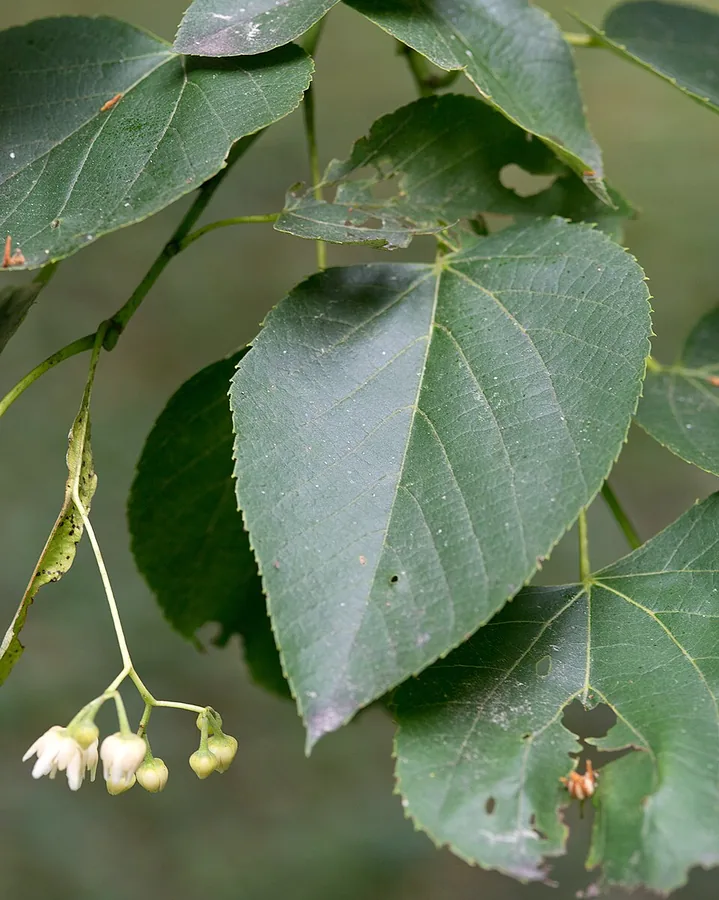
American basswood, widely known as linden, is a large native shade tree, and its heavy pollinator traffic explains the folk name bee tree. From late spring into early summer it produces small, pale-yellow flowers whose carrying fragrance recruits pollinators through the day. At maturity the species reaches 60 to 80 feet (18 to 24 m) and develops a broad, rounded crown.
The tree suits a long timescale and forgives ordinary neglect. It rates hardy through severe winters, performs in full sun or part shade, and accepts a wide range of soils provided they drain. The large heart-shaped leaves cast dense shade, and the soft, low-density wood is the source of both the basswood name and its historic value to carvers.
Site it with room to develop and it demands little further attention. One trait warrants planning: aphids favor it and shed sticky honeydew through summer, so weigh that before placing a patio or a parked vehicle beneath the canopy.
Care
The short version: full sun to part shade in moist, well-drained soil, with consistent moisture through the establishment years and little intervention thereafter.
Light
Linden performs best in full sun, which drives a denser crown and heavier flowering, yet it accepts partial shade without decline. In lower light the canopy grows looser but the tree remains healthy.
Water
Hold a young tree evenly moist, irrigating every 7 to 14 days through dry periods while the root system develops. Established specimens tolerate some drought, but consistent moisture always yields better growth, so avoid prolonged drying of the root zone.
Soil
The species accepts clay, loam, and sand so long as the medium is medium-moisture and well-drained, since standing water is the real limitation. It grows across a pH span of 5.5 to 8.0, which encompasses most cultivated soils.
Temperature
This is a markedly cold-hardy tree, rated from -40°F to 100°F (-40°C to 38°C). That wide tolerance for severe winters and hot summers accounts for its broad range across the continent.
Humidity
Ambient humidity is not a limiting factor outdoors, so no target range applies. Air movement is the relevant variable, because stagnant, humid air around the canopy favors the leaf spots and mites noted above.
Feeding
An established tree in reasonable soil seldom requires fertilizer. Where growth lags, incorporate a balanced slow-release tree fertilizer in early spring, applied sparingly, since surplus nitrogen fuels the flush of soft growth that aphids exploit.
Pruning
Prune in late winter to early spring, before growth resumes, to train a single strong central leader and to excise dead, damaged, or crossing branches. Remove the basal suckers and sprouts the tree produces whenever they emerge.
Repotting
Linden is a landscape tree, so repotting has no ongoing role once it is established in the ground. A nursery specimen showing roots circling the container or protruding from the drainage holes should be planted out promptly to prevent girdling.
Size & spacing
Allow generous space, since the tree attains 60 to 80 feet (18 to 24 m) in height and spreads 30 to 60 feet (9 to 18 m) wide. Position it well clear of structures, walls, and overhead lines so the broad crown can develop unobstructed.
When to plant
As a tree, linden has no annual sowing window to schedule. Establish young trees in spring or fall once hard frost has passed, and the fragrant bloom follows unprompted from late spring into midsummer.
Northern hemisphere
Southern hemisphere
Typical months for a temperate climate: start earlier in warm zones, later where spring frosts linger.
- Plant: Spring or fall, after the threat of hard frost has passed
- Harvest: Fragrant pale-yellow flowers in late spring to early summer (May to July)
Hardiness
USDA hardiness zones: 3–8
Temperature: down to -40°C
Troubleshooting
A vigorous linden largely regulates itself, and the majority of what a grower observes is cosmetic. Match the symptoms below against the record before treating, since a mature specimen absorbs pest pressure that would set back a smaller plant.
Wilting limbs with frass and round exit holes at the trunk base
The linden borer, Saperda vestita, mines galleries through the wood of the lower trunk and limbs, and its round exit holes and sawdust-like frass mark the feeding zone while the interrupted vascular flow wilts the limb above. Prune out and destroy infested limbs to remove the larvae. Because the borer selects stressed trees, sustained irrigation and intact bark are the real defense, so keep mowers and trimmers away from the base and consult an arborist for infestations in the trunk itself.
Fix:
- Prune out and destroy borer-infested limbs
- Keep the tree vigorous, as borers preferentially attack stressed trees
- Consult an extension office or arborist for severe trunk infestations
Glossy residue on foliage with a dark film that follows
The glossy residue is aphid honeydew, the sugary excretion of feeding aphids, and the black that follows is a sooty mold colonizing that sugar rather than the leaf itself. Dense aphid populations, at times reinforced by scale insects, produce enough honeydew to coat the foliage and the ground beneath. A forceful jet of water dislodges the colonies, resident lady beetles and lacewings suppress the rest, and the mold recedes once its honeydew food source is cut off.
Fix:
- Hose aphids off with a strong jet of water
- Encourage beneficial predators such as lady beetles and lacewings
- Apply insecticidal soap or horticultural oil to accessible foliage for severe infestations
- Sooty mold disappears on its own once the honeydew source is controlled
Interveinal tissue consumed, leaving a skeletal canopy
Japanese beetles feed on the soft interveinal tissue and leave the vein network intact, which produces the skeletonized, lacelike foliage seen from June to August. On young specimens, dislodging the metallic green adults into soapy water in the cool of early morning, when they are sluggish, gives the best control. An established linden carries reserves enough to refoliate after seasonal defoliation, so tolerate the damage and avoid pheromone traps, which draw additional beetles to the site.
Fix:
- Hand-pick or knock beetles into soapy water in the early morning on smaller trees
- Tolerate damage on large established trees, which recover
- Avoid Japanese beetle pheromone traps, which attract more beetles
Stippled or spotted foliage from several possible agents
Several agents present alike on the foliage. Lace bugs, basswood thrips, and spider mites feed on the underside and stipple the surface, dropping dark fecal specks that confirm their presence, while fungal leaf spots arise as discrete lesions during wet seasons that favor infection. Raking fallen leaves removes the overwintering spore load, overhead rinsing in dry spells suppresses mites that thrive in heat and low humidity, and beyond that the damage is cosmetic and needs no intervention.
Fix:
- Rake and dispose of fallen leaves to reduce fungal spores
- Hose down foliage to dislodge mites in dry spells
- Most leaf spot is cosmetic and needs no treatment
Toxicity
For households with pets the verdict is clear: linden is entirely safe. The ASPCA lists it as non-toxic to cats, dogs, and horses, and no part of the tree contains a toxic principle. The fragrant flowers are dried for a soothing tea, and the young leaves are tender enough to eat.
Safe for
People · Cats · Dogs · Horses · Rabbits · Livestock · Birds
Cats None
The ASPCA classifies linden as non-toxic to cats, so an exploratory nibble presents no concern. Any plant eaten in bulk can produce transient gastric upset, but the foliage holds no toxic principle.
Dogs None
Dogs face no toxic principle in the leaves, bark, or flowers, which places the species firmly on the safe list. A dog that mouths a fallen branch is at no risk.
Horses None
The ASPCA records linden as non-toxic to horses, which may browse it without harm. Both the young foliage and the flowers qualify as safe forage.
Rabbits Safe
Rabbits may consume the leaves and twigs with no toxic exposure. The species is a recognized browse plant, and the tender spring growth is entirely safe for them.
Livestock Safe
Cattle, goats, and sheep may graze the foliage safely, as it contains no compound that troubles ruminants. Linden has a long record of use as cut fodder without incident.
Birds Safe
Birds nest within the canopy and forage around the flowers with no hazard. Neither the seeds nor the buds carry a toxic principle.
People Safe
The species is safe for people; the fragrant flowers are dried for a soothing tea and the young leaves are tender enough to eat. No part of the tree must be avoided.
No special handling precautions; honeydew from aphids can make surfaces under the tree sticky but is not toxic.
Varieties
A few linden forms are worth distinguishing, from compact selections of the native species to silver-leaved relatives. These are the taxa most often encountered in landscapes and along streets.
Tilia americana 'Redmond'
This selection of the native species holds a tighter, more pyramidal habit and matures near 40 to 60 feet, which suits it to formal shade and to street planting where a predictable form matters.
Tilia cordata 'Greenspire'
A littleleaf linden bearing small heart-shaped leaves of 1 to 3 inches within a dense oval crown, it is valued across Europe and beyond as a durable, city-proof street tree.
Tilia tomentosa
The silver linden owes its name to dark green leaves whose white woolly undersides catch the light as the wind turns them, giving the canopy a shimmering cast.
How to propagate
Linden is propagated by several methods according to the objective, from slow seed to grafting that fixes named cultivars to the suckers the tree generates on its own.
SeedDemanding
Sow cleaned seed outdoors in fall, or stratify for sowing in spring · 1-2 years or more to germinate
Seed propagation demands patience because the seed combines a hard, impermeable coat with double dormancy. Even a warm-then-cold stratification sequence may leave viable seed dormant for one to two years, after which emergence is slow and irregular. Sow cleaned seed outdoors in fall to let winter satisfy the chilling requirement, or stratify it for a spring sowing.
GraftingDemanding
Late winter for bench grafting or summer for budding · 1 growing season to take
Named cultivars such as 'Redmond' and 'Greenspire' do not reproduce true from seed, so propagators graft or bud them onto seedling rootstock to preserve the clone. Bench graft in late winter or bud in summer, and a compatible union calluses and knits over a single growing season.
LayeringModerate
Spring · 1-2 years to root
Basswood suckers freely from the base, and this natural clonal tendency gives the propagator ready material to work with. In spring, pin a low branch to the soil to layer it or lift an already-rooted sucker, then allow one to two years for an independent root system to form before transplanting.
Myths
Linden trees are poisonous to dogs and cats.
The ASPCA classifies linden as non-toxic to dogs, cats, and horses, with no toxic principle in any part of the tree. Excess consumption of any plant may bring mild gastric upset, yet nothing in a linden is poisonous.
The sticky black coating on basswood leaves is a disease that is killing the tree.
That film is aphid honeydew colonized by a harmless sooty mold that lives on the sugars rather than the leaf. The appearance alarms, but it is strictly cosmetic, and it clears once the aphid source is controlled. An established tree sustains no injury from it.